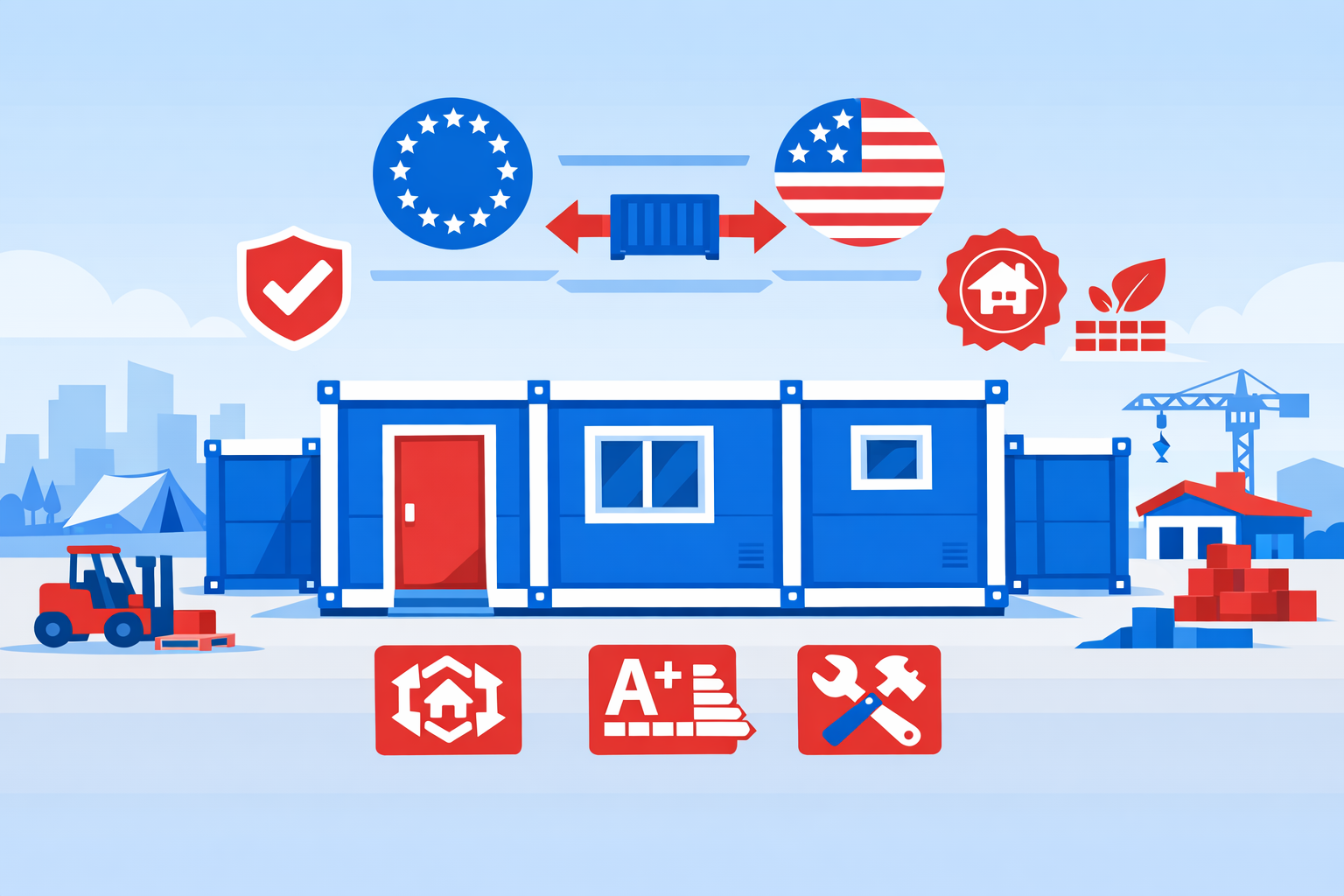
A new EU-US agreement has established unified standards for modular housing used in disaster relief, aligning safety, performance, and supply-chain requirements. The European Commission and the U.S. Department of Housing announced the initiative on April 3, 2026. The agreement introduces harmonized rules for product certification, building codes, energy efficiency, and retrofit compatibility, aiming to streamline procurement and deployment across both regions.
Background
Modular construction-factory-built housing units assembled on-site-offers speed and resource efficiency in disaster response. Divergent national building codes and certification regimes have historically impeded the cross-border scaling of such solutions within Europe[1]. At the EU level, the Construction Products Regulation and the Energy Performance of Buildings Directive set foundational standards, though member states maintain national variations that fragment the market[1]. In the U.S., ongoing discussions about performance-based building codes have also drawn attention to regulatory barriers to modular adoption[2].
Details
Under the new framework, the EU and the U.S. will recognize each other's modular housing certifications based on aligned technical assessments developed by CEN/CENELEC in Europe and ANSI/ICC in the U.S. Mutual recognition is designed to reduce duplicate testing and expedite cross-border delivery of modular units. The agreement introduces joint energy-efficiency benchmarks, aligning EU nearly-zero-energy building (nZEB) standards with U.S. performance criteria and establishing common requirements for insulation, airtightness, and embodied carbon. Supply-chain standards will also be harmonized, enabling quicker logistics approval for oversized prefabricated modules under shared transport guidelines. This responds to previously fragmented national rules concerning module dimension limits[3].
Manufacturers, insurers, and relief agencies in both regions will update product designs, insurance policies, and procurement processes to reflect the unified standards. Early feedback from industry stakeholders notes immediate cost savings in compliance testing and enhanced eligibility for cross-border contracts, including under EU humanitarian frameworks and FEMA deployments in the U.S.
Outlook
Implementation will begin in mid-2026, with pilot cross-border deployments scheduled later in the year. Authorities are expected to assess results to guide further regulatory alignment. If successful, the framework could serve as a template for broader cross-jurisdictional cooperation in construction innovation.