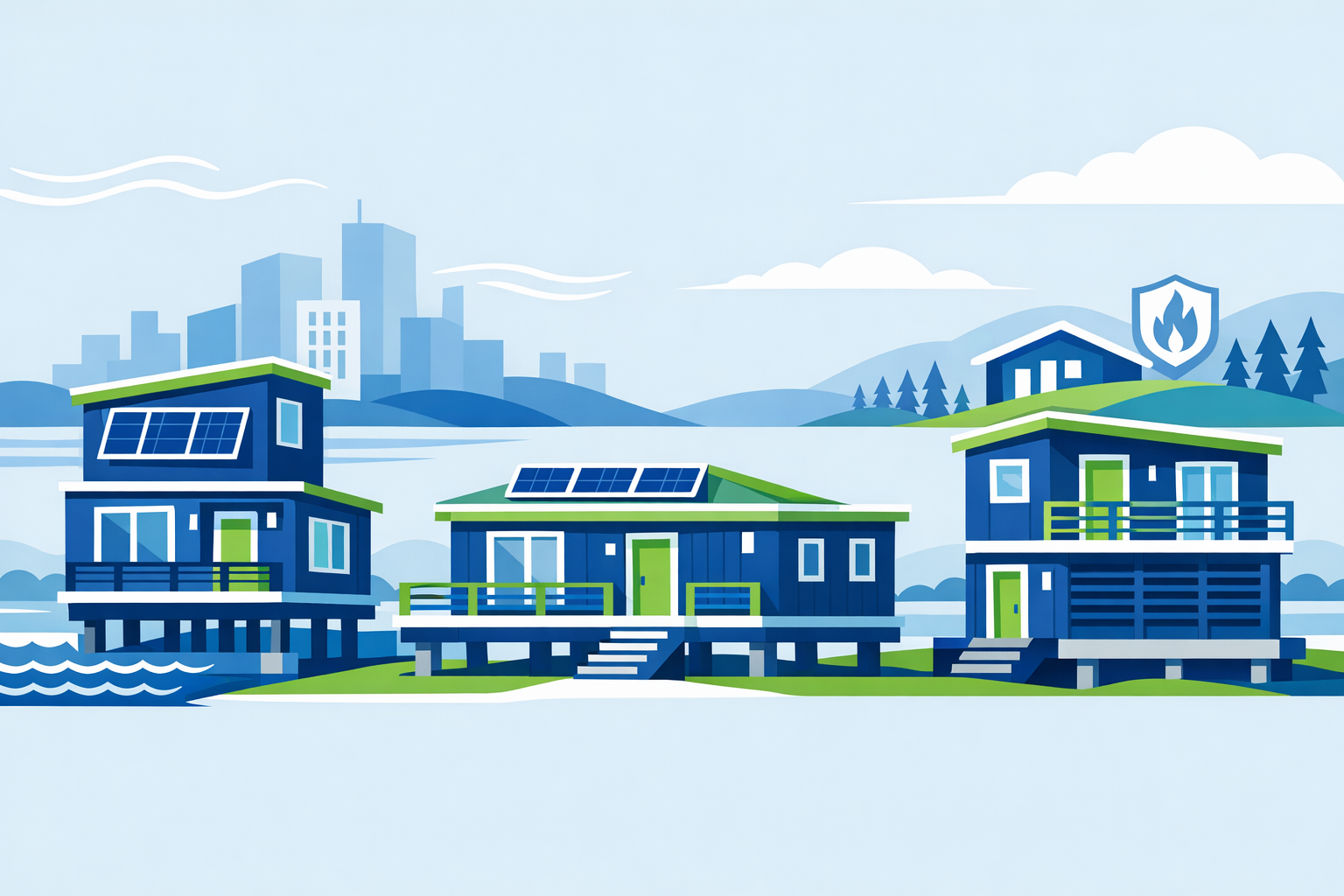
The U.S. government now ties federal funding for modular housing to climate-resilience standards, requiring designs that mitigate flood, wildfire, and extreme weather risks. These criteria affect grant eligibility and subsidized loans administered by agencies such as FEMA and HUD, impacting how modular developers and housing authorities plan projects nationwide.
Background
Federal programs, including FEMA's Building Resilient Infrastructure and Communities (BRIC) and HUD's Community Development Block Grant-Disaster Recovery (CDBG-DR), have increasingly adopted resilience standards as funding prerequisites. The Federal Flood Risk Management Standard (FFRMS), finalized in 2024, mandates that FEMA-funded projects address future flood risks through elevated structures and careful site selection. The standard applies to project funding announced on or after September 9, 2024[1]. HUD's CDBG-DR program also requires that new or reconstructed housing obtain certification under recognized green and resilience standards, such as Enterprise Green Communities or ICC-700 Green+Resilience[2].
Details
Modular housing developers must now integrate resilience measures at the outset of design and procurement. For HUD's Section 202 multifamily financing, applications must include a climate-risk narrative referencing FEMA's National Risk Index and documentation on design strategies addressing specific hazards[3]. HUD has also proposed a non-competitive grant of up to $7 million to support states and organizations implementing energy-conservation and resilience standards for manufactured homes[4].
While these requirements are expected to raise initial design and construction costs, research indicates that resilient modular units-particularly volumetric types-offer improved resistance to wind, seismic, and fire hazards. This can extend building service life and reduce maintenance expenses[5]. Accelerated permitting processes and reduced post-construction risks may offset higher upfront costs through insurance savings and faster deployment of affordable housing.
Modular manufacturers and state agencies must now adjust supply chains and workflows to meet resilience criteria. Design processes will require features such as elevated foundations, fire-resistant materials, and site-specific mitigation strategies. These developments are likely to drive demand for training and certification in resilience-compliant modular construction.
Outlook
Resilience-linked funding is poised to support wider adoption of modular housing by encouraging standardized, hazard-resistant designs. However, increased costs and regional differences in climate risks may affect implementation across states. Agencies and developers will need to closely track funding opportunities and embed resilience standards within modular construction practices to secure federal support.