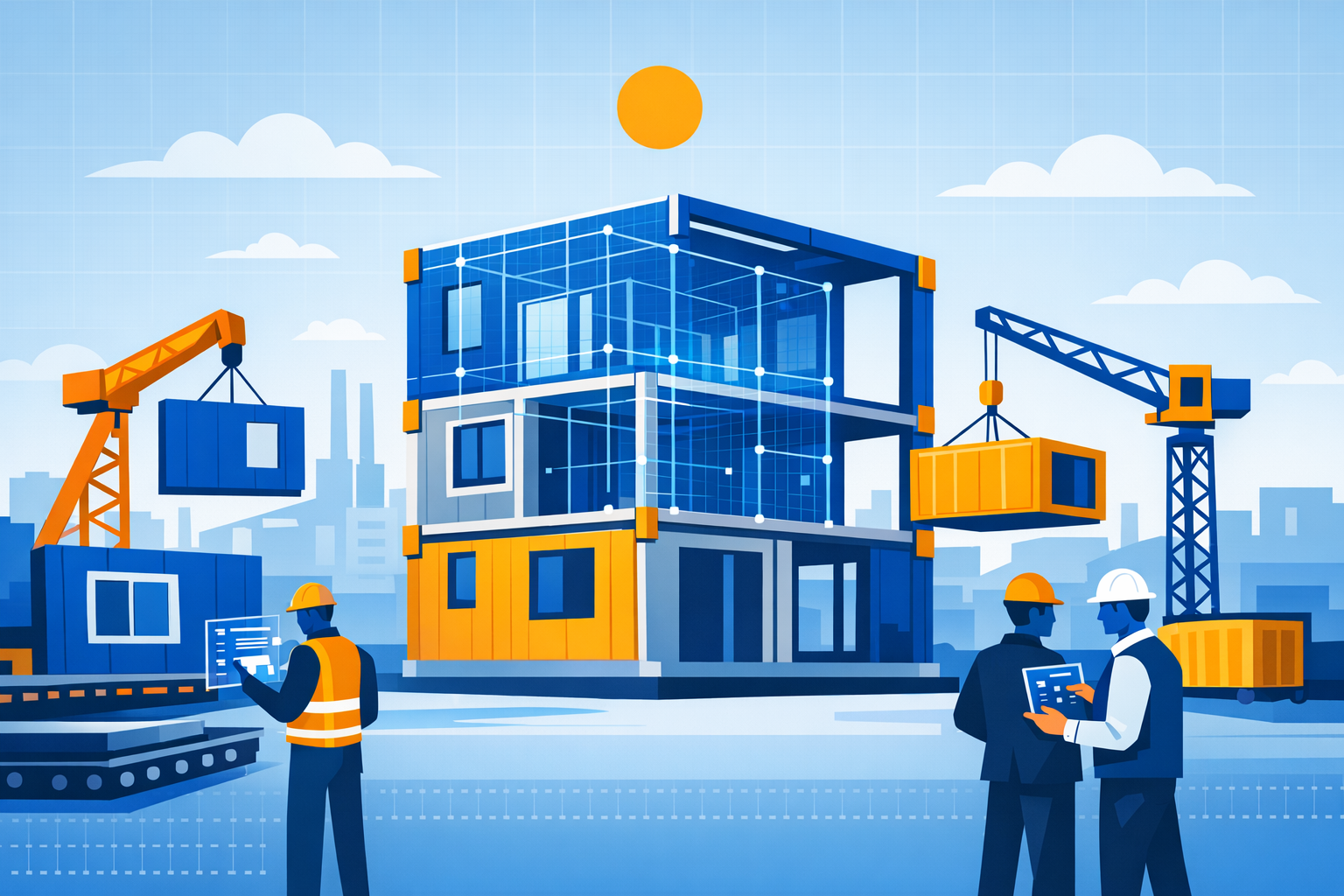
The U.S. construction industry has operated on largely the same foundational processes for over a century. While manufacturing, communications, and other sectors have transformed through digitization and process improvements, building construction practices have remained largely static. Now, a federal program is working to break that inertia - and the results are beginning to reach the broader market.
The U.S. Department of Energy's Advanced Building Construction (ABC) Initiative, led by the Building Technologies Office (BTO), integrates energy-efficiency solutions into productive U.S. construction practices for new buildings and retrofits. For construction professionals navigating pressure on schedules, costs, and sustainability targets, understanding what the ABCI offers - and what it demands - has become strategically important.
What Is the ABCI and Who Leads It?
The DOE Building Technologies Office's Advanced Building Construction Initiative aims to change how buildings are constructed and renovated. Its focus: developing industrialized construction innovations that can rapidly deliver efficient, affordable, and appealing new buildings and retrofits at scale.
The initiative operates under the DOE's Office of Energy Efficiency and Renewable Energy (EERE) and draws on a broad coalition of stakeholders. Through a multi-pronged approach, the ABC Initiative addresses research, development, and market challenges with the goal of integrating high-efficiency, low-carbon innovations into the construction industry's broader modernization efforts. Competitively awarded R&D projects, cutting-edge research at DOE national laboratories, the ABC Collaborative's industry partnerships, workforce training, and other strategic activities all work in concert - not only driving new technologies and approaches but also ensuring wide market adoption.
At the heart of the program's economic rationale is a straightforward challenge of scale. America's 118 million homes and 5.6 million commercial buildings account for approximately 40% of the nation's total energy demand and use 75% of its electricity. About half of these buildings were constructed before 1980, when most of today's more efficient products and building practices did not yet exist.
Funding Levels: A Multi-Phase Investment
The ABCI has deployed funding in successive competitive rounds, each expanding in scope and application:
| Phase / Round | Award Amount | Projects / Awardees | Primary Focus |
|---|---|---|---|
| FOA Launch (2019) | Up to $33.5M | Open competition | Retrofit integration, new construction tech, workforce training |
| Phase 1 Awards (2020) | $26.3M | 40 projects, 29 organizations | Prefab panels, packaged MEP systems, digitization |
| Phase 2 Awards (2022) | $31.8M | 7 project teams | Whole-building retrofits targeting 50-75% thermal load reduction |
| Retrofit Upgrades (2022) | $32M | 30+ projects, 7 awardees | Low-carbon renovation in low-income communities |
In Phase 1, BTO awarded $26.3 million to 40 competitively selected projects led by 29 organizations, all pursuing innovations aligned with the ABC funding opportunity's goals.
Phase 2 escalated ambitions considerably. DOE awarded $31.8 million to seven project teams demonstrating how advanced construction techniques integrated with energy-efficient technologies can seed the next generation of retrofit solutions. Retrofit targets set a high bar: selected teams must demonstrate whole-building approaches that reduce thermal energy loads by 50-75%.
Technology Pillars: Prefabrication, Digital Twins, and Interoperable Data
The ABCI is not a single-technology program. Its architecture spans five interconnected technical domains:
1. Prefabricated and Panelized Components
By pairing offsite factory-based construction with advanced building technologies - such as prefabricated high-performance wall panels and packaged HVAC and water heating pods - the ABC Initiative seeks to enable rapid deployment of innovations that can simultaneously modernize the sector and address the climate crisis.
A representative example: a retrofit system developed under the program consists of prefabricated, insulated envelope panels, mechanical system pods, and prefabricated ductwork integrated with digital workflow automation to streamline design, manufacturing, and delivery.
Oak Ridge National Laboratory won a 2024 R&D 100 Award for its Real-Time Evaluator for Fast and Accurate Installation of Prefabricated Components. This recognition from a competitive international technology evaluation highlights the maturity of ABCI-funded research.[1]
2. Digital Twins and Real-Time Data Integration
Digital twins - persistent, data-rich virtual models of physical assets - are a critical enabler of ABCI's ambitions. An Auto-CuBES digital twin generation tool developed under the initiative generated a digital twin of a duplex in 12 minutes with an accuracy of 1/8 inch. Automated point-cloud building envelope segmentation achieved this result, compared to more than four hours for semi-automated methods. Faster and more accurate digital twin generation lowers costs through shorter execution times and fewer errors.
Broader adoption, however, faces structural hurdles. The lack of standardized frameworks and protocols for interoperability across systems and platforms limits seamless adoption of digital twin applications at scale. Challenges persist in data quality and platform compatibility when integrating information from BIM, IoT sensors, and operational systems. ABCI's digitization workstream directly targets these gaps.
3. Offsite and Industrialized Construction
The ABC Initiative accelerates U.S. building decarbonization through industrialized innovations that deliver low-carbon, affordable, and appealing new buildings and retrofits. In this context, industrialization refers to streamlining manufacturing, business models, and installation to become reproducible at scale.
The National Renewable Energy Laboratory (NREL) has explored this model's practical potential. NREL worked with modular manufacturer Model/Z and affordable housing fund SoLa Impact to identify how industrialized construction can reduce costs, time, and waste - an approach offering a scalable, cost-effective response to the housing crisis.[2]
4. Workforce Training and Business Model Development
Beyond funding research on technologies, software, and digitization, the ABC Initiative coordinates key building sector stakeholders to tackle related challenges including workforce training, business models, demand growth, and service delivery.
One concrete example: NREL helped a modular home manufacturer incorporate energy efficiency strategies into its assembly process and developed workforce training to enable a seamless transition to a highly efficient product line. Workforce training is also embedded across the funding structure - Topic 3 of the ABC funding opportunity focuses on field validation of innovative technologies and building practices, workforce training, and service delivery methods suited to regional and local needs.
5. Data Interoperability and Digitization
The ABC Initiative combines advanced methods - offsite construction, design for manufacturing and assembly, packaged mechanical systems, robotics, and 3D printing - with low-carbon materials and high-efficiency systems. Connecting these into a coherent digital workflow requires standardized data interfaces between design, factory production, logistics, and on-site installation: precisely what BTO's software and digitization investments aim to deliver.
For more on how offsite methods compare to conventional delivery across multiple variables, see our detailed analysis: Off-Site Advantage: When Modular Construction Delivers Real Value.
Implications for Public Infrastructure and Private Projects
The ABCI targets both public and private building sectors. As modular construction and prefabrication gain traction worldwide and affordable housing demand continues to grow, conditions are ripe for reinventing U.S. construction. The initiative aims to ensure the U.S. leads not only in construction productivity - with underserved communities actively participating in a reimagined workforce - but in developing and delivering low-carbon building solutions accessible to all.
For public infrastructure programs, standardized procurement interfaces and offsite component specifications could reduce cycle times from design to construction authorization. Demonstration projects are distributed nationally, covering diverse climate zones and building typologies.
For private developers, the program represents an opportunity to de-risk adoption of modern methods of construction (MMC). The National Institute of Building Sciences' Off-Site Construction Council highlights productivity benefits of offsite approaches, including improvements in scheduling, price, quality, and safety. While prefabrication and other offsite methods have existed in the United States for decades, venture capital firms and leading technology companies have recently begun investing heavily in startups developing offsite "disruptive innovations" that shift construction from the building site to the factory.
The federal imprimatur - validated specifications, national lab testing, demonstrated performance data - gives private sector buyers a more credible basis for procurement decisions involving unfamiliar technologies.
The scale of the retrofit challenge further underscores urgency. To meet national decarbonization goals, these innovations must be applied to 80% of existing building stock by 2050. That requires accelerating the residential retrofit rate by 15 times and doubling the rate for commercial buildings.
For a closer look at how federal funding is shaping modular housing strategy at the project level, read our coverage: Federal Grants Advance Modular Housing Through Lifecycle Cost Focus.
Key Challenges Ahead
The ABCI's ambitions match the scale of the problem, but several structural challenges will determine how quickly its outputs translate into mainstream construction practice.
Permitting and Code Alignment State and local permitting systems were built around traditional, site-built construction. Modular and panelized assemblies manufactured in one jurisdiction and installed in another can face inconsistent code interpretations, third-party factory inspections, and lengthy approvals. Until permitting processes are harmonized - or expedited for factory-certified components - the speed advantage of offsite manufacturing risks being absorbed in administrative delays.
Workforce Readiness Selected ABC projects include commitments to deliver advanced, interactive workforce training programs emphasizing advanced technologies, building science, and design and construction insights. However, transitioning from traditional site trades to factory-based production, digital workflow management, and precision installation requires sustained training investment well beyond what individual projects can provide.
Data Interoperability at Scale Traditional construction logistics rely on manual processes and fragmented tools, leading to inefficient planning, poor communication, and disorganized supply chains. Despite advances in digitalization, integrated, data-driven approaches tailored to construction logistics remain scarce. Solving this at the industry level - not just within individual demonstration projects - will require agreed-upon open data standards spanning factory, logistics, and site systems.
Measuring Impact For the initiative's metrics to be credible across both public and private programs, performance data must flow consistently from demonstration projects into publicly accessible benchmarks. Without a standardized measurement framework covering energy performance, schedule, cost, and carbon, buyers and policymakers will lack the evidence base to mandate or incentivize ABCI-aligned methods on major procurements.
Situating ABCI in the Broader Policy and Market Context
The ABCI is not the first federal effort to accelerate offsite construction or push for digital interoperability in buildings. Programs from HUD, DOT, and GSA have addressed related challenges in housing, transport infrastructure, and federal facilities over prior decades. What differentiates the ABCI is its explicit integration of energy performance targets with construction productivity and digital infrastructure - treating these not as separate policy goals but as mutually reinforcing levers.
The ABC Collaborative brings together a broad array of building industry stakeholders to accelerate the development, demonstration, standardization, and mainstream adoption of high-performance construction technologies and processes that enable widespread delivery of ABC solutions.
With a goal of a carbon-neutral U.S. building stock by 2050, DOE is partnering with private, public, and non-profit leaders to develop high-value products and approaches that deliver new buildings and retrofits with highly energy-efficient, low-carbon footprints.
The initiative's phased funding structure, national lab involvement, and industry collaborative model position it as a long-cycle program rather than a one-time stimulus. That continuity is arguably its most significant feature: construction supply chains and procurement systems respond to sustained policy signals, not short-term grant windows.
Key Takeaways for Construction Professionals
- The ABCI represents the most structured federal framework to date for integrating prefabrication, digital twins, and energy performance into industrialized construction at national scale.
- Across multiple funding rounds, DOE's BTO has committed more than $120 million to ABCI-aligned R&D, demonstrations, and workforce development.
- Digital twin interoperability remains an unsolved industry-wide challenge; ABCI's software and digitization workstream directly targets this gap.
- Permitting reform and workforce upskilling are the implementation bottlenecks most likely to determine whether demonstration-stage gains transfer into mainstream project delivery.
- Private sector firms can use ABCI's publicly available performance data and national lab partnerships to de-risk procurement of MMC components and systems.
- The initiative's 2050 decarbonization target - requiring a 15x acceleration in residential retrofit rates - signals the pace of change that construction technology supply chains must prepare to support.