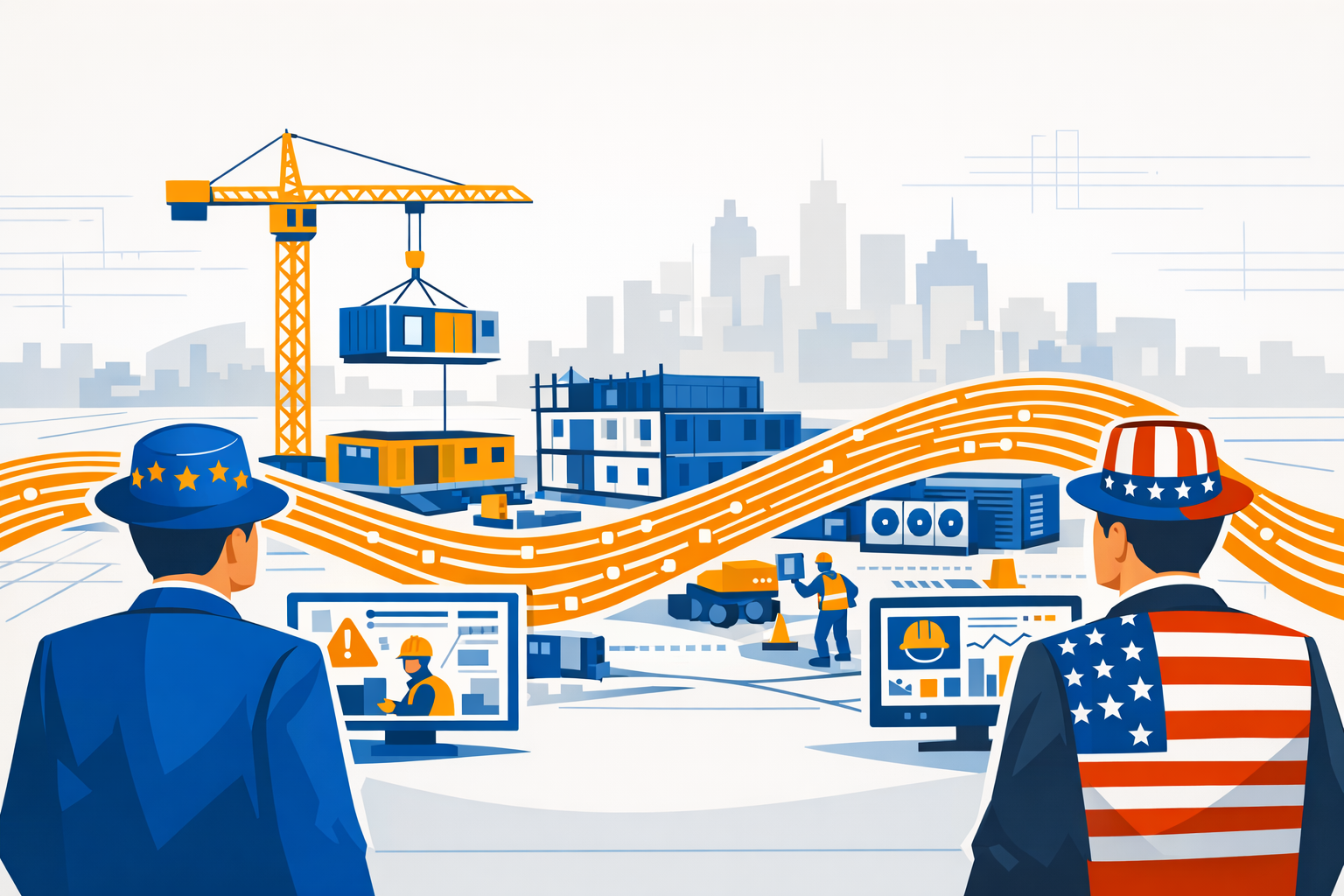
The U.S. Department of Energy's Advanced Building Construction (ABC) Initiative is expanding its scope and funding to standardize AI-assisted offsite manufacturing and digital permitting across public and private construction sectors, as lagging industry productivity and a deepening skilled-labor shortage intensify pressure for systemic reform.
Led by DOE's Building Technologies Office (BTO), the ABC Initiative integrates energy-efficiency solutions into high-productivity U.S. construction practices for new buildings and retrofits. The initiative develops building technologies deployable with minimal onsite construction time while coordinating key building-sector stakeholders on workforce training, business models, demand growth, and service delivery. Its expanding mandate now intersects with a broader federal push to harmonize AI safety protocols and data standards across jurisdictions.
Background
Building construction practices have remained largely unchanged over the past century. While other industries have transformed through digitization and process improvements, lagging construction productivity drives up costs, contributing to the nation's affordable housing crisis and burdening U.S. businesses with higher real estate expenses.
The ABC Initiative accelerates the speed and scale of U.S. building decarbonization through industrialized innovations that deliver low-carbon, affordable, and appealing new buildings and retrofits.[1] The initiative underpins BTO's principal effort to unlock deeper energy savings in the U.S. building sector, which still consumes 40% of the nation's energy and 75% of its electricity.
Labor pressures are driving urgency. The Associated Builders and Contractors projected the industry needed 439,000 more workers in 2025 alone. Despite weakening cyclical demand for labor, a fundamental shortage of skilled workers continues to challenge the sector. According to Dodge Construction Network's Prefabrication & Modular Construction SmartMarket Report, builders using offsite methods routinely achieve 20-50% reductions in construction schedules.
Details
The ABC Initiative has deployed multiple competitive funding rounds to accelerate the shift to industrialized construction. BTO awarded $26.3 million to 40 competitively selected projects led by 29 organizations under the ABC Funding Opportunity. A separate round allocated $31.8 million to seven project teams to demonstrate next-generation whole-building retrofit approaches, according to DOE. DOE also announced nearly $83 million in funding to 44 projects to lower energy bills by supporting new energy-efficient building technologies, construction practices, and buildings-sector workforce programs.
ABC combines advanced technologies and methods-including offsite construction, design for manufacturing and assembly, packaged mechanical systems, robotics, and 3D printing-with low-carbon materials and high-efficiency systems. In one federally funded demonstration, engineering designs are being customized with machine learning using site data, while insulation panel fabrication is conducted offsite with 3D virtual reality tools. The workflow is expected to cut construction time and project costs by 50%.
On the permitting front, AI integration into compliance workflows is gaining traction. Digital tools are making a greater impact for construction officials, particularly in permitting systems and inspections, according to speakers at the 2026 Building Innovation Conference hosted by the National Institute of Building Sciences. BIM's practical deployment remains challenged by implementation complexity, interoperability issues between vendor ecosystems, and significant adoption barriers-particularly for small and mid-size firms.
The ABC Collaborative brings together building industry stakeholders to accelerate the development, demonstration, standardization, and mainstream adoption of high-performance construction technologies. It coordinates demand-side actors such as building owners and developers alongside supply-side participants including manufacturers, suppliers, installers, workforce training organizations, financiers, insurers, code officials, and government agencies.
Workforce retraining is a parallel priority. DOE-funded programs are developing offsite construction-specific curricula, working with factories, schools, and strategic industry partners to build career pathways targeting the offsite manufacturing pipeline. Recipient teams are required to work, train, and learn together to develop common, durable practices for a robust building retrofit workforce.
For further context on how federal agencies are addressing digital security alongside these construction shifts, see our earlier coverage of unified cybersecurity standards for modular construction and digital twin workflows.
Outlook
DOE is partnering with private, public, and non-profit leaders with a goal of carbon-neutral U.S. building stock by 2050. The ABC Research Opportunities Report, which provides context for investment through 2035, is periodically updated to reflect lessons learned, expert and stakeholder input, and technological and market changes. Builders and developers should watch for updated procurement frameworks and new interoperability mandates as federal agencies move to incorporate ABC-aligned standards into public infrastructure contracts over the next 12-18 months.