Executive summary. Modular and off-site construction is evolving from isolated pilots to mainstream alternatives in housing and infrastructure, but its benefits vary by project type. This article analyzes where off-site methods surpass traditional site-built approaches in cost, time, and risk, and where conventional construction remains more suitable. It also details the regulatory, insurance, and delivery challenges modular construction must overcome to scale in Europe and globally.
Modular construction's value proposition in 2026
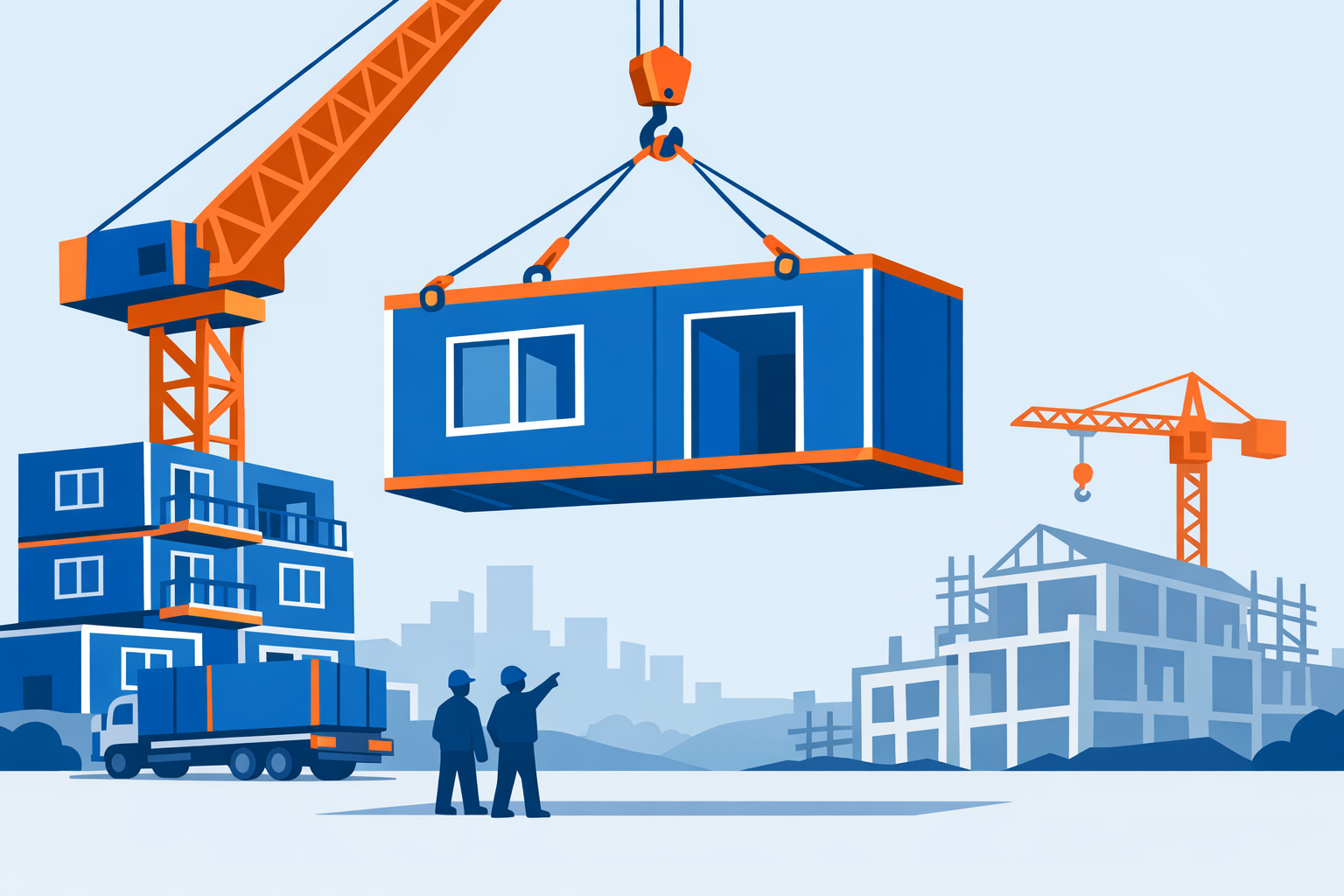
Modular construction's recent resurgence is driven by housing shortages, aging infrastructure, labor constraints, and decarbonization targets in mature markets.
Recent analyses estimate the global modular construction market at US$100-110 billion in 2024, with projected mid- to high-single-digit annual growth through 2030.[1] This includes both volumetric modules and panelized prefabrication across residential, commercial, and infrastructure sectors.
For owners and contractors, the value proposition typically includes:
- Schedule compression. Volumetric modular projects are reported to deliver 20-50% faster than comparable traditional builds due to parallelism between site work and factory production.[2]
- Potential cost reduction. Where designs are standardized and project volumes substantial, modular delivery has shown up to 20% construction cost savings versus conventional methods, though early implementations often realize lower gains or cost premiums.[3]
- Risk reallocation. Weather and on-site productivity risks decline, while new risks emerge relating to factory throughput, logistics, interfaces, and regulatory acceptance of non-traditional assemblies.
In Europe, modular methods are increasingly integral to addressing the housing crisis. In Germany, over a quarter of new single- and two-family homes use prefabricated and modular techniques; the federal government underscores serial and modular housing in a 14-point plan to accelerate delivery and lower costs.[4]
Where modular housing outperforms traditional building
Standardized, repeatable residential typologies
Modular construction is most competitive in repetitive, multi-unit residential programs involving a small number of replicable apartment or room types. Common applications include:
- Social and affordable multi-family housing
- Student and worker accommodations
- Senior living and care facilities
- Repetitive mid-rise apartment schemes with modest façade variation
McKinsey and others have found modular systems excel where units are "repeatable and stackable," benefiting from economies of series production and learning curves across similar modules.[3]
Factory production in these scenarios stabilizes labor productivity, reduces rework, and enables tighter quality control than typically possible on congested urban sites.
Cost and schedule tipping points in housing
Benchmarking and case studies identify key conditions where modular methods generally surpass conventional on-site housing:
- Scale of repetition. Projects with at least 80-100 identical units (e.g., apartments with aligned wet-core locations) achieve better factory pricing and logistics efficiencies than smaller schemes.
- Program constraints. Where rapid delivery is critical-for revenue, contracts, or political commitments-modular's 20-50% faster completion often outweighs any unit-rate premium. Industry and consulting data show modular housing consistently achieves 20-50% program reductions over traditional delivery, especially with early design finalization.[2]
- High site complexity. Tight urban sites, limited laydown space, or proximity to sensitive neighbors (schools, hospitals) increase the value of shorter on-site durations and fewer heavy operations.
- Inflationary contexts. Shorter programs reduce exposure to wage and material price volatility, and quicker occupancy lowers financing costs.
Where these conditions are absent-for instance, highly customized buildings, irregular geometries, or small-scale projects-conventional methods often remain more cost-effective.
Risk profile and safety in modular housing projects
Off-site approaches alter housing project risk profiles significantly.
Studies indicate complex tasks shift to controlled factory environments at ground level, lessening fall and weather-related site risks and enabling more consistent safety management.[5]
An industry survey found that half of respondents consider prefabrication safer than traditional methods, while only around 4% saw negative impacts on safety.[6]
Risks are redistributed rather than eliminated:
- Factory risks. Concentrated lifting, welding, and repetitive work increase specific incidents, though these are generally more manageable.
- Transport and cranage. Oversized loads and heavy lifts introduce rare but potentially severe risks, requiring robust planning and contingencies. Safety reviews note common low-impact site hazards are replaced by fewer, higher-consequence events needing strict management.[7]
- Interface risk. Tolerances, connections, and stability during assembly create structural and sequencing risks distinct from traditional workflows.
Effective risk management relies on integrated planning spanning design, manufacturing, logistics, and site assembly, underpinned by BIM and clear contract responsibilities.
Modular methods in infrastructure and bridges
Accelerated bridge and transport projects
Infrastructure owners increasingly use modular and prefabricated solutions for accelerated bridge construction (ABC) and corridor renewals.
A recent German pilot used a modular road bridge system to cut on-site construction from an estimated 12 months to about 16 weeks-reducing time by more than half and minimizing traffic disruption.[8]
Reviews of prefabricated bridge elements show 40-50% reductions in construction timelines against cast-in-place methods, with 15-20% cost savings on suitable projects, particularly where user-delay costs are high.[9]
U.S. bridge renewal surveys emphasize:
- Up to 50% faster construction for precast substructures relative to cast-in-place
- Day-scale road or rail closure opportunities, rather than weeks
- Lower impacts on adjacent utilities and sensitive environments
Accelerated delivery is most important where user delay costs-including productivity loss, congestion, and safety risks from lane or track closures-are significant.
When modular infrastructure makes financial sense
Modular bridge and infrastructure options are most valuable when:
- Traffic constraints prevail. Urban arteries, motorway interchanges, and essential rail lines where closure windows must be minimized.
- Span repetition is possible. Viaducts and overpasses with standardized spans and components suit modular systems.
- Access is limited. Sites with restricted staging or environmental concerns benefit from concise installation periods.
- Lifecycle and resilience matter. Factory production can boost durability, and standardized modules may simplify future replacement.
Where bespoke geometry, poor component access, or relaxed construction windows exist, conventional or hybrid solutions may still offer better value.
Comparative performance: traditional vs. modular
A simplified comparison of typical outcomes for suitable modular and conventional projects:
| Dimension | Traditional multi-family housing | Modular multi-family housing | Traditional bridge replacement | Modular/ABC bridge replacement |
|---|---|---|---|---|
| Typical schedule | 18-30 months, sequential | 9-20 months, 20-50% faster on eligible projects | 12-36 months, extended on-site | On-site phases cut 40-50%; total program shortened by months |
| Cost profile | Low design premium; higher site prelims/rework | Up to 0-20% savings on standardized, scaled projects; premium risk for bespoke/small projects | Lower fabrication; higher user delay costs | Higher fabrication/logistics; lower user delay/prelim costs |
| Site labor | Large, variable on-site workforce | Smaller, stable site crew; higher factory labor | High site labor at peaks | Labor shifts to off-site fabrication and yards |
| Quality & tolerances | Site- and supervision-dependent | Factory-controlled conditions improve tolerances | Variable; site/weather influence durability | Factory and controlled install boost consistency |
| Risk profile | Weather, site labor, interface clashes | Factory throughput, logistics, connection/regulatory risk | Prolonged traffic and public disruption | Concentrated risk in lifts, short closure windows |
(These values are indicative, varying by project type, market, and execution capability.)
Barriers that still limit off-site adoption
Capital intensity and supply chain maturity
Scaling modular requires significant upfront capital for factories, assembly lines, and product platforms. Large integrated players can invest, but fragmented regional markets lag.
- Supplier consolidation is ongoing, yet most European countries have few firms capable of high-volume, competitive delivery.[10]
- Developers and contractors remain cautious of single-supplier risk and possible disruptions from factory issues.
For infrastructure, capacity for large precast or steel elements is often concentrated among few suppliers, increasing counterparty risk but also enabling standardization through program continuity.
Data and design interoperability
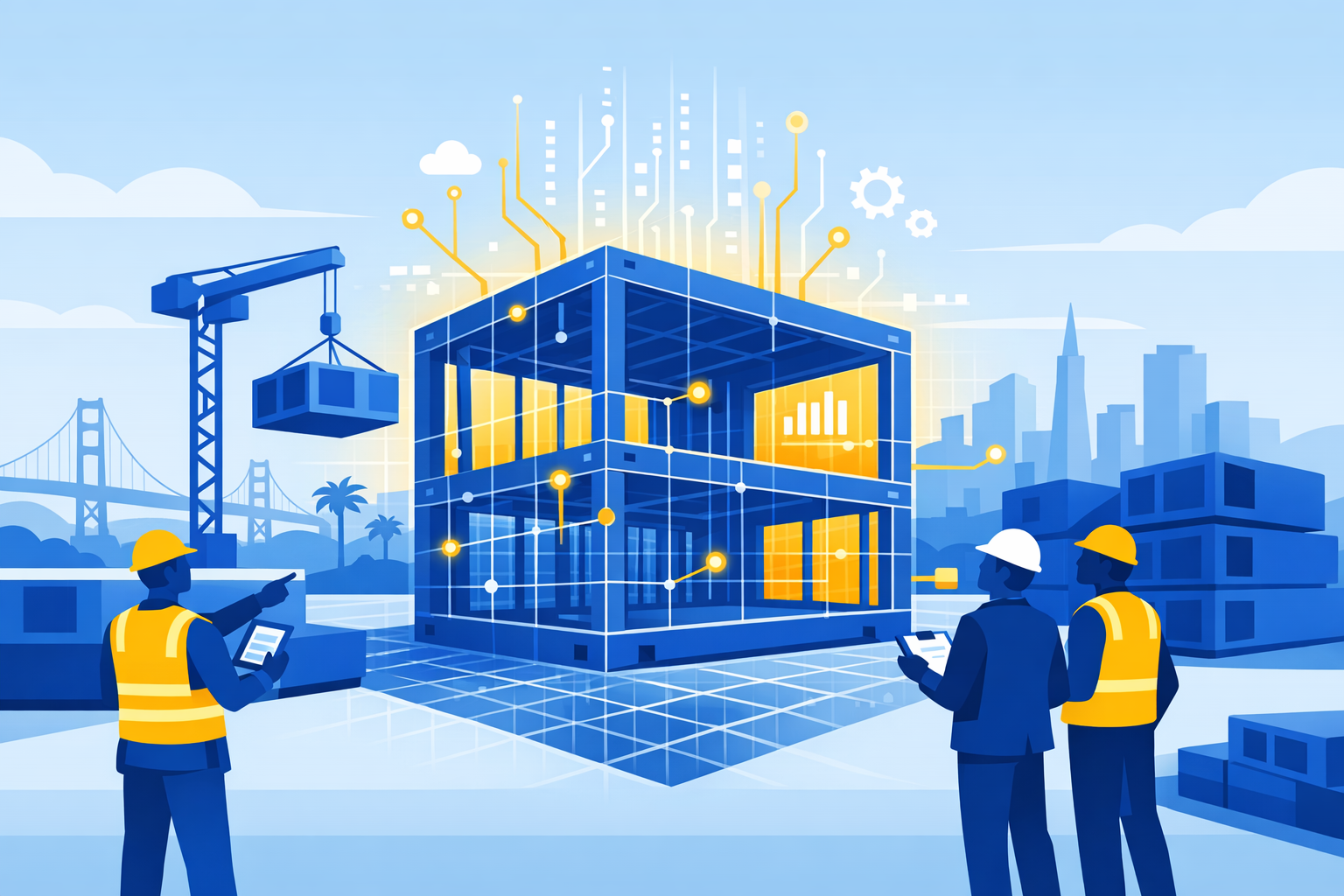
Effective modular delivery calls for digital continuity from design to manufacturing and site assembly.
- Many factories use custom software and CNC systems, creating challenges for BIM model integration.
- Absence of standard data formats for tolerances, interfaces, and manufacturing limits increases redesign efforts and reduces efficiency.
- Design for Manufacture and Assembly (DfMA) and 4D/5D BIM workflows are gaining ground but are inconsistently adopted among mid-tier contractors and regional designers.[11]
Regulation, building codes, and permitting
Regulation continues to hinder industrialized building expansion in Europe.
Germany's building practice is dictated by 16 state codes; industry organizations and policy experts advocate for more harmonized frameworks to enable modular and serial approaches at scale.[12]
Policy discussions at the EU and national levels increasingly recognize modular construction for speeding housing delivery, but outdated planning and inconsistent treatment of factory elements continue to delay permits.[13]
Major regulatory challenges include:
- Inconsistent rules for type approvals and system certifications
- Ambiguity over factory QA responsibility versus on-site inspection
- Planning systems tailored to plot-specific, custom approvals over standardized buildings
Workforce skills and delivery models
Modular construction shifts roles and required skills throughout the value chain:
- Design teams must coordinate and freeze layouts earlier within system limits.
- Site crews transition from wet trades to assembly, cranage, and precision installation.
- Project managers focus on interface and logistics planning over continuous on-site work.
Insufficient training can diminish modular's benefits. For instance, low familiarity with modular methods can lead contractors to add schedule allowances or rework contingencies offsetting time gains.[3]
Practical selection framework for developers and builders
A structured screening process helps decision-makers assess modular or off-site strategies for upcoming projects.
1. Assess design repeatability and standardization
- Quantity of repeatable units (rooms, apartments, spans)
- Standardization in wet cores, MEP risers, façade modules
- Willingness to adopt a product platform versus unique designs
2. Quantify schedule and disruption costs
- Urgency of completion (political, funding, contractual)
- Financial impact of delay (lost rent, penalties, user delay costs)
- Community and traffic disruption for infrastructure assets
3. Evaluate supply-chain capacity and competition
- Existence of at least two qualified modular/precast suppliers
- Track record with similar project types and scales
- Proximity and logistics suitability for large modules
4. Map regulatory and insurance constraints
- Local and national requirements for approvals, fire, acoustics, structure
- Local authority familiarity with modular construction
- Insurer demands for factory QA, transport, site assembly
5. Decide the delivery model
- Fully integrated design-manufacture-install vs. separated packages
- Early contractor/manufacturer engagement to mitigate design risk
- Clear allocation of interface and tolerance design responsibility
Projects that rate highly on repeatability, schedule sensitivity, supply-chain maturity, and face manageable regulatory obstacles make the best early candidates.
Budgeting and risk management for modular delivery
Cost planning and commercial structures
Modular construction shifts costs earlier, increasing the share of off-site, fixed-price manufacturing against variable on-site activity.
Best-practice budgeting includes:
- Front-loaded design and coordination allowances for early-stage efforts
- Separate contingencies for factory, transport, and site interface risks
- Explicit pricing for change orders post-design freeze, as modifications are costly after production begins
Common contract models:
- Design-build contracts with modular subcontractor responsible for system and shop drawings
- Multi-party/alliance contracts for large programs, aligning developer, GC, and manufacturer incentives
- Performance guarantees on tolerances, throughput, and delivery slots with liquidated damages
Insurance, quality, and testing
Insurance models are adapting to modular construction's distinct risks.
Specialist insurers note the heightened importance of Construction All Risks (CAR) and Erection All Risks (EAR) coverage in modular delivery, with claim complexities over whether damage occurred in-factory, in transit, or on site.[14]
Sound risk and quality management includes:
- Rigorous factory acceptance testing (FAT) and pre-shipment inspection
- Detailed records of module identification, transport, and lifting for traceability
- Clear insurance demarcation by project stage: factory, storage, transit, and site erection
- Use of BIM-linked quality and digital twins for installation tracking and future maintenance
Infrastructure modules often require additional structural testing, mockups of critical connections, and direct regulator engagement for approvals.
Frequently Asked Questions
How can project sponsors determine if modular will be cheaper than traditional construction?
Cost outcomes hinge on project specifics. Modular delivery is cost-competitive where there is high repetition, pressing schedule demands, and ready access to at least two qualified manufacturers. Bespoke designs, smaller volumes, or immature supply chains may result in cost premiums that outweigh faster delivery.
Does modular construction suit architecturally complex buildings?
While modular systems allow for façade articulation, varied materials, and hybrid podiums, efficiency is highest when building geometry and grids are regular. Highly irregular forms, cantilevers, or plan variation between floors typically erode modular benefits and may require hybrid solutions combining modular and traditional elements.
What are the main construction risk management shifts when using modular?
Risk is transferred from extended, weather-sensitive site work to time-critical manufacturing and logistics. Although site hazards are reduced, concentrated risks arise in cranage, transport of large modules, and factory throughput. Integrated planning, early detection of clashes via BIM, comprehensive lift and delivery protocols, and clear contractual roles are essential.
How does modular construction affect building codes and approvals?
In most European regions, modular buildings must meet standard performance criteria, but factory system approvals are less standardized. Fragmented codes, limited experience among authorities, and ambiguous approval rules can prolong permitting. Early regulator engagement, proven systems, and robust documentation on safety and performance help mitigate delays.
Are modular buildings and bridges as durable as traditional construction?
Durability relies on design, materials, detailing, and quality controls. Factories can improve consistency in curing and tolerances, and prefabrication reduces site exposure for infrastructure elements. With properly designed connections, waterproofing, and maintenance, long-term performance meets or exceeds conventional benchmarks.
Conclusion: turning pilots into scalable programs
Modular and off-site construction now extend beyond pilots, delivering proven schedule, cost, and risk advantages in appropriate housing and infrastructure contexts. Benefits are strongest when designs are standardized, projects have scale, and delay or disruption costs are significant.
However, scaling these advantages demands more than adopting new techniques. It requires harmonized regulations, mature supply chains, interoperable digital processes, adaptive insurance policies, and project delivery model reform. Developers, contractors, and public clients who systematically screen projects, invest in early integrated design, and structure risk-sharing manufacturer relationships are best positioned to convert modular success into repeatable, program-level achievements.