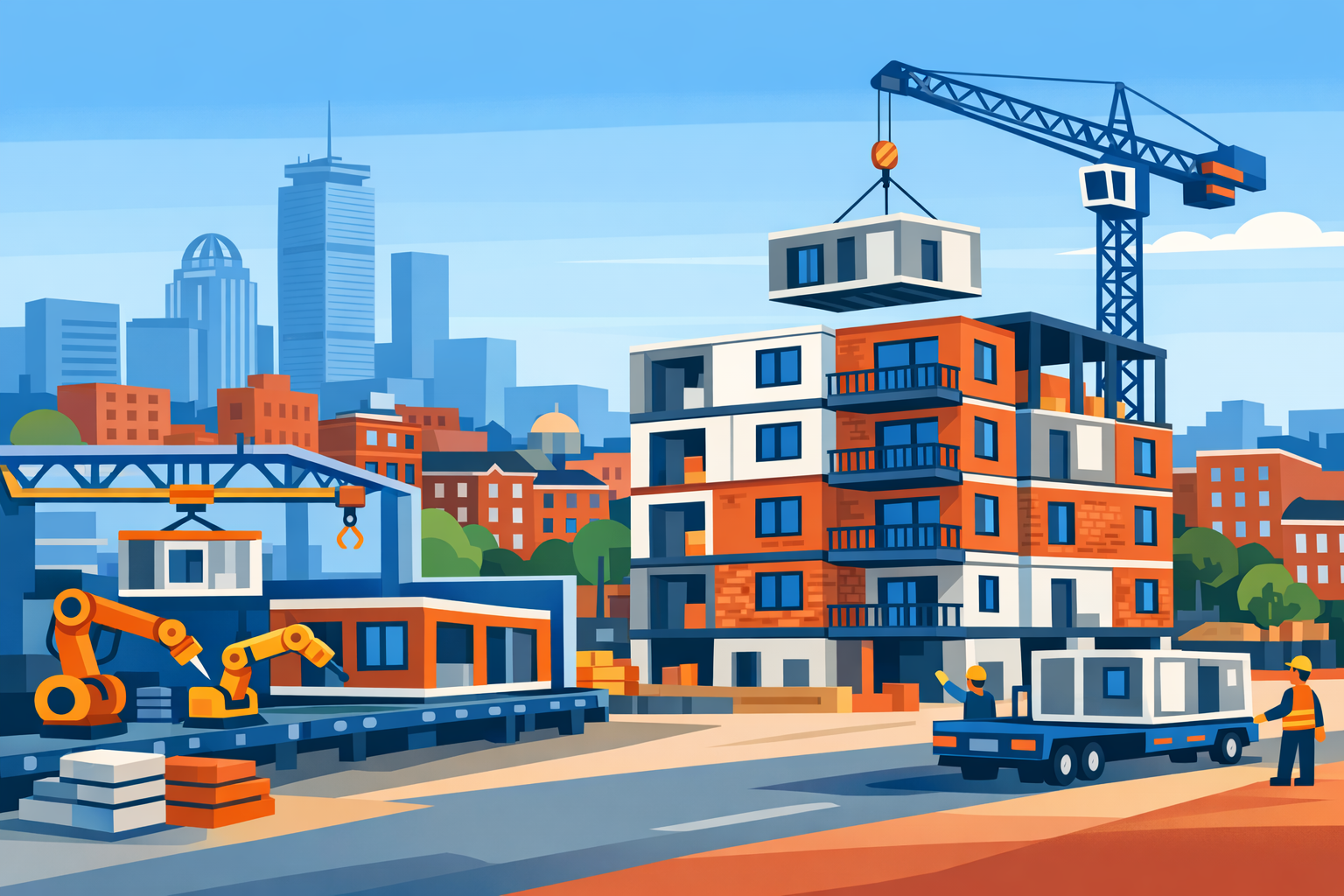
The U.S. Department of Energy's Advanced Building Construction (ABC) Initiative is mobilizing federal funding, multi-stakeholder collaboration, and measurable performance benchmarks to standardize industrialized construction methods across new builds and retrofits at national scale. Led by DOE's Building Technologies Office (BTO), the program targets chronic construction-sector underperformance, an acute skilled-labor shortage, and a 2050 decarbonization deadline that demands a step-change in building delivery rates.
Background
Building construction practices in the United States have remained largely unchanged over the past century, even as manufacturing, communications, and other capital-intensive industries transformed through digitization and process improvement. The consequences are quantifiable: only about 1 million new buildings are completed per year in the United States, while the country's existing stock exceeds 125 million buildings, according to DOE. More than half of that existing stock was built before 1980, prior to modern building codes that require improved energy performance. Deep energy retrofits-the kind the ABC Initiative aims to accelerate-remain rare: in leading jurisdictions, only 1.75% of homes and 2.2% of commercial real estate are retrofitted annually, rates DOE considers far too low to meet housing quality and climate goals.
Industrialized construction-the practice of streamlining manufacturing, business models, and technology installation to become reproducible at scale-has emerged as the sector's primary response. According to a McKinsey analysis cited by Autodesk, the construction sector could potentially save $20 billion and cut project lifecycles in half by adopting industrialized construction methods.
Details
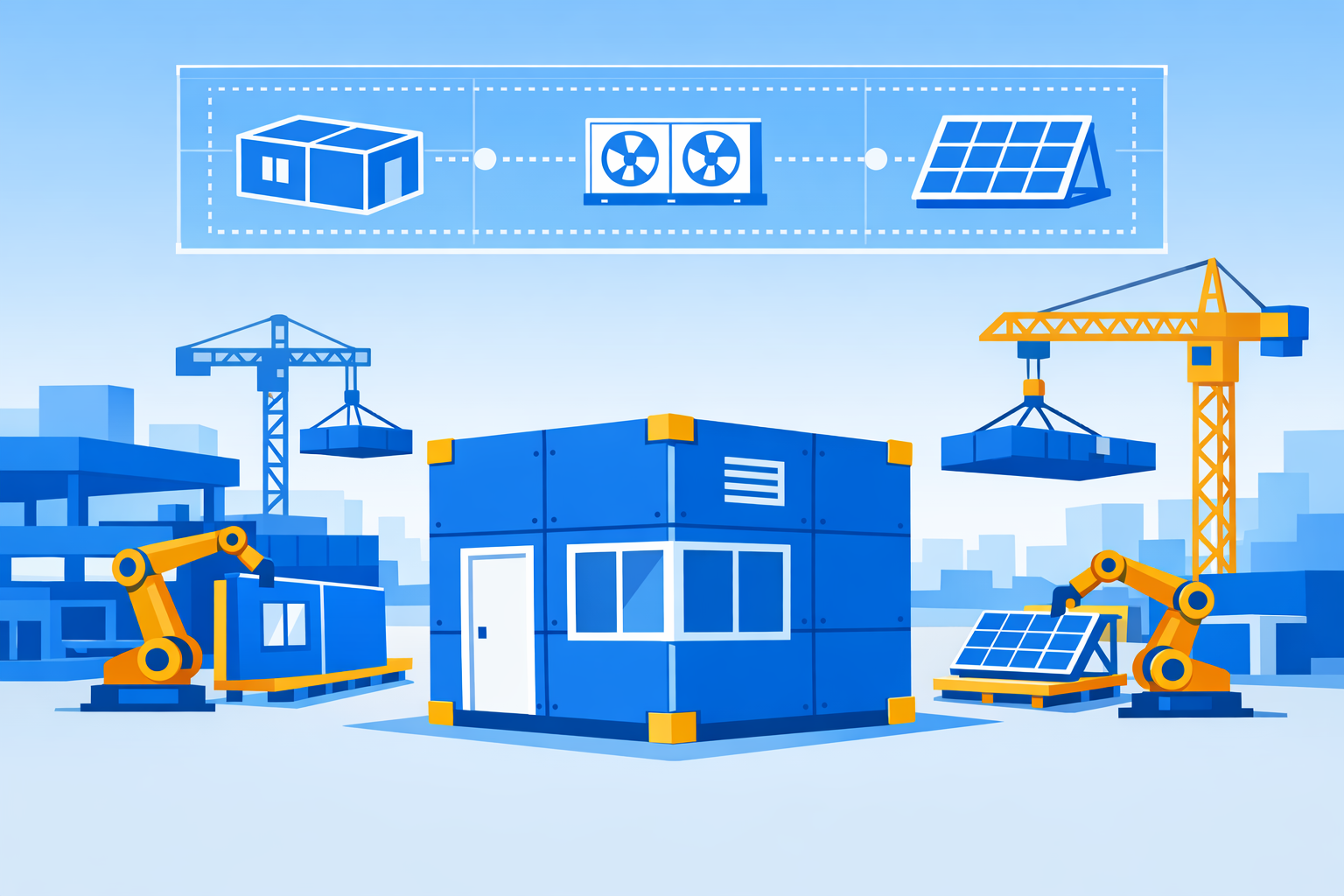
DOE's Building Technologies Office has funded 20 research, development, and demonstration projects under the ABC Initiative, of which 14 ABC Topic 1 awards focused specifically on industrialized building solutions for retrofits, according to the ABC Collaborative's Phase I report. The initiative deploys a two-pronged strategy: funding new technologies and engaging private and public sector stakeholders across the buildings industry, according to DOE. Its technical portfolio includes offsite factory-based construction paired with prefabricated high-performance wall panels, packaged HVAC and water heating pods, robotics, additive manufacturing, and AI-assisted design-to-fabrication workflows DOE describes as an "art-to-part" process.
On the funding side, DOE awarded $31.8 million to seven project teams to demonstrate advanced construction techniques integrated with energy-efficient technologies and practices as the next generation of building retrofit solutions. The agency also announced $33.5 million in a separate funding opportunity announcement targeting deep energy retrofit and new construction technologies. Retrofit demonstrations must reduce thermal energy loads by at least 50-75%, establishing a concrete performance benchmark for contractors and project owners evaluating standardized ABC methods. These seven teams will collectively bring ABC innovations to more than 30 existing buildings, with the majority located in low-income communities.
The ABC Initiative is designed to tackle critical issues related to the U.S. building stock's consumption of 75% of the country's electricity and 40% of its total energy, according to the Pacific Northwest National Laboratory. To reach 2050 decarbonization goals, DOE estimates that industrialized methods must be applied to 80% of the existing building stock by 2050, requiring a 15-times acceleration in the residential retrofit rate and a doubling of the commercial retrofit rate.
Workforce implications are significant. According to the Associated General Contractors of America's 2025 Workforce Survey, 92% of construction firms that are hiring report difficulty finding qualified workers, and 45% identify labor shortages as the leading cause of project delays. Associated Builders and Contractors estimates the industry needs to attract 349,000 net new workers in 2026 to meet demand. Factory-based construction models offer a partial offset: factory and offsite construction methods have the potential to produce higher quality and faster construction timelines, improve productivity, integrate energy-efficiency technologies, and provide workers with controlled working conditions at lower costs, according to DOE's ABC strategy documents.
The ABC Collaborative is specifically tasked with accelerating the development, demonstration, standardization, and mainstream adoption of innovative, high-performance construction technologies and processes, according to IAEI Magazine. It convenes owners, developers, construction companies, financiers, utilities, and national laboratory researchers-the breadth of stakeholder alignment that procurement reform and supply-chain standardization will require.
Outlook
The initiative's ability to scale hinges on whether procurement frameworks-across federal, state, and municipal contracting-can be updated to accept and reward industrialized delivery models. Parallel federal action on permitting technology, including a April 2025 Presidential Memorandum directing agencies to standardize permitting data and software and issue a Permitting Technology Action Plan within 45 days, could reduce one of the most commonly cited friction points in modular and prefabricated project delivery. Industry analysts at PwC note that more than half (56%) of engineering and construction executives plan to significantly increase investment in technologies such as AI, robotics, and digital twins, suggesting private-sector appetite aligns with the ABC Initiative's technology roadmap. Whether adoption rates, time-to-permit improvements, and lifecycle cost reductions become standardized industry benchmarks-rather than project-by-project metrics-will determine how quickly the initiative's gains transfer from demonstration sites to mainstream contracting.