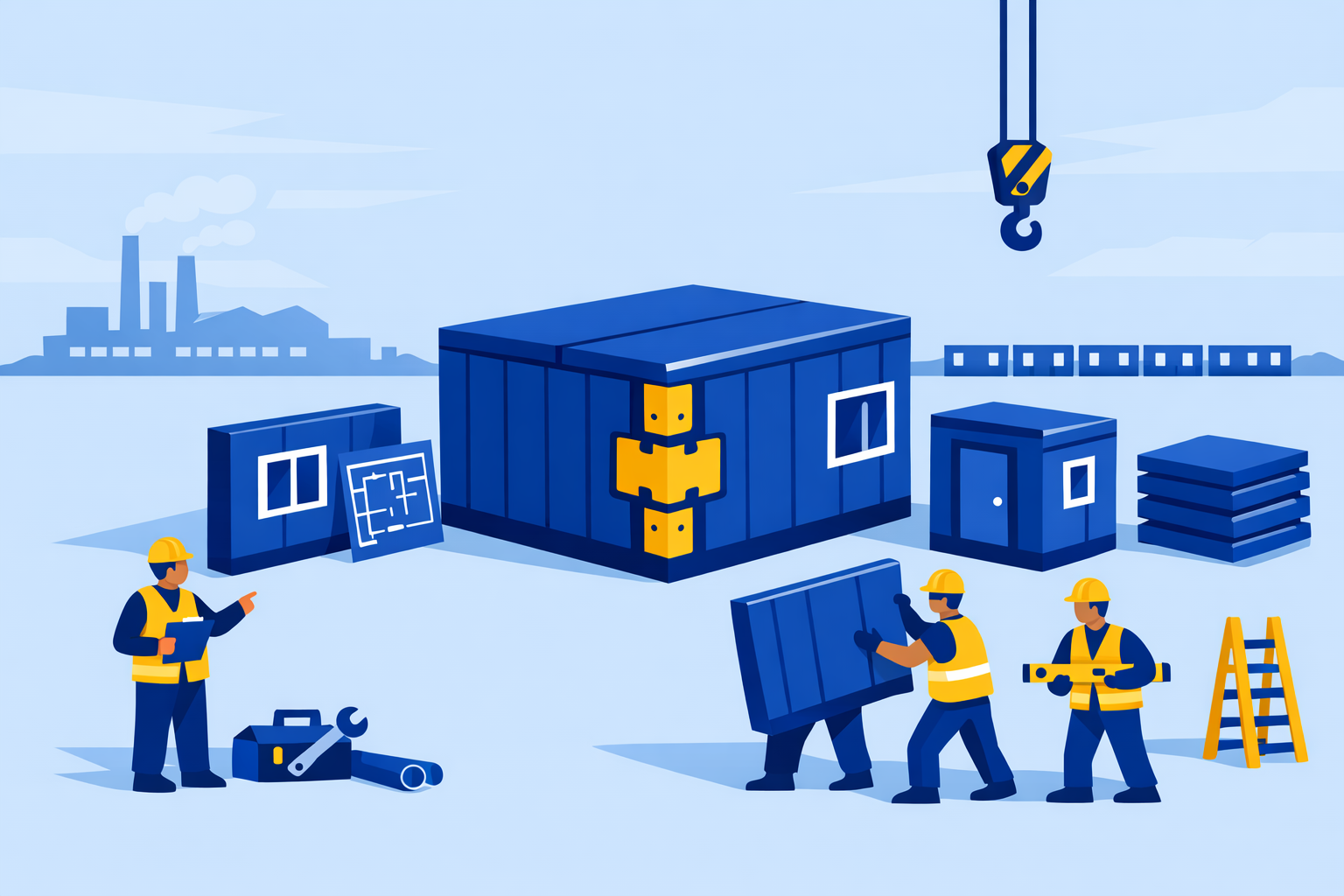
The U.S. Department of Energy's Advanced Building Construction (ABC) Initiative is expanding its effort to standardize factory-built and modular construction systems, directing hundreds of millions in federal funding toward industrialized methods that could reshape how contractors, developers, and code officials procure and approve offsite-built projects.
Background
The ABC Initiative, led by the DOE's Building Technologies Office (BTO), integrates energy-efficiency solutions into high-productivity U.S. construction practices for new buildings and retrofits.[1] The program's origins trace to a well-documented productivity problem: while industries such as manufacturing and communications have transformed through digitization and process improvements, U.S. construction productivity has consistently declined since 1968. Lagging productivity directly increases costs, contributing to the nation's affordable housing crisis. Higher upfront construction costs also lead building owners and investors to forgo the latest energy-efficiency technologies, even when those technologies reduce total operating and maintenance expenses.
The regulatory landscape for modular construction remains fragmented. Each state follows its own code adoption cycle and amendment policies, producing a national base-model code with numerous regional variances. The lack of uniform interface specifications has historically constrained manufacturers from scaling factory-built systems across multiple jurisdictions.
Initiative Details
ABC combines advanced technologies and methods - including offsite construction, design for manufacturing and assembly, packaged mechanical systems, robotics, and 3D printing - with low-carbon materials and high-efficiency systems.[2] Beyond funding technology research, software, and digitization, the initiative coordinates key building sector stakeholders to address related challenges such as workforce training, business models, demand growth, and service delivery.[3]
On the funding side, the DOE's Building Technologies Office awarded $26.3 million to 40 competitively selected projects under an ABC Funding Opportunity Announcement, according to the DOE. A separate award of $31.8 million went to seven project teams tasked with demonstrating next-generation whole-building retrofit approaches targeting thermal energy load reductions of at least 50-75%. A further $33.5 million funding opportunity announcement was directed at deep energy retrofit and new construction technologies.
By pairing offsite factory-based construction with advanced building technologies - such as prefabricated high-performance wall panels and packaged HVAC and water heating pods - ABC seeks to accelerate deployment of construction sector advancements. In fall 2020, the DOE launched the ABC Collaborative to help the United States remain globally competitive in high-performance prefabricated and modular approaches, convening builders, architects, engineers, manufacturers, building owners, trade associations, government agencies, research institutions, financiers, and utilities.
On the standards front, a parallel development emerged in April 2025. New York Tech's Center for Offsite Construction (CfOC) Consensus Committee began development of CfOC/ICC 1220-202x - a new standard covering configurations and connections for offsite construction - in partnership with the International Code Council (ICC). The standard establishes requirements for the location and specifications of module-to-module and building-to-module connections across essential building systems, including structural, plumbing, electrical, mechanical, fire protection, and data. It also provides for standardization of modular component dimensions. The standard is intended to serve as design criteria adopted by owners, designers, manufacturers, lenders, and governments to support efficiency and certainty in the delivery of offsite construction components and projects. The CfOC was approved as an Accredited Standards Developer (ASD) by the American National Standards Institute (ANSI) in February 2025.
On the market side, multifamily residential led the U.S. permanent modular construction market in 2024 at $7.1 billion in project value, with FMI projecting that figure to rise to $11.3 billion by 2029, according to FMI's 2025 United States Permanent Modular Construction Industry Report.
Procurement and Adoption Implications
For contractors and developers, the convergence of federal R&D investment and emerging interface standards creates both opportunity and transition risk. ABC targets opportunities along the supply chain and applies new business models to address market fragmentation, delivering streamlined, easy-to-install solutions for new construction and renovation. However, each region carries unique regulatory requirements, environmental conditions, and cultural preferences. Modular construction companies are working closely with local authorities and stakeholders to tailor approaches to specific regional needs.
Lagging construction labor productivity raises the cost of new buildings and retrofit upgrades while limiting adoption of energy-efficient technologies. The ABC Initiative's technical assistance program addresses this directly, offering support to enhance the performance, productivity, and energy efficiency of industrialized construction projects.
Outlook
Through competitively awarded R&D projects and research at DOE national laboratories, the ABC Initiative works to ensure solutions are widely deployed, with a stated goal of a carbon-neutral U.S. building stock by 2050. Project teams should monitor the finalization timeline for the CfOC/ICC 1220 standard; its adoption by owners, lenders, and authorities having jurisdiction (AHJs) would directly affect procurement specifications and modular product approval workflows across state lines. Government support and policy initiatives play a critical role in overcoming regulatory barriers. By incentivizing modular construction through grants or streamlined approval processes, governments can drive innovation and investment while reducing regulatory obstacles.