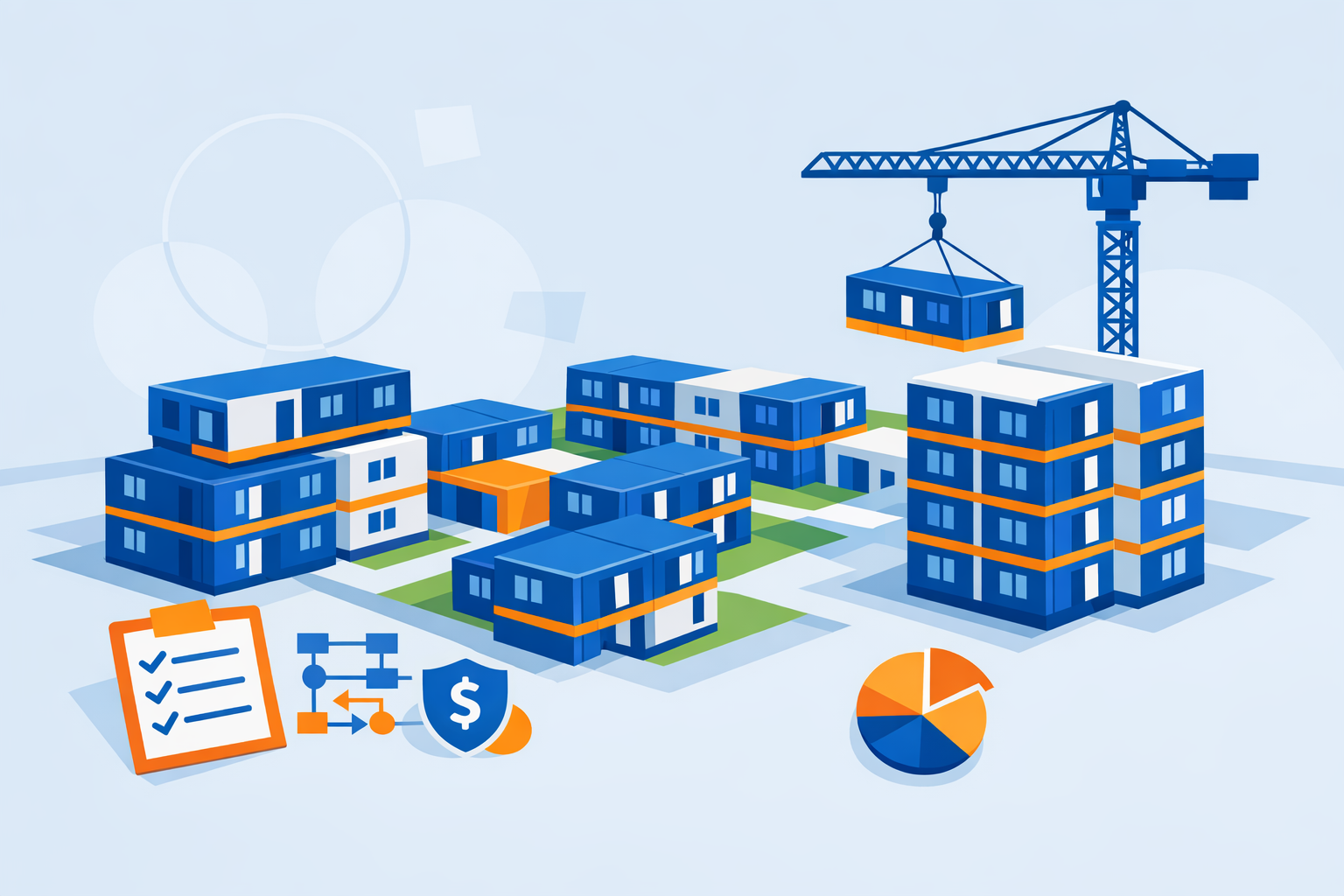
The student housing pipeline in the United States is thinning. Only 22,000 beds were expected to be delivered in 2025, a 42 percent decline from the prior year. Against that backdrop, one of the largest campus housing programs in the country just selected a procurement strategy that could reshape how universities plan, finance, and execute large-scale residential builds.
Cal Poly in San Luis Obispo has selected a construction management firm to oversee a $1.2 billion multi-phase student housing project slated to be the nation's largest modular housing development.[1] University officials awarded the contract to Boston-based Suffolk, which will lead an effort to add approximately 3,600 new student beds and renovate about 1,200 existing beds on the Cal Poly campus.[2] The deal is structured as a construction management-at-risk (CMAR) engagement - a delivery method gaining traction in higher education precisely because it addresses the cost uncertainty, schedule pressure, and coordination complexity that define modern campus construction.
What CMAR Means - and Why It Matters Here
Construction management-at-risk (CMAR) is a project delivery method in which the owner hires a construction manager during the design phase to provide preconstruction advisory services. The CM then commits to delivering the project within a guaranteed maximum price (GMP), assuming financial responsibility for cost overruns. Unlike traditional delivery methods, CMAR requires this GMP commitment before the bidding stage, shifting financial risk from the owner to the construction manager.
For Cal Poly, this structure allows Suffolk to coordinate across a complex web of stakeholders - the university's facilities team, architect Steinberg Hart[5], and modular manufacturer FullStack Modular - from design through final occupancy. Suffolk will leverage modular construction and precision stacking methods, using advanced digital modeling, geospatial positioning, and AI-driven planning tools to streamline the project and minimize campus disruption.[3]
Why Universities Are Turning to CMAR
The Cal Poly contract does not exist in a vacuum. The CMAR delivery method has gained popularity for years and is now the preferred strategy for many public and private sector clients, institutions, and nonprofit organizations. Several structural forces explain why universities, in particular, are gravitating toward CMAR for high-density housing:
Cost certainty through GMP. The GMP provides a cost cap, creating greater budget certainty. The CM can also offer detailed cost breakdowns and regular financial updates, giving owners full transparency on spending. For public universities operating under state-system oversight, this predictability is essential.
Early collaboration. CMAR occupies a structural middle ground: the CM joins during design (like design-build) but the architect maintains an independent contract with the owner (like design-bid-build). The owner gains early construction input without sacrificing independent design oversight. This is particularly valuable when integrating modular and offsite construction components that require parallel design and manufacturing timelines.
Risk transfer in multi-phase programs. A $1.2 billion, multi-year program with nine planned buildings presents compounding risk across phases. CMAR allows each phase to carry its own GMP while maintaining continuity of construction management. The more complex a project, the more valuable CMAR becomes - the process enables the project team to collaboratively identify and mitigate risks well before construction starts. Leveraging the CM's construction expertise during design reduces project risk while increasing certainty of outcome for cost, schedule, and workmanship.
Modular coordination. Campus administration has been working with FullStack Modular, which is constructing modular housing units at its factory in Los Angeles County. FullStack Modular remains responsible for manufacturing the units, while Suffolk now oversees management of the broader project.[4] CMAR enables the CM to manage the interface between factory production schedules and site readiness - a coordination layer that traditional design-bid-build cannot easily accommodate.
CMAR vs. Design-Build vs. Design-Bid-Build
The choice of delivery method defines risk allocation, schedule potential, and the owner's level of design control. The following comparison outlines how CMAR stacks up against the two most common alternatives:
| Feature | CMAR | Design-Build (DB) | Design-Bid-Build (DBB) |
|---|---|---|---|
| CM involvement in design | Early - joins during schematic design | Integrated - single design-build entity | None - GC enters after design is complete |
| Risk transfer | CM assumes cost overrun risk via GMP | Design-builder assumes single-point risk | Owner bears most coordination risk |
| Cost certainty | High - GMP established before construction | Moderate - varies by contract structure | Low - true cost unknown until bids received |
| Owner design control | High - separate architect contract preserved | Limited - design under builder's control | High - owner controls full design phase |
| Schedule compression | Moderate - overlapping design and preconstruction | High - fully integrated fast-tracking | Low - sequential phases |
| Best suited for | Complex, multi-phase institutional projects | Time-critical projects with clear scope | Simple projects with well-defined scope |
While both DB and CMAR integrate design and construction, CMAR provides a GMP, adding financial safeguards that DB lacks and enhancing budget control. In design-bid-build, the true project cost remains unknown until design is complete and bids are received, often leading to surprises and costly redesign. Design-bid-build still serves less complex projects but grows increasingly unpredictable as project complexity rises.
Research supports the performance differential. CMAR projects are delivered with 6.5% less cost growth and 12.5% less schedule growth than comparable DBB projects, providing owners with increased certainty.
Challenges for CMAR in University Settings
CMAR is not without complications, particularly within the governance structures common to public universities:
Procurement compliance. Public institutions often operate under state-mandated procurement statutes. While many states have expanded CMAR authorization - the Minnesota Legislature passed Statute §16C.34 in 2005 authorizing many state agencies to use CMAR, and in 2023 Minnesota Statutes §471.345 and §471.463 broadly expanded this permission to municipalities - some jurisdictions still require legislative or board-level approval.
GMP negotiation complexity. Setting the GMP can be challenging, especially when the design is not fully developed. For a project incorporating volumetric modular units manufactured off-site, locking in a GMP requires accurate pricing from the modular supplier well before traditional construction documents would be complete.
Stakeholder alignment. University projects often require approval from campus facilities departments, system-level chancellors, state oversight boards, and in some cases legislative bodies. CMAR demands sustained engagement from all parties during preconstruction, which can strain governance processes not designed for that level of collaboration.
Potential conflicts of interest. A key criticism of CMAR is the potential for conflicts of interest. Since the construction manager participates in both preconstruction and construction phases, situations may arise where the CM's interests conflict with those of the owner or other project stakeholders.
Industry Outlook: What the Cal Poly Model Could Mean for Campus Construction
The Cal Poly project carries broader implications. The project marks the first large-scale use of modular construction within the California State University system. If Suffolk delivers on schedule - Building A, opening in fall 2026, will house just over 500 students; Building B will open in fall 2027 with space for approximately 700 - the model could become a template for other CSU campuses and state university systems nationwide.
ENR data from the Top 100 Project Delivery Firms highlights substantial revenue increases for both design-build and CMAR methods. Design-build saw a 26.1% rise to $137.19 billion, while CMAR increased by 8.56% to $173.97 billion. CMAR revenue among top project delivery firms reached $173.97 billion, reflecting an 8.56% increase. There is a reason 100 of ENR's Top 400 General Contractors use CMAR as the delivery method for over 75% of their work.
For lenders, CMAR's GMP structure provides a firmer basis for underwriting construction loans on campus housing projects. For insurers, the single-point-of-accountability model may streamline risk assessment. And for universities navigating declining student housing supply pipelines and rising construction costs, CMAR's combination of cost discipline, schedule transparency, and design control makes it a compelling alternative to legacy delivery methods.
As Preston Hoopes, general manager of Northern California at Suffolk, stated regarding the Cal Poly project: "Cal Poly has set an ambitious vision for expanding housing, and Suffolk is leveraging modular construction to deliver at the speed the university needs and the scale it demands."
Frequently Asked Questions
What is construction management-at-risk (CMAR)? CMAR is a delivery method in which a construction manager is hired during the design phase to advise the owner on cost, schedule, and constructability. The CM then commits to a guaranteed maximum price (GMP) and assumes financial risk for overruns.
How does CMAR differ from design-build? In CMAR, the owner retains separate contracts with the architect and the CM, preserving independent design oversight. In design-build, a single entity handles both design and construction. CMAR provides GMP-based cost protection; design-build typically does not.
Why is CMAR well-suited for modular construction projects? Modular construction requires tight coordination between off-site manufacturing and on-site assembly. CMAR brings the CM in early enough to manage the interface between factory production schedules, site preparation, and phased delivery - reducing the risk of costly misalignment.
What is the scope of Suffolk's Cal Poly project? The $1.2 billion program adds approximately 3,600 new student beds and renovates 1,200 existing beds across nine modular buildings on the Cal Poly San Luis Obispo campus, with phased completion through 2030.
Is CMAR available for public university projects in all states? Not universally. Availability depends on state procurement statutes. Many states have expanded CMAR authorization in recent years, but some still require specific legislative approval for public-sector CMAR contracts.