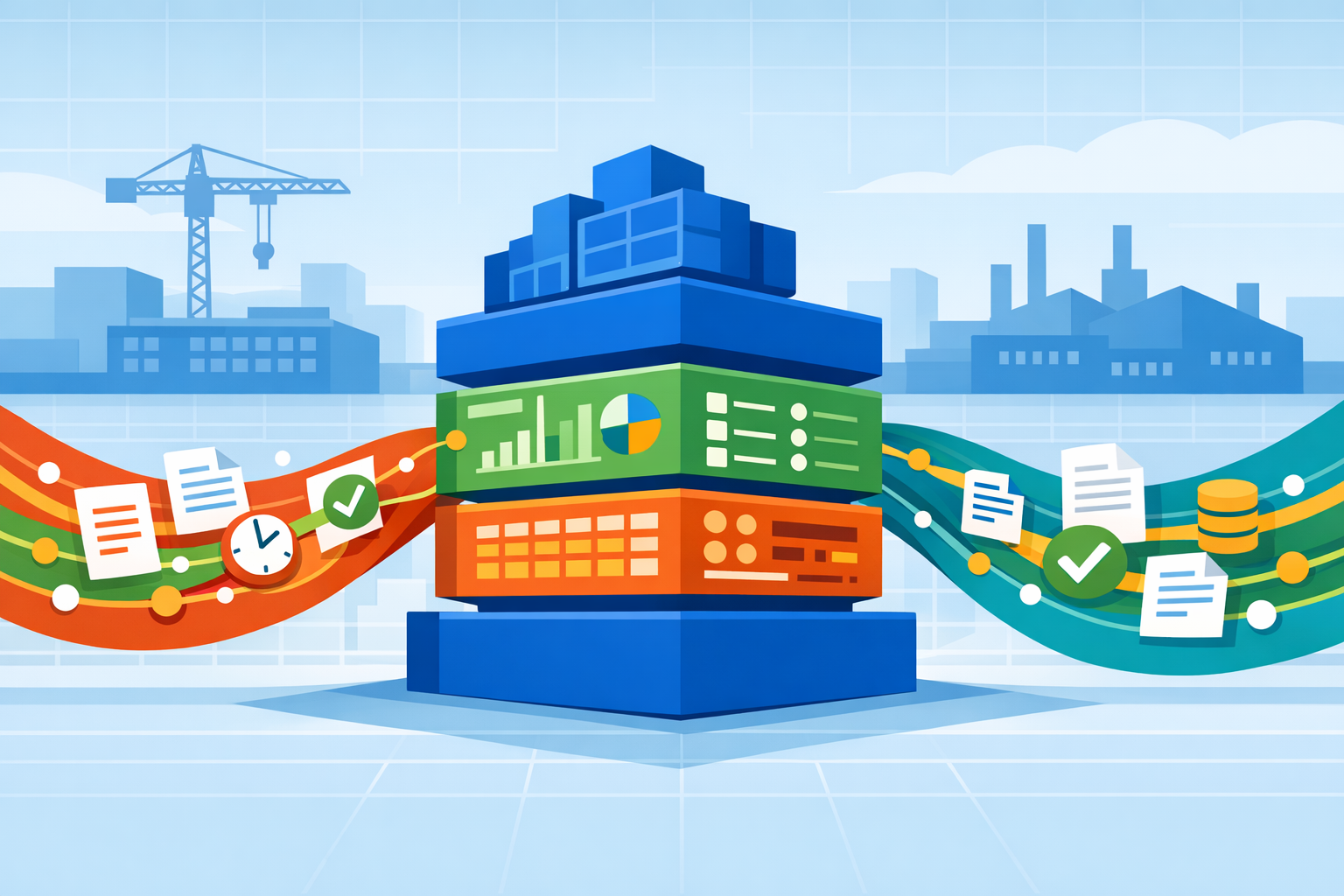
Trimble's proposed acquisition of Document Crunch, a provider of AI-driven contract intelligence, signals a transition toward embedding governance logic at the core of construction technology ecosystems. In the context of offsite and modular construction-where seamless data integration from contracts through BIM, ERP, and factory systems is essential-this move marks an evolution toward integrated, rule-based project management.
Deal Overview: AI Contract Intelligence Moves Into the Platform Core
Trimble announced on April 2, 2026, that it had signed an agreement to acquire Document Crunch, an AI-based construction document analysis and risk management platform.
While financial terms were undisclosed, Document Crunch will be incorporated into the Trimble Construction One (TC1) project delivery platform. The integration aims to transfer contract obligations, compliance requirements, and payment terms into project management and ERP workflows.
Document Crunch's platform has supported more than 10,000 construction projects-serving general contractors, subcontractors, designers, owners, insurers, and other risk-focused stakeholders.
The company functions as a document compliance infrastructure, using AI to identify critical clauses, allocate risk, and clarify team responsibilities and deadlines. Prior to this deal, Document Crunch was already integrated with Trimble's ProjectSight and partnered across other industry platforms.
Document Crunch raised at least $37 million in venture capital before acquisition, including a $21.5 million Series B in October 2024 to expand its AI-driven compliance technology.
Trimble will report Document Crunch under its Architecture, Engineering, Construction and Operations (AECO) division and treat the platform as a core component of its broader construction suite.
Why This Matters for Offsite and Modular Construction
Offsite and modular construction rely on precise coordination of design, manufacturing, logistics, and on-site assembly. This coordination is underpinned by the data model and the contractual terms governing scope, accountability, and risk.
Recent market data shows over 56% of large-scale residential and infrastructure projects are adopting modular or prefabricated methods, with more than 48% of stakeholders prioritizing factory-produced components for speed and accuracy.
Within the offsite sector, over 49% of activity involves integrated digital design, BIM workflows, and precision fabrication, with reported structural quality metrics exceeding those of traditional construction by over 55%.
Interoperability remains a significant industry constraint.
More than 37% of contractors cite interoperability challenges between prefabricated components and conventional onsite construction, notably around structural interfaces and service layouts.
For offsite and modular manufacturers, these issues manifest as:
- Misalignment between contract terms and production priorities (e.g., tolerances, handover definitions, testing requirements)
- Poor synchronization of design changes from BIM models to fabrication instructions and supplier orders
- Fragmented audit trails as components traverse plants, logistics providers, and subcontractors
- Challenges demonstrating compliance to regulators and insurers due to scattered documentation and version control
Embedding AI-based contract intelligence into a comprehensive construction platform signals a shift: contracts become operational rule sets that manage data across the offsite value chain, rather than static documents.
From Contracts to Data Governance: How Trimble Could Connect the Stack
Contractual Rule Sets Feeding ERP and Project Controls
Trimble positions Document Crunch as the "contractual rule set" within its platform, aiming to automatically distribute obligations and compliance requirements into project controls and ERP modules.
In offsite and modular delivery, this could mean:
- Contractual delivery milestones triggering manufacturing release schedules and shipping dates
- Liquidated damages and incentives influencing project forecasts and risk registers
- Notifications and claim deadlines generating workflow tasks and alerts for project managers and commercial teams
- Safety, testing, and inspection clauses automating quality checklists and commissioning processes
If implemented as presented, Document Crunch's AI models could operate as a governance layer, structuring legal text into data fields shared across scheduling, cost control, and commercial workflows.
Linking Contract Intelligence to BIM and Design-to-Fabrication
BIM is already central to offsite manufacturing processes.
Studies report over 60% of major offsite plants have BIM-enabled manufacturing, reducing design conflicts by approximately 25% and improving production scheduling accuracy by nearly 30%.
A persistent challenge is connecting contractual requirements with what the design and fabrication stack delivers. With Document Crunch embedded in Trimble's platform, several governance workflows become possible:
- Specification alignment: Performance requirements and reference standards from contracts mapped to BIM object properties and fabrication parameters.
- Change control: Contract-initiated variations trigger updates to model versions and shop drawings, with traced changes.
- Tolerances and testing: Tolerance clauses linked directly to quality checks at the module or panel level, reflected in both BIM and ERP systems.
Governance Map: Before and After the Deal
| Data / Governance Domain | Typical Pre-Acquisition State | Potential Post-Acquisition Pattern (Trimble + Document Crunch) |
|---|---|---|
| Contract obligations | Clauses stored as PDFs; manually interpreted by legal teams | Parsed into actionable rules that populate PM and ERP fields |
| BIM and design data | Managed in separate tools | Key obligations (specs, tolerances, approvals) linked to BIM elements |
| Offsite manufacturing data | Factory MES/spreadsheets loosely connected to design/contracts | Schedules and quality checks driven by contract-derived milestones |
| Field installation and QA | Disconnected checklists and punch lists | Inspections aligned with contractual acceptance and testing criteria |
| Financials and ERP | Cost codes loosely related to risk allocations | Payment terms and risk allocations built into ERP workflows |
This comparison highlights industry direction; the acquisition positions governance as a central data platform concern, not merely a legal-tech solution.
Impact on Timelines, Risk Management, and Quality Assurance
In offsite projects, delays and disputes often result from disconnects between contractual terms, design intentions, and factory outcomes. Integrated document intelligence may close this gap.
Timelines and Coordination
- Early detection of misaligned milestones between contracts, factory production, and site programs
- Automated surfacing of notice periods, approval lead times, and sequencing constraints impacting capacity and logistics
- Accelerated review of supplier and subcontractor agreements to reduce pre-production bottlenecks
Risk and Claims Management
Trimble highlights potential to quickly identify payment term conflicts, scope ambiguities, and notification requirements before they become claims. This is critical for modular programs involving multiple plants:
- Standardized risk allocation across contract portfolios
- Consistent insurance, warranty, and indemnity terms by phase and geography
- Comprehensive, auditable records of how obligations were executed
Quality Assurance and Compliance
For offsite construction, quality is largely defined pre-installation. Data-governed workflows facilitate:
- Integration of acceptance criteria and sampling plans into digital QA checklists
- Tying nonconformance reports and corrective actions to specific contract provisions
- Producing evidence packages for regulators and clients linking contracts, inspections, and as-built data
Market Structure: Platform Consolidation vs. Fragmentation
The Trimble-Document Crunch deal raises questions about technology platform consolidation.
Some vendors, like Trimble Construction One, promote unified environments for ERP, field collaboration, and cost management. Others emphasize best-of-breed approaches mixing multiple point solutions.
Key trends include:
- Governance gravity: Platforms owning contract intelligence may exert control over adjacent services, such as project controls and payments.
- Ecosystem positioning: Document Crunch's preexisting integrations outside Trimble may affect whether the market enables neutral services or encourages vendor lock-in.
- Competitive responses: Other vendors may accelerate AI contract review capabilities, either through internal development or acquisitions.
For offsite construction, where participants often span several software environments, the need for cross-platform compatibility will remain prominent.
Implications for Small and Mid-Size Contractors
Smaller contractors and modular manufacturers typically have slim margins and fewer legal resources. The deal's impact hinges on how governance features are integrated into available platforms.
Potential effects:
- AI risk tools in existing platforms: If Document Crunch functions are bundled within Trimble offerings, smaller firms may access contract intelligence without standalone tools.
- Standardization from major clients: Large contractors' adoption of AI compliance workflows may set expectations for smaller subcontractors to follow similar systems.
- Vendor lock-in vs. interoperability: The value of integration must be balanced against constraints of proprietary ecosystems and the need for cross-platform operations.
- Improved compliance reporting: Automated extraction of regulatory clauses may enhance the timeliness and accuracy of reporting, especially for firms managing operations in multiple jurisdictions.
What to Watch Over the Next 12-24 Months
Several indicators will reveal whether this acquisition significantly changes data governance in offsite construction or amounts to a routine feature integration.
1. Depth of Integration Across the Trimble Stack
- Speed of Document Crunch feature rollout inside Trimble Construction One modules
- Capability to create reusable rule sets across projects
- Inclusion of obligation and risk metrics as key data in dashboards and reports
2. BIM and Design-to-Fabrication Hooks
- Announcements of direct integration between contract intelligence and BIM workflows
- Demonstration of use cases in modular factories where contracts shape production and quality plans
3. Ecosystem Openness and Partner Strategy
- Ongoing availability of APIs and integrations with non-Trimble systems
- Partnerships that extend beyond ERP into manufacturing and supply chain tools
4. Measurable Governance Outcomes
- Case studies reporting reduced disputes, claims, or rework using integrated contract intelligence
- Metrics on improved notice compliance, prompt change notifications, and higher first-time quality
Industry research has linked higher digital maturity in modular and offsite manufacturing to reduced rework rates and more predictable delivery schedules.
Demonstrated performance improvements related to Document Crunch integration will clarify the acquisition's strategic significance.
Frequently Asked Questions
How does the Trimble-Document Crunch acquisition alter contract workflows in modular and offsite projects?
The acquisition seeks to embed contract review and management into continuous project and ERP workflows, automating the surfacing of obligations such as lead times, tolerances, and logistics within daily operations. Governance rules could move from static contract documents to dynamic data objects guiding scheduling, approvals, and risk management across projects.
What is the impact on BIM integration for offsite construction?
While BIM underpins modular construction, its connection to contractual requirements often remains loose. AI contract intelligence within Trimble's ecosystem could link specification clauses and performance criteria directly to BIM objects and construction sequences, supporting compliance checks and traceability from contract to as-built status.
Will small and mid-size contractors need to use Trimble to benefit from this trend?
Not necessarily. The broader shift is toward AI-driven contract intelligence and data governance as industry standards. Other vendors are developing similar tools; interoperability and open data exchange will be key for widespread adoption beyond Trimble users.
Could the acquisition affect pricing and competition in construction platforms?
Governance features-such as AI contract review and compliance tracking-are likely to become standard in mid-to-high tier construction platforms. This may reshape pricing strategies, with vendors bundling governance tools into premium tiers or leveraging them as competitive differentiators. Over time, competition may center on the quality of integrations and total cost of ownership.
What preparatory steps should offsite manufacturers and contractors take?
Firms should consolidate contract templates, align commercial structures with BIM and ERP codes, and define governance metrics (e.g., notice compliance, dispute resolution rates, rework). These steps facilitate future adoption of AI contract intelligence, regardless of the vendor.
Conclusion: Governance-Centric M&A and the Offsite Construction Landscape
The Trimble-Document Crunch transaction reflects a larger industry trend: the migration of governance functions from legal departments into the core of construction platforms. For offsite and modular construction-where project success depends on the consistency of data flowing from contracts, through models, to factories and sites-this integration could prove transformative.
Action steps for construction organizations:
- Map governance gaps: Identify how contract terms currently connect-or fail to connect-to BIM, ERP, and production systems.
- Standardize before automating: Rationalize templates and processes to create a stable base for AI-driven rule automation.
- Monitor integration metrics: Track how platform governance improvements translate to measurable gains such as fewer disputes or higher first-pass quality.
As governance-oriented M&A progresses, a distinct line will emerge between projects that harness coherent, AI-powered rule sets and those still relying on fragmented, manual contract interpretation. The Trimble-Document Crunch deal places this distinction at the forefront of the industry's agenda.