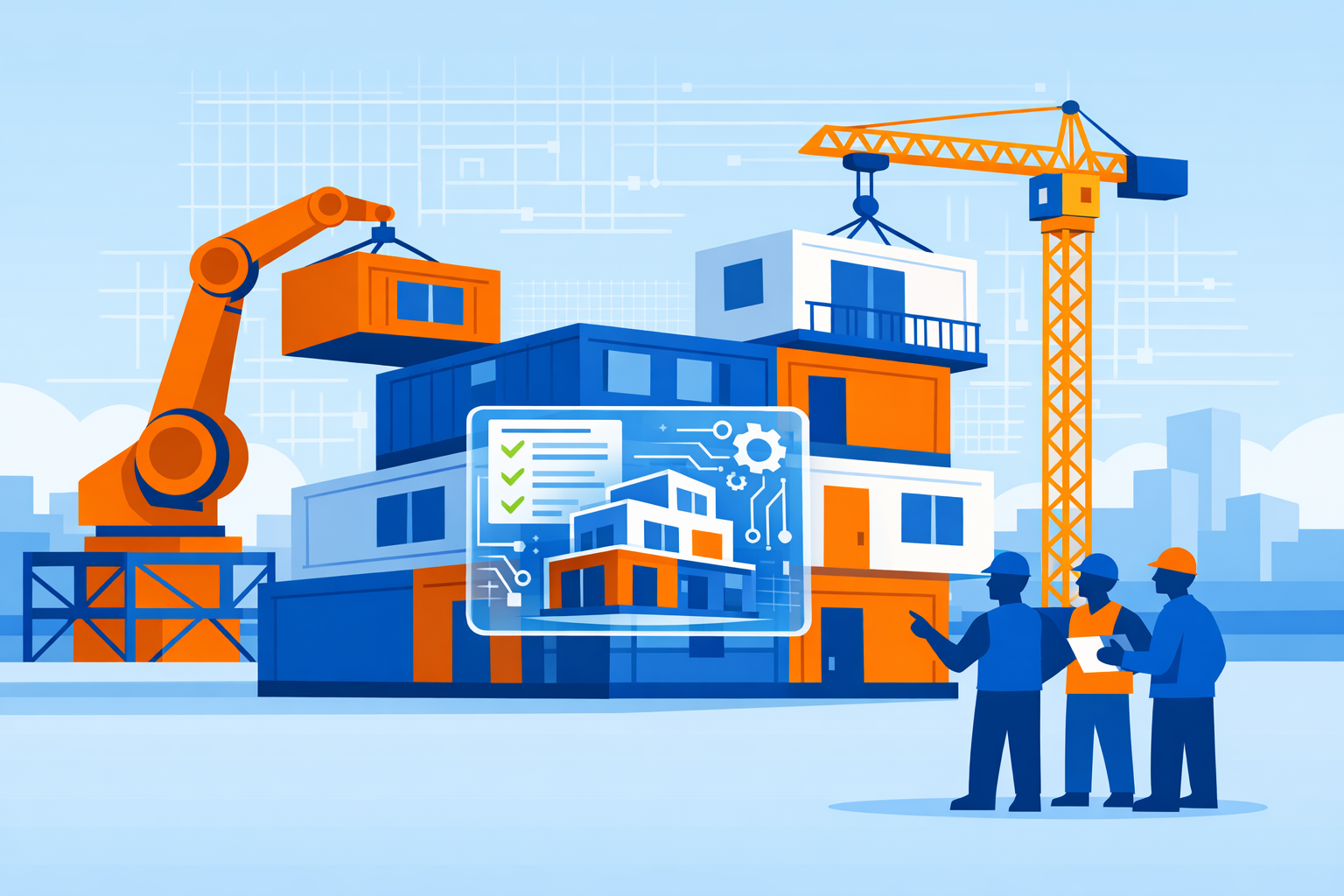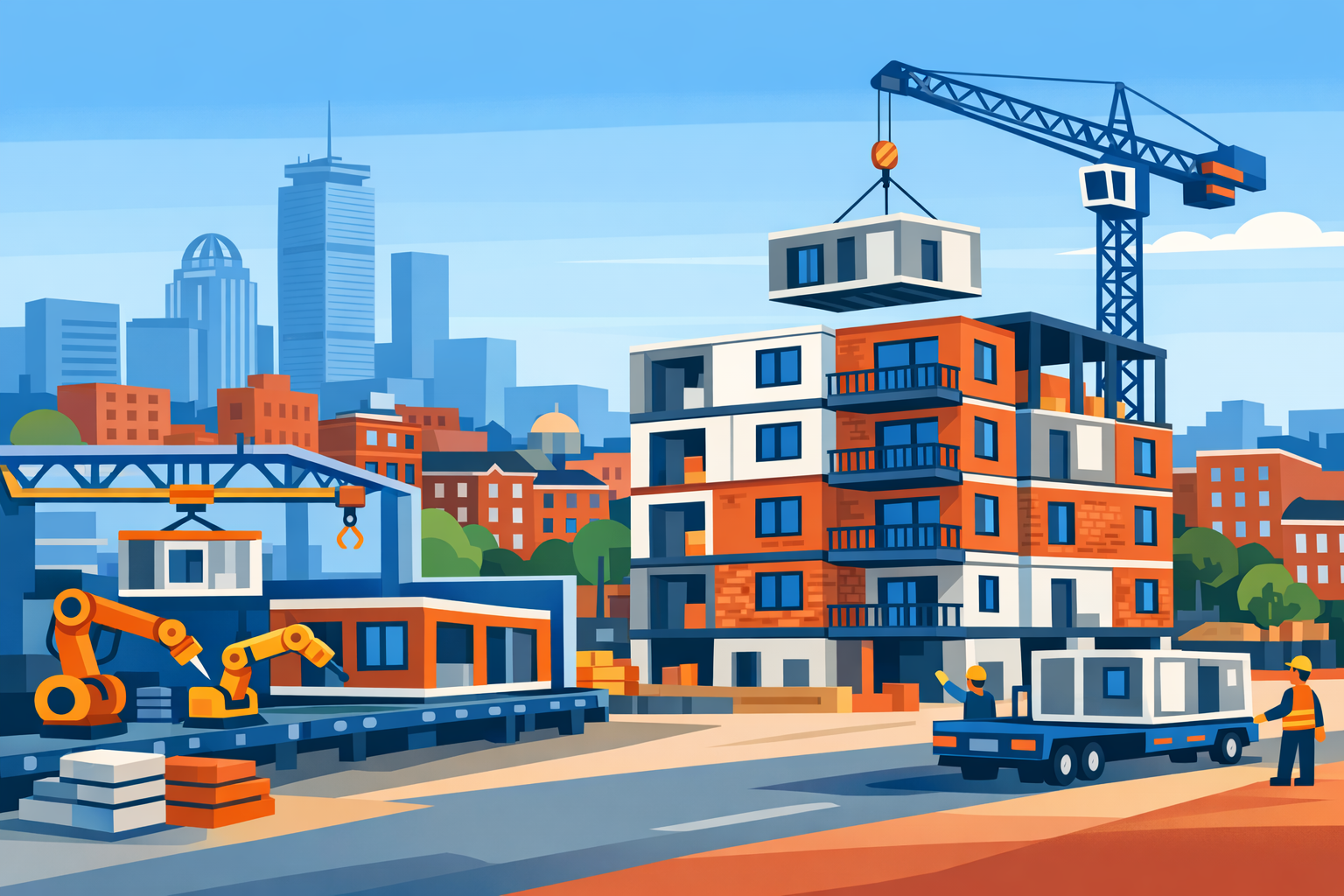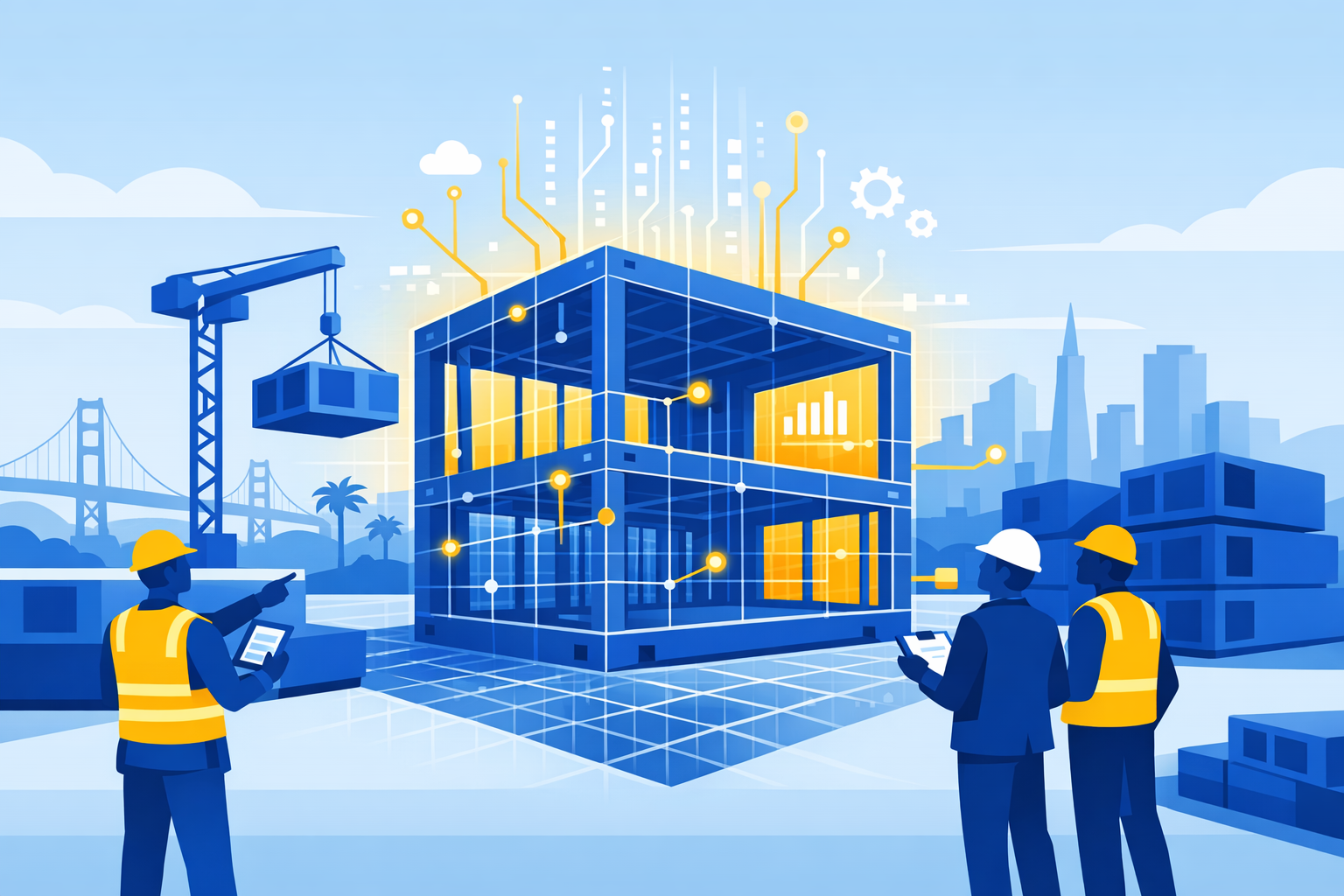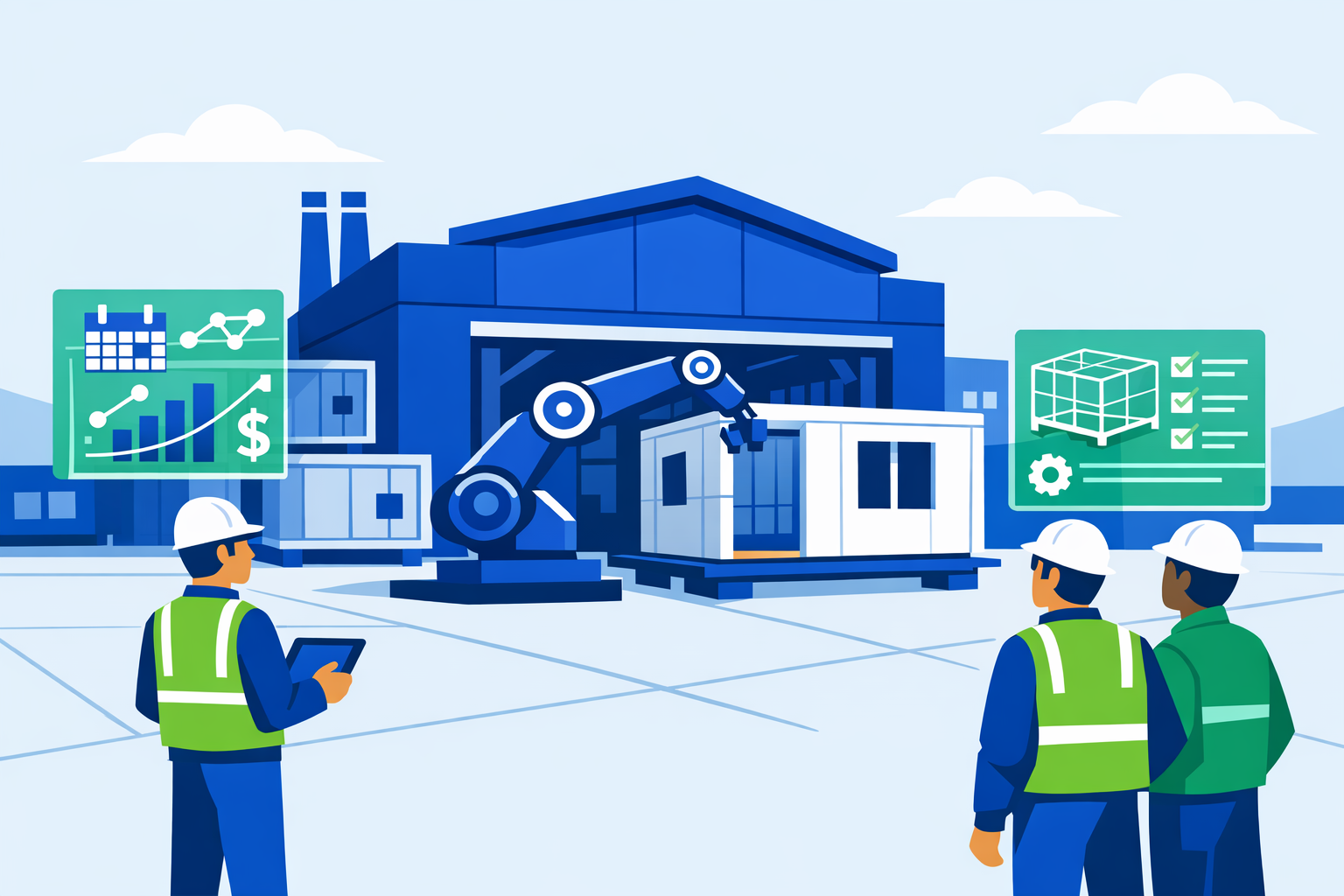
AI-driven robotics and digital twins are advancing from pilot projects to production environments in modular construction factories across North America. Early implementations are yielding measurable improvements in schedule adherence, cost reduction, and safety performance, while also revealing challenges in data integration and governance that will influence which firms achieve sustainable ROI.
This analysis examines performance data from recent projects, evaluates workforce and safety impacts, and outlines a governance framework for owners and contractors exploring AI-enabled offsite construction technologies.
Market Signal: Modular and AI Adoption Are Scaling, Not Experimenting
The North American modular construction market reached approximately US$27.3 billion in 2023, according to a regional market report.[1] While full AI integration covers only a portion of this figure, adoption trends are accelerating.
McKinsey estimates that volumetric modular construction can shorten project durations by 20-50% and reduce costs by up to 20% compared to traditional methods.[2] AI, robotics, and digital-twin platforms are increasingly viewed as critical tools for capturing these efficiencies at scale.
Recent market analysis values the global AI-in-construction sector at US$3.99 billion in 2024, with anticipated growth to US$11.85 billion by 2029-representing a compound annual growth rate above 24%.[3] Construction and engineering executives in North America identify AI as a top investment priority in the near term.
Where ROI Is Emerging: Robotics, Digital Twins, and Automation
Factory Robotics in Modular Housing
Robotics suppliers and modular builders are releasing quantified performance data from automated factories in the residential and mid-rise markets.
- ABB reports that robotic automation at Intelligent City's Canadian modular facility led to a 15% production efficiency increase, a 38% rise in output, and a 30% reduction in material waste.[4]
- A 2025 cost-benefit analysis of modular automation modeled labor, machinery, and energy costs for affordable housing. The study found that automated scenarios reduced annual wage expenses by 51.7% (from US$721,800 to US$348,700) due to streamlined labor complemented by robotics.[5]
These outcomes are consistent with broader evaluations showing significant throughput and ROI gains in modular robotics as factories reach stable production volumes.[5]
Digital Twins for Schedule and Cost Control
Digital-twin construction setups integrating BIM, scheduling (4D), and cost modeling (5D) are transitioning from research trials to field deployments in North America.
A 4D/5D digital-twin pilot on a mid-rise project in Dallas-Fort Worth reported a 43% reduction in estimating labor and a 6% drop in overtime, maintaining on-time completion.[6] Though not exclusively modular, these platforms can support offsite manufacturing workstreams.
Offsite-centric digital twins are also advancing within factories. Firms such as DIRTT connect parametric design data directly to fabrication lines, creating a product-and-factory twin that coordinates design, manufacturing, and installation.[7]
Comparative View: ROI Signals Across Technology Layers
| Technology layer | Representative early benefits in offsite use | Primary constraints at this stage |
|---|---|---|
| Factory robotics (framing, milling, assembly) | 15-40% higher line efficiency; up to ~50% modeled labor-wage savings at volume | High capex; need for standardized products and steady demand |
| Digital twins (4D/5D, factory + product) | 40%+ reductions in estimating effort; measurable cuts in overtime and rework | Data integration with legacy BIM/ERP; model governance |
| AI-assisted planning/QC (vision, optimization) | Faster clash detection, schedule optimization, automated inspections | Data quality, lack of labeled datasets, fragmented standards |
Values reflect reported and modeled ranges from recent studies; results vary by project scope and maturity.[5]
Workforce and Labor-Market Implications
Skills Shift, Not Simple Substitution
Evidence from automated modular plants indicates workforce restructuring instead of widespread job eliminations.
Facilities such as Autovol and Intelligent City combine robotics technicians, software engineers, and traditional trades on production lines.[8] Operators supervise multiple robotic cells, prioritize exception handling and quality control, and conduct preventive maintenance, while repetitive and hazardous tasks shift to automation.
In modeled scenarios, labor-cost reductions result largely from higher worker productivity and the removal of repetitive tasks, not from elimination of all craft roles.[5] This trend is increasing demand for skills in mechatronics, data management, and BIM-driven production.
Safety Outcomes and New Risk Profiles
Studies of construction robotics highlight both safety improvements and emerging risks.
- Case studies show significant decreases in ergonomic strain and hazardous exposure, alongside cost and schedule advantages-including a 41% cost reduction from material-handling robot deployment.[9]
- A scoping review of robotics safety identified 77 robot-related accidents in U.S. OSHA Severe Injury Reports from 2015 to 2022.[10]
U.S. safety authorities and standards organizations emphasize structured governance. NIOSH references ANSI/RIA R15.06 and ISO/TS 15066 standards to define safe human-robot interactions and limit contact forces.[11] For modular factories, this points to rigorous risk assessments, virtual fencing, and layered sensing for collaborative robots.
Governance, Data Readiness, and Interoperability Hurdles
Data Foundations for AI and Digital Twins
Industry specialists note that performance bottlenecks in AI are often caused by data fragmentation rather than limitations of the technology itself.[12] Common challenges include:
- Inconsistent BIM practices between design and factory teams
- Limited adoption of common data environments among project stakeholders
- Insufficient labeling of historical data on quality, defects, and schedules for AI model training
Without robust data pipelines spanning design, factory production, and on-site assembly, AI tools for planning, scheduling, and quality control remain siloed.
Avoiding Vendor Lock-In and Siloed Digital Twins
Offsite factories depend on integrated platforms, including design tools, MES/ERP, robotics controllers, and digital-twin systems. However, many implementations remain vendor-specific.
Recent digital-twin solutions promote open APIs and composable apps, but integrations still typically require custom connectors and middleware.[13] Progress at the asset and city-scale twin level has outpaced integration within modular factories.[7]
For owners and general contractors, this raises strategic concerns: factory data, AI models, and digital twins closely tied to a single provider can constrain future procurement choices.
Actionable Roadmap for Owners, Contractors, and Developers
Organizations assessing AI-enabled offsite construction should focus on three immediate priorities highlighted by North American pilots and research:
Treat data as capital equipment.
- Implement project-wide BIM standards and naming conventions compatible with factory MES/ERP systems.
- Clarify ownership and retention of production, sensor, and quality data in contracts.
Phase robotics and AI based on ROI clarity.
- Begin with defined factory tasks (panel milling, repetitive framing, layout) where automation already demonstrates cost and safety benefits.
- Pair initial robotics with targeted digital-twin pilots addressing specific use cases, such as schedule risk management or automated progress verification.
Formalize governance for safety and ethics.
- Align robotics deployment with established safety standards (ANSI/RIA, ISO/TS 15066) and conduct independent risk assessments.
- Develop internal AI governance protocols covering model validation, bias mitigation in scheduling and workforce tools, and cybersecurity for control systems.
As offsite construction in North America expands through larger automated facilities and broader AI integration, organizations focused on data readiness and structured governance are positioned to achieve sustained improvements in construction ROI.
Frequently Asked Questions
How quickly are AI and robotics paying back in modular construction?
Early case studies indicate that payback periods depend significantly on production volume and standardization. In modular housing, increases of 15-40% in line efficiency and modeled wage-cost reductions over 50% suggest potential payback within several years once steady throughput is achieved.[5]
Are AI and robotics eliminating construction jobs in offsite factories?
Current evidence indicates workforce transformation rather than net job loss. Automated modular plants reduce low-skill, repetitive work, while creating new roles for technicians and digital specialists.[14] Long-term employment effects will depend on facility growth rates and investment in skill development.
What are the biggest barriers to scaling digital-twin construction in modular projects?
Key barriers include fragmented data, non-standardized BIM workflows, and limited interoperability between design, factory, and field systems.[7] Many digital-twin deployments remain project-specific, with limited reuse of models or data architectures.
How do AI-enabled modular factories affect project safety?
Robotics can reduce exposure to lifting, dust, and repetitive strain, but introduce risks related to collisions and control failures. Studies document reduced ergonomic hazards and injuries, but also robot-related incidents linked to inadequate governance.[9] Comprehensive risk assessments, defined operating boundaries, and adherence to established safety standards are required.
What should owners require in contracts to avoid vendor lock-in?
Owners are increasingly specifying open data formats (IFC, open APIs), explicit rights to project and operational data, and the ability to export digital-twin models to independent platforms.[13] Including these requirements in RFPs helps prevent long-term vendor dependence and supports competitive procurement for future lifecycle needs.