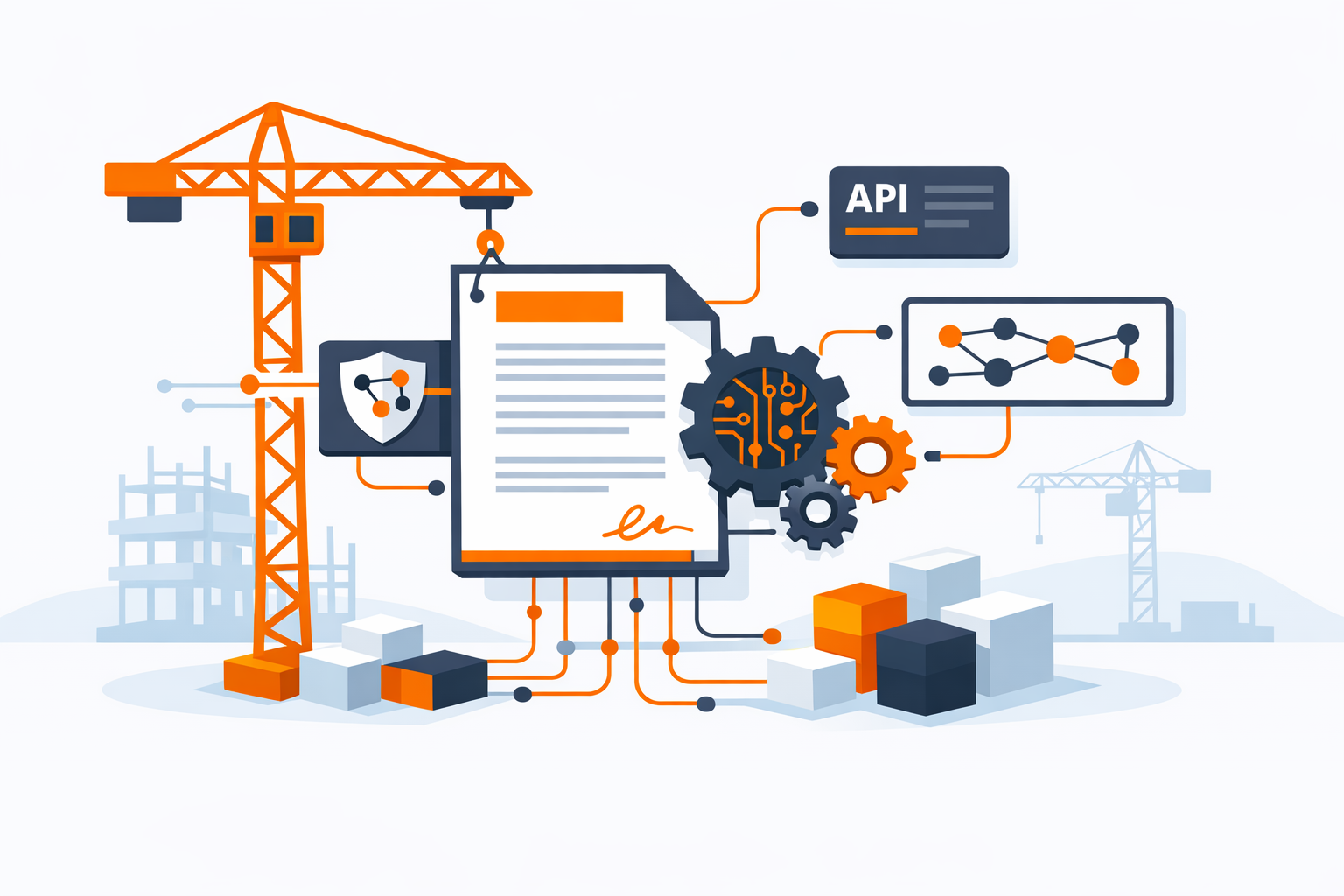
Executive summary. Trimble's agreement to acquire Document Crunch marks a significant step in construction technology consolidation, positioning AI-driven contract intelligence at the core of project management and ERP platforms. This move reinforces Trimble's strategy to become the primary digital construction system of record, while highlighting critical industry questions about interoperability, API standards, and future data governance in mixed software environments.
Deal Overview: An AI Contract Engine for Trimble Construction One
Key facts about the transaction
On April 2, 2026, Trimble announced it had signed an agreement to acquire Document Crunch, an AI-powered contract and document analysis platform focused on construction risk management; financial terms were not disclosed.[1] Trimble expects the transaction to close later in 2026, with Document Crunch to be reported within its AECO software segment.[1] Document Crunch's technology has been deployed on more than 10,000 projects and is used by over 500 general contractors and construction managers.[1] The company has raised at least $37 million in venture capital prior to the acquisition.[2]
Trimble aims to embed Document Crunch's "contractual rule set" across the Trimble Construction One (TC1) ecosystem, transforming contracts, specifications, and insurance documents into structured data for use in project management, ERP, and field applications.[1]
Core functional objectives cited by Trimble include:[1]
- Automated identification of high-risk provisions, such as payment terms, notification windows, and scope gaps.
- Standardized playbooks for contract review across project teams.
- Integration of obligations and compliance checkpoints into project management and ERP systems.
- Reduced administrative effort in risk reviews, project playbooks, and delay notices.
Where Document Crunch fits in Trimble's stack
Trimble has built a broad construction technology portfolio including BIM software (Tekla Structures), collaboration solutions (Trimble Connect), project management (ProjectSight), ERP platforms (Viewpoint Vista and Spectrum), and heavy civil tools (B2W).[3] In 2018, Trimble acquired Viewpoint, a construction management and ERP provider, for approximately $1.2 billion.[4] In 2022, Trimble acquired B2W Software, expanding its civil construction portfolio with estimating, tracking, and maintenance modules.[5]
Document Crunch is positioned as a risk and compliance intelligence layer that connects with:
- ProjectSight, already partner-integrated for contract risk review and document management.
- Trimble Construction One ERP and financials, to align payment terms, change orders, and lien waivers with contract language.
- BIM and digital construction tools such as Trimble Connect and Tekla, linking model-based workflows to contractual obligations and acceptance criteria.[1]
Document Crunch users report reducing contract review times by up to 80% using AI-driven summaries and risk flags.[6] At scale, embedding these capabilities into core project management and ERP platforms could reshape preconstruction and project controls processes.
ConTech Consolidation and the Push Toward Platform Models
A deal aligned with the "system of record" race
The acquisition comes amid increased M&A activity in construction technology.
Global data indicates that construction tech mergers and acquisitions averaged about 100 deals per year in 2024-2025, as companies consolidate point solutions into integrated platforms.[7] The North American construction industry-nearly a $4 trillion market-is at a digital turning point, with job openings 50% higher in 2020-2024 than 2015-2019, and 98% of firms planning technology investments to counter labor shortages.[7]
These trends favor providers that can:
- Deliver end-to-end project management across preconstruction, construction, and financials.
- Serve as the system of record for operational, financial, and contractual data.
- Apply AI and analytics to improve productivity, reduce risk, and support decision-making.
Trimble, Autodesk, and Procore each aim to anchor such ecosystems.[8] The Document Crunch acquisition supports Trimble by:
- Converting contracts to queryable data objects rather than static PDFs.
- Aligning contractual risk data with cost codes, schedules, and RFIs in a unified model.
- Building a data repository around historical contract, specification, and claims information.
AI contract intelligence as a differentiator
The deal highlights the expanding role of AI in construction software.
Market forecasts expect the global AI in construction market to reach approximately USD 7.63 billion by 2032, with a CAGR of about 34.5% from 2024 to 2032.[9]
Within this trend, contract and document intelligence is seen as high-value, given its impact on profit margins, claims, and cash flow. Document Crunch's domain-specific language models, trained on construction contracts and specifications, support this market direction.[2]
By owning this AI capability, Trimble can:
- Incorporate AI contract review at every project phase-bid, award, change order, closeout.
- Integrate risk scores and obligations into budgeting, scheduling, and progress monitoring tools.
- Provide differentiated workflows with auditable, AI-supported decision trails for owners and contractors.
Interoperability: OpenBIM Commitments vs Platform Gravity
Trimble's stated OpenBIM posture
Trimble maintains a public commitment to an open BIM approach. Company materials describe IFC (Industry Foundation Classes) as a key exchange format for OpenBIM and state that Trimble "pursues an open BIM concept," supporting IFC and BIM Collaboration Format (BCF) workflows via Tekla Structures and Trimble Connect.[10]
Trimble's BIM collaboration platform is marketed as API-friendly, connecting ERP systems and document management tools via open interfaces.[11] ProjectSight and Construction One also emphasize integration with Viewpoint ERPs, B2W, reality capture, and third-party tools.[12]
As Document Crunch is further embedded into Trimble's offerings, maintenance of robust REST APIs and neutral export formats for AI-derived contract insights will be important for firms using multi-vendor systems (e.g., Trimble ERP with Procore or Autodesk Construction Cloud).
Potential benefits vs. interoperability risks
The acquisition may lead to more integrated yet potentially less open environments. The table below summarizes impacts for owners, general contractors, and subcontractors.
| Dimension | Potential upside in Trimble-Document Crunch stack | Key interoperability / governance risk |
|---|---|---|
| Contract data structure | AI turns clauses into structured data, standardizing obligations across projects and linking to cost codes, RFIs, and schedules. | Proprietary structures could hinder migration of contract histories to other platforms. |
| BIM & digital construction workflows | Contractual requirements can connect to BIM objects and workflows in Trimble Connect and Tekla. | Non-Trimble BIM software may have limited access if APIs or exports are restricted. |
| Field-office integration | ProjectSight and Viewpoint can surface contract-driven alerts in field and cost workflows.[1] | Third-party project management software users may lose access to advanced features found only in TC1. |
| Analytics & reporting | Unified data across cost, schedule, and contract risk enables richer analytics and AI-driven forecasting. | Maintaining data lineage and audit trails could be challenging if cross-platform sync is incomplete. |
Contractors and owners must assess whether Trimble will:
- Keep Document Crunch as a neutral service with open APIs and data export options, or
- Focus primarily on TC1-centric deployments, incentivizing full-suite adoption.
Trimble's OpenBIM history suggests industry attention will remain focused on how these principles extend to contract and document intelligence layers.
Data Governance: From Static Documents to Governed Contract Data
Contract intelligence as a data-governance backbone
Traditional contract management in construction has centered on PDFs and email, leading to version control challenges, inconsistent metadata, and fragmented risk tracking. Document Crunch within TC1 seeks to convert contracts into governed data assets.
Key data governance outcomes include:
- Standardized clause classification (e.g., payment terms, indemnities, warranties) mapped to workflows.
- Role-based visibility allowing teams to access obligations in context, limiting exposure to unnecessary legal detail.
- Centralized audit trails to document how AI recommendations were generated and implemented.
- Data lineage from contract to action, connecting clauses to change orders, RFIs, submittals, or schedules.
With growing owner and public-sector requirements for auditability, ESG reporting, and compliance, robust governance features are increasingly a prerequisite for complex programs.
Alignment with digital twins and BIM-based delivery
Digital construction increasingly uses BIM and digital twins to manage geometry, schedules, performance, and operational data.[13] Integrating AI contract data with these systems could support:
- Model-linked acceptance criteria and test plans created from contract and specification clauses.
- Digital twin validation steps for contractual performance guarantees and maintenance.
- Improved risk forecasting by combining field data with contractual remedies.
These advancements depend on:
- Data portability across platforms (e.g., exporting contract obligations as open formats compatible with IFC models or external CDEs).
- Clear governance around validation, approval, and updating of AI-interpreted contract data throughout a project's lifecycle.
Strategic Considerations for Construction Leaders
Implications for project management software strategy
For mid-to-large contractors and developers, the Trimble-Document Crunch transaction suggests contract intelligence may soon be standard within project management software, not a specialist add-on.
Key takeaways:
- Platform selection will focus on practical integration of project management, ERP, BIM, and AI risk tools-not just feature lists.
- Vendor evaluations will increasingly weigh contract AI maturity, explainability, and cross-system compatibility.
- Best-of-breed vs. suite strategies may need reconsideration as advanced workflows become exclusive to integrated suites.
Governance and risk management alignment
The acquisition highlights the need to align technology adoption with formal governance:
- Risk and legal teams require standard frameworks for approving AI-derived contract interpretations and managing exceptions.
- Data governance councils should define authoritative contract data sources and rules for synchronizing across platforms.
- Audit and compliance teams need clarity on AI logs, decision trails, and retention, especially for public sector or regulated projects.
Without this foundation, the benefits of AI contract intelligence may be limited by disputes over its outputs at critical project moments.
Actionable Conclusions and Next Steps
Organizations following this deal should consider:
- Mapping current contract data flows: Examine how contracts and specifications are created, entered, and tracked within project management and ERP systems.
- Evaluating interoperability requirements: Identify external platforms (e.g., Procore, Autodesk Construction Cloud) needing contract data access.
- Defining data governance expectations: Specify needs for auditability, AI transparency, and data retention prior to adopting new contract AI tools.
- Stress-testing exit strategies: Assess the ease of contract data migration if vendor relationships change.
- Engaging with vendors on roadmaps: Seek specific commitments from Trimble and others regarding APIs, OpenBIM support, and open data standards for contract intelligence.
As AI use expands, organizations treating contract data as a governed asset, rather than static documentation, are positioned to benefit most from this wave of technology consolidation.
Frequently Asked Questions
What does Document Crunch do in a construction workflow?
Document Crunch uses AI to analyze contracts, specifications, and insurance documents, highlighting critical clauses and risks and generating standardized summaries.[6] It flags unfavorable terms and conflicts, then feeds these insights into structured playbooks and dashboards, enabling consistent understanding and tracking across projects.
How might the acquisition affect existing Document Crunch customers?
Trimble and independent sources report that Document Crunch operations will continue with some independence initially, and that integrations with Trimble ProjectSight and Construction One will expand.[1] Customers should anticipate tighter integration with Trimble platforms, enhanced AI features linked to ERP and field data, and potential changes to packaging or commercial terms as Document Crunch becomes part of the broader suite.
What are the main interoperability questions raised by the deal?
Key questions center on API and data portability. Stakeholders seek assurance that AI-generated contract insights will be accessible through open APIs, that enriched contract data can be exported to neutral formats, and that contract intelligence supports OpenBIM standards such as IFC and BCF.[10]
How does this relate to BIM software and digital twins?
By structuring contract and specification data, Document Crunch can provide rules that connect directly to BIM workflows-for example, assigning acceptance criteria, inspection requirements, or performance guarantees to model objects or digital twin stages.[1] Over time, this could enable automated verification where field data from sensors or reality capture is measured against both BIM models and contractual benchmarks.
What should organizations prioritize when evaluating AI contract tools in light of this acquisition?
Priorities include the specificity of AI models, explainability, override controls, strong integration with project management, ERP, and document management systems, and clarity on data ownership, access, and portability. Market research indicates ongoing platform consolidation, so resilience to vendor lock-in-through open standards, governance, and export features-should factor into evaluations.[7]