Material costs in U.S. housing construction have risen 34% since 2020, while 92% of construction firms report being unable to find enough workers - and conventional modular approaches still depend on factory supply chains hundreds of miles from the build site. A startup operating south of Austin is challenging both constraints at once, using an AI-enabled cable robot to transform on-site dirt into code-compliant, fireproof homes. The implications for affordable housing, sustainable construction, and on-site modular delivery warrant close attention from developers, project managers, and policymakers alike.
What Is Happening in Central Texas
Terran Robotics has completed robotic construction of its first earthen adobe home at Proto-Town, an experimental development community in Lockhart, Texas. The build used an adaptive, AI-enabled cable robot known as the "Terry" system to construct the monolithic wall system entirely from localized, sustainable materials.
The startup is using robots to build homes from clay pulled directly from the ground - a new approach aimed at lowering costs and fundamentally changing how houses are built. Co-founder Daniel Weddle describes the primary material bluntly: "This is the cheapest material to build with. Our goal is affordable housing."[1]
In the western United States, approximately 20% of new homes are already constructed using earth-based methods. What separates Terran's approach is the automation layer replacing centuries of hand labor.
The Technology Stack: How the "Terry" System Works
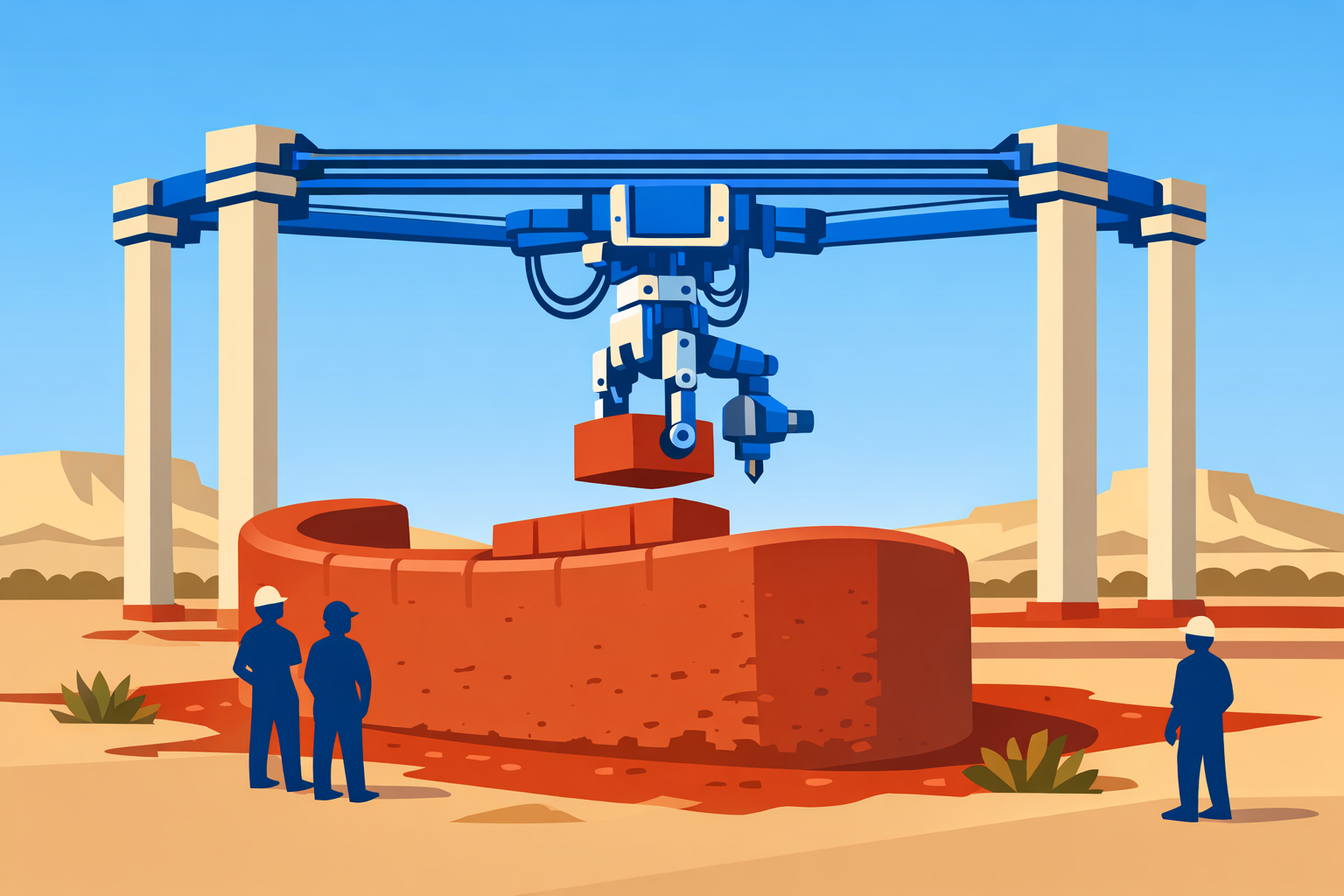
Unlike conventional 3D printers that follow rigid, predetermined digital toolpaths, the Terran Robotics system uses advanced depth cameras and artificial intelligence to evaluate the physical build environment in real time. Operating from a suspended four-pillar cable gantry anchored by earth screws, the robot maintains constant spatial awareness, building topographical heat maps of the wall and identifying low spots and voids on the fly.
The build sequence involves three phases:
- Material preparation: Earthen materials - a natural mix of approximately 20% clay, soil, water, and straw - are sourced directly from the build site. The raw earth is sifted, mixed, and placed immediately, requiring zero structural steel.
- Automated placement: The robot lowers from above, picks up clay with a claw, carries it to the wall, and drops it into place. It then switches tools, using a hammer attachment to pound the material into shape.
- Real-time quality control: Terran walls are code-compliant mass walls built to IRC Appendix U - Cob Construction (Monolithic Adobe). The robot's impulse hammer uses computer vision to scan the wall surface and vibration feedback to sense material hardness, achieving the precision needed to meet structural code without manual intervention.
The robot builds autonomously around the clock, using reinforcement learning and computer vision to optimize every placement. Each build makes the next one faster - leveraging AI capabilities that would have been impossible even five years ago.
Critically, deployment requires minimal crew: with a truck and trailer, two people, and one day, Terran's cable-driven robot can cover a space as large as a football field.
Sustainability Metrics: A Material Advantage
The environmental case for clay-adobe construction is substantial, and Terran's robotics amplify it significantly.
One of the most compelling aspects is what the company calls "zero-mile" sourcing. The clay and soil come directly from the building site - often from the same excavation that creates the foundation. No delivery trucks haul concrete or lumber from hundreds of miles away. The primary ingredient is, quite literally, free. This translates to a dramatic reduction in embodied carbon.
Terran Robotics claims its homes produce 80% less embodied carbon than conventional construction, with zero structural steel required, according to the company's published technical specifications.
The thermal mass of thick adobe walls keeps interiors cool in summer and warm in winter without heavy reliance on HVAC. The homes are also naturally soundproof, fireproof, and mold-resistant - qualities that are difficult and expensive to achieve with conventional stick-frame construction.
Because the walls are zero-VOC (volatile organic compounds), indoor air quality is naturally healthier than in homes built with synthetic insulation and chemically treated lumber.
Regulatory Landscape: Building Codes and Permitting Considerations
For construction professionals evaluating adoption, the regulatory pathway is a central concern. Terran's walls are structured around a specific appendix of the International Residential Code.
The IRC includes appendices for several natural building methods: Appendix U for Cob (2021), Appendix R for Straw-Clay (2015), Appendix Q for Tiny Houses (2018), and Appendix BA for Hempcrete (2024). Terran operates under Appendix U - but adoption is not uniform.
Insurance challenges remain: unpermitted or alternatively built structures may face difficulty obtaining coverage. Natural homes also have a limited buyer pool, and properties may sell at land value only.
The first Texas home includes two adobe walls and two wood-framed sides; the next version is expected to be built entirely from earth. Co-founder Weddle acknowledges that perfecting corners is one of the biggest challenges ahead. Once complete, the walls are coated to protect against storms and long-term wear.
Developers entering this space should treat code compliance not as a solved problem but as an active, jurisdiction-by-jurisdiction due diligence exercise.
Regulatory Note for Developers: Terran Robotics' adobe walls comply with IRC Appendix U - Cob Construction (Monolithic Adobe). However, not all jurisdictions have adopted IRC Appendix U. Project managers should verify Appendix U adoption status with local and county planning departments before pursuing permitting. Texas jurisdictions vary in their adoption of IRC appendices, and some counties may require alternative compliance paths or third-party structural review.
Clay-Adobe vs. Conventional Modular: A Side-by-Side View
| Feature | Traditional Prefab/Modular | Terran Robotics Clay-Adobe |
|---|---|---|
| Primary Material | Timber, steel, concrete | On-site clay, soil, straw, water |
| Material Sourcing | Factory/off-site supply chain | Zero-mile - excavated on-site |
| Embodied Carbon | Baseline (conventional) | ~80% lower than conventional |
| Structural Steel | Required | None |
| Code Compliance | IRC standard chapters | IRC Appendix U (Cob/Monolithic Adobe) |
| Wall System | Framing + insulation + siding + drywall | Single monolithic wall (replaces 4 systems) |
| Fire Resistance | Requires added treatment | Inherently fireproof |
| Thermal Performance | Requires insulation layer | High thermal mass - passive regulation |
| Robot Setup | Off-site fabrication | 2 people, 1 day, football-field coverage |
| Design Flexibility | Modular/panel constraints | Curves and custom features at near-zero extra cost |
| Mold/VOC Risk | Present with synthetic materials | Zero-VOC, mold-resistant |
| Scalability Status | Commercially established | Pilot stage (20+ homes planned 2026) |
This comparison highlights a key differentiator: where conventional modular construction relies on sophisticated off-site manufacturing chains, Terran's model collapses that chain entirely. The supply chain is the site.
Labor, Supply Chain, and Scalability Implications
The Associated Builders and Contractors reports that more than 454,000 additional construction workers are needed to meet industry demand in 2025, underscoring the depth of the ongoing labor shortage. Terran's model addresses this directly - not by replacing skilled trades, but by radically restructuring which tasks require human labor.
Others have attempted similar automated construction approaches, but high material costs have caused those efforts to stall. As co-founder Dwiel notes: "You're reducing the cost of labor with automation, but if you've got expensive materials, the end product is also going to be expensive. In our case, because we're using the clay that's on site as our primary building method, we've got low cost materials, we've got low cost labor, and then our robot is also low cost."
According to founding designer Jacob Bower-Bir, the system can shape walls into curves, sleek modern forms, or traditional looks without significant additional labor. This positions the technology for market segments beyond affordable housing - potentially including custom residential and mixed-use development as the platform matures.
However, geology matters. The suitability of on-site clay varies significantly by region and site. Not every parcel will yield material with the correct clay-to-aggregate ratio for monolithic adobe. Pre-build soil testing should be considered a standard precondition for project feasibility.
Terran has received grant funding from the National Science Foundation, Elevate Ventures, and the Flywheel Fund, and has partnered with Autodesk and ARUP - the engineering firm behind the Sydney Opera House - to refine its technology further.
Expansion Roadmap and Broader Adoption Signals
In Bloomington, Indiana, where the company is headquartered, Terran is building accessory dwelling units (ADUs) on existing residential properties. In Columbus, Indiana, the company is partnering with Chestnut Development to create "pocket neighborhoods" - clusters of multiple homes on plots that traditionally hold a single-family house.
Over the next year, Terran Robotics plans to construct more than 20 similar units at the Proto-Town site, iterating on its software stack to increase processing speed and deliver a highly reliable, low-carbon housing solution for developers.
The approach also sits within a broader wave of on-site robotic construction innovation. ABB Robotics, through a collaboration with Cosmic Buildings, is deploying mobile robotic microfactories to build modular structures on-site in areas devastated by the 2025 Southern California wildfires - offering a glimpse of AI-enabled construction in disaster-recovery contexts. That parallel development signals growing industry confidence in on-site, AI-driven fabrication as a viable alternative to traditional prefab delivery.
For developers, construction robotics data standards remain an adjacent challenge to watch: as Terran's platform matures and integrates with BIM workflows, interoperability with broader project management ecosystems will be critical for mid-to-large-scale deployment.
What Developers, Policymakers, and Insurers Need to Act
For this technology to move from pilot to mainstream, several parallel tracks must advance:
- Developers should begin soil feasibility assessments and engage early with local planning departments on IRC Appendix U adoption status. Early-mover projects in clay-rich regions such as Texas, the Southwest, and parts of the Midwest carry the strongest natural material advantage.
- Policymakers can accelerate adoption by formally adopting IRC Appendix U at the state and local level, establishing third-party testing protocols for robotic adobe construction, and including clay-adobe systems in affordable housing subsidy eligibility.
- Insurers face an evaluation challenge: adobe structures built to IRC Appendix U are fireproof and mold-resistant, yet some insurers continue to treat non-conventional materials as elevated risk, potentially limiting financing and resale liquidity for early projects. Updated actuarial models reflecting the proven durability of earth-based masonry - structures built with similar materials have stood for over 1,000 years - would better align with actual risk profiles.
The Texas pilot at Proto-Town is, by any measure, a modest-scale experiment. But its design logic - eliminate the supply chain, automate the labor, use what's already on the ground - has structural implications that extend well beyond a single ranch south of Austin.
Key Takeaways
- Terran Robotics completed its first AI-built clay-adobe home at Proto-Town, Lockhart, Texas in April 2026, with 20+ additional units planned within twelve months.
- The "Terry" cable robot uses machine learning, depth cameras, and a pick-place-hammer sequence to build IRC Appendix U-compliant monolithic adobe walls autonomously, 24/7.
- Material cost advantage is substantial when clay is available on-site: zero structural steel, zero framing lumber, and zero concrete trucks required.
- Claimed embodied carbon reduction is 80% versus conventional construction, with added performance benefits including fire resistance, mold resistance, and passive thermal regulation.
- Regulatory variability is the primary near-term barrier: IRC Appendix U adoption differs by jurisdiction, and insurance frameworks have not yet caught up to earth-based construction's actual risk profile.
- Scalability requires pre-build soil testing, regional geology assessment, and jurisdiction-specific permitting due diligence - this is not a one-size-fits-all deployment.
- The model complements, not replaces, skilled trades: mechanical, electrical, and finish trades remain integral to project delivery, with the robot focused exclusively on the wall system phase.