Construction software has long been sold on the promise of consolidation - one platform to replace the chaos of disconnected spreadsheets, email threads, and siloed field data. Procore Technologies built its market position on exactly that premise. But as the construction SaaS market matures and open data standards reshape the competitive landscape, a closer reading of Procore's strategic position reveals something more nuanced than simple platform dominance: a deliberate pivot toward interoperability as the next competitive moat.
For construction professionals evaluating software upgrades, integration roadmaps, or long-term vendor commitments, understanding where Procore stands - and why - offers a sharper lens on where the entire sector is heading.
The Strength Case: Scale, Retention, and Lifecycle Coverage
Procore's competitive moat rests on breadth and stickiness. The company reported a gross revenue retention rate of 94% and a net revenue retention rate of 106% for 2024 - metrics that signal not just satisfaction but deep operational entrenchment. Once a firm's project documents, RFIs, submittals, and financials live inside Procore, migration carries significant cost and disruption risk.
Analysts highlight the company's strong competitive position, with a reported 63% combined win rate against top competitors for FY22-FY24 YTD as of September 30, 2024. That win rate holds even as Autodesk Construction Cloud - the most direct enterprise rival - has expanded aggressively.
As of December 31, 2024, Procore reported full-year revenue of $1.152 billion, a 21% year-over-year increase. The company projects 12% year-over-year growth for full-year 2025, with non-GAAP operating margin expected between 13% and 13.5%. These figures confirm commercial momentum, but the decelerating growth rate from prior years is also a structural signal: the easiest markets are already converted.
Procore combines financial management, field operations, reporting, and document control into a single ecosystem, reducing the need to manage multiple disconnected construction applications. That lifecycle coverage - spanning preconstruction through closeout - is the platform's most durable differentiator at the enterprise tier.
The Weakness Exposure: Lock-In, Pricing Opacity, and Scheduling Gaps
The same stickiness that makes Procore attractive to enterprise buyers is increasingly framed as vendor lock-in by mid-market operators. Online reviewers frequently note that the platform can feel overwhelming for new users due to the large number of modules, settings, and administrative workflows involved.
Scheduling remains a persistent gap. While Procore handles construction administration well, many users find its scheduling and task management capabilities less advanced than specialized project management platforms. Advanced scheduling workflows often still require Primavera P6 or Microsoft Project integrations, meaning Procore functions more as a coordination layer than a full scheduling engine.
Pricing opacity compounds adoption friction. Procore follows a custom pricing model based on company size, active projects, and selected modules, providing quotes individually rather than publishing standard pricing tiers. Custom middleware can cost USD 50,000 per connection, so firms evaluating total cost of ownership must account for both subscription fees and integration infrastructure - a burden that disproportionately affects contractors below the $50 million annual turnover threshold.
The Opportunity Signal: Interoperability as the Next Frontier
The most strategically significant development in Procore's current positioning is not its financial performance - it is the deliberate move toward open, interoperable architecture.
The company has announced two major evolutions to the Procore Ecosystem: the introduction of Agentic APIs and a shift to a Managed, Trusted Marketplace while maintaining an Open Platform. These Agentic APIs are built on Procore's Datagrid infrastructure - sophisticated endpoints designed for deep search across PDFs, images, and videos, with agents that take action across software stacks and provide verifiable answers.
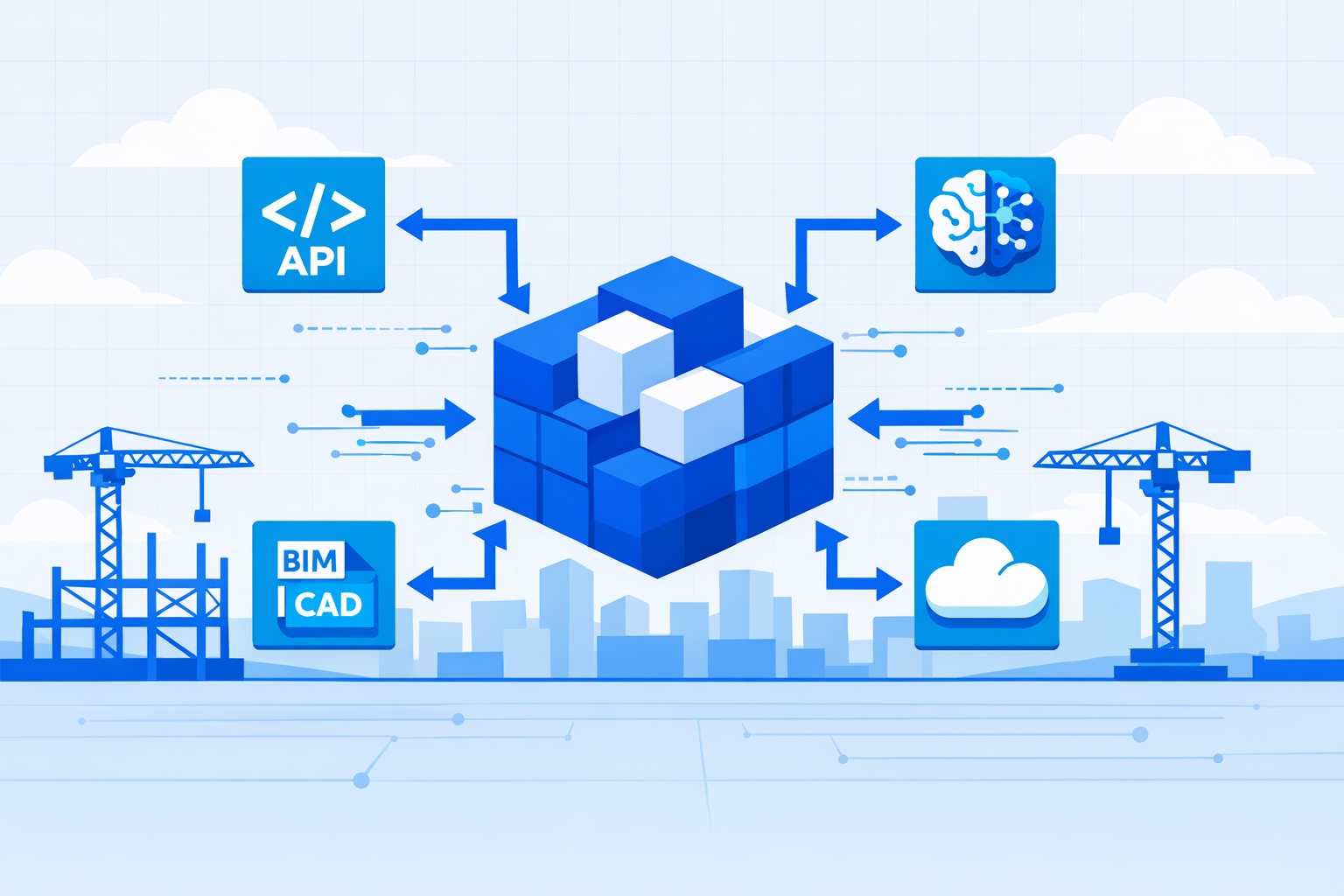
The NVIDIA partnership demonstrates what this architecture enables in practice. Procore will act as the central hub, automatically translating and syncing complex 3D models from over 15 different BIM and CAD formats into one live digital twin. By synchronizing project data and leveraging OpenUSD - the open-source industry standard for 3D interoperability - the framework aims to ensure owners receive an asset fully optimized for operations at handover.
The AWS collaboration reinforces the same direction. Procore has entered a multi-year Strategic Collaboration Agreement with Amazon Web Services to accelerate AI capabilities, enhance data interoperability, and improve project outcomes. Procore will integrate Amazon Bedrock large language models into its platform, giving customers choice and flexibility in AI solutions.
International revenue grew 18% year-over-year in Q1 2025 on a constant currency basis, pointing to a second major opportunity dimension: markets that remain significantly under-digitized. Cloud-based construction management solutions are growing at 17.5% annually, with Southeast Asia, India, and the Middle East representing the highest-growth frontiers.
This pivot matters for construction firms because it signals that Procore is positioning interoperability not as a concession to competition but as a product strategy - one that reduces the all-or-nothing adoption calculus that has historically slowed enterprise deals.
The Threat Landscape: Open Standards and the Upstream Land Grab
Procore's pivot toward openness is not entirely voluntary. Two structural threats are forcing the issue.
Open standards eroding proprietary moats. Innovation increasingly hinges on AI and interoperability, and the average contractor runs 11 discrete applications, yet just one-third exchange data without manual workarounds. As global interoperability standards - including IFC extensions and emerging construction data schemas - mature (detailed in the Global Interoperability Standard Enables Unified Construction Tech Workflows analysis), niche vendors can increasingly plug into shared data layers without building full platforms. The proprietary data advantage diminishes when structured project data can flow across any certified tool.
Autodesk's upstream land grab. Autodesk expanded upstream by acquiring Forma, moving earlier into feasibility and zoning analysis so that construction-phase competitors face an incumbent long before ground breaks. If Autodesk becomes the platform of record at the design and preconstruction stage, Procore risks being introduced as a downstream handoff rather than a foundational system - a materially weaker commercial position.
The top five suppliers - Oracle, Autodesk, Procore, Trimble, and Bentley Systems - collectively captured roughly 45% of 2025 revenue, leaving ample space for specialists focused on residential builders or owner-operator handover workflows. That fragmentation means Procore must defend both above (against platform giants) and below (against nimble point solutions) simultaneously. As covered in the Trimble-Document Crunch M&A analysis, rivals are also actively acquiring AI contract intelligence to deepen their own system-of-record claims.
SWOT at a Glance
| SWOT Dimension | Key Signal | Implication for Construction Firms |
|---|---|---|
| Strength | 94% gross revenue retention; 63% win rate vs. top competitors | High switching costs entrench Procore as the default system of record |
| Strength | Full project lifecycle coverage from preconstruction through closeout | Reduces integration overhead for multi-phase project teams |
| Weakness | Steep learning curve; limited native scheduling depth | Firms still rely on Primavera P6 or MS Project, raising total TCO |
| Weakness | Opaque custom enterprise pricing; no published tiers | Budget predictability challenges for mid-market contractors |
| Opportunity | Agentic APIs, NVIDIA/AWS partnerships enabling cross-platform AI | AI agents can query Procore data across stacks without full migration |
| Opportunity | International expansion - 18% YoY intl. revenue growth (Q1 2025) | Emerging markets represent a structurally under-digitized runway |
| Threat | Open standards (IFC, OpenUSD) reduce proprietary data moat | Niche vendors can compete on the same data layer with lower build cost |
| Threat | Autodesk's upstream Forma acquisition secures design-phase incumbency | Procore risks being positioned as a downstream handoff tool |
What This Means for Software Strategy in 2025 and Beyond
The Procore SWOT is ultimately a proxy for a broader question facing every construction firm evaluating SaaS platforms: is the goal to adopt a unified system of record, or to build a best-of-breed stack connected by open APIs?
Procore's current positioning suggests the answer is increasingly "both." While its Marketplace is becoming more curated, the platform remains open - customers with niche integrations that do not meet broad Marketplace criteria can still access third-party integrations, retaining control over data and tech stacks.
Interoperability has now overtaken price as the top evaluation criterion in construction software procurement, according to market analysis from Mordor Intelligence. Vendor roadmaps now emphasize open APIs and regional data centers as primary differentiators.
Remote collaboration became routine during the pandemic, and the associated opex model convinced finance chiefs that subscription software delivers a faster return than capital-intensive servers. Construction and engineering firms subsequently lifted cloud budgets 18% year over year.
For project managers, technology leads, and directors of operations, the practical implication is clear: the next phase of construction SaaS adoption will be defined not by which platform has the most features, but by which platform can connect most reliably to everything else on the jobsite. Procore's strategic signals - Agentic APIs, NVIDIA digital twin integration, AWS Bedrock LLMs, and a Managed Marketplace - are all bets on that thesis.
Key takeaway for software evaluators: Firms sourcing platforms in 2025 should require vendors to demonstrate real-time, bidirectional API connectivity - not just one-way data exports - before committing to multi-year SaaS agreements. The strength of a platform's partner ecosystem is now as important as the depth of its native feature set.
Frequently Asked Questions
What is Procore's market share in construction management software? In 2024, Procore held the leading market share for construction applications at 7.4%.
What are Procore's biggest competitive risks? The two primary structural threats are Autodesk's upstream expansion into the design and preconstruction phase and the emergence of open interoperability standards that lower barriers for niche vendors to compete without building full platforms.
What are Agentic APIs in the context of Procore? Procore is building a new class of Agentic APIs on its Datagrid infrastructure - sophisticated endpoints designed for deep search across PDFs, images, and videos, with agents that take action across software stacks. Whether used for AI agents, semantic search, or reality capture, these APIs bring computation to the data and will be monetized via a flexible consumption model.
How does Procore compare to Autodesk Construction Cloud? Autodesk Construction Cloud (ACC) offers deep integration with BIM and CAD software, making it ideal for design-driven or preconstruction-heavy workflows through a unified environment connecting design, cost, and field execution. Procore excels in field operations, document control, and financial management - making platform selection a function of where a firm's highest-value workflows are concentrated.
Is Procore suitable for smaller contractors? Procore is often considered too complex and costly for small teams, with users frequently citing a steep learning curve, long onboarding time, and higher overall cost as drawbacks. Lighter tools typically offer a better fit for contractors managing fewer concurrent projects.