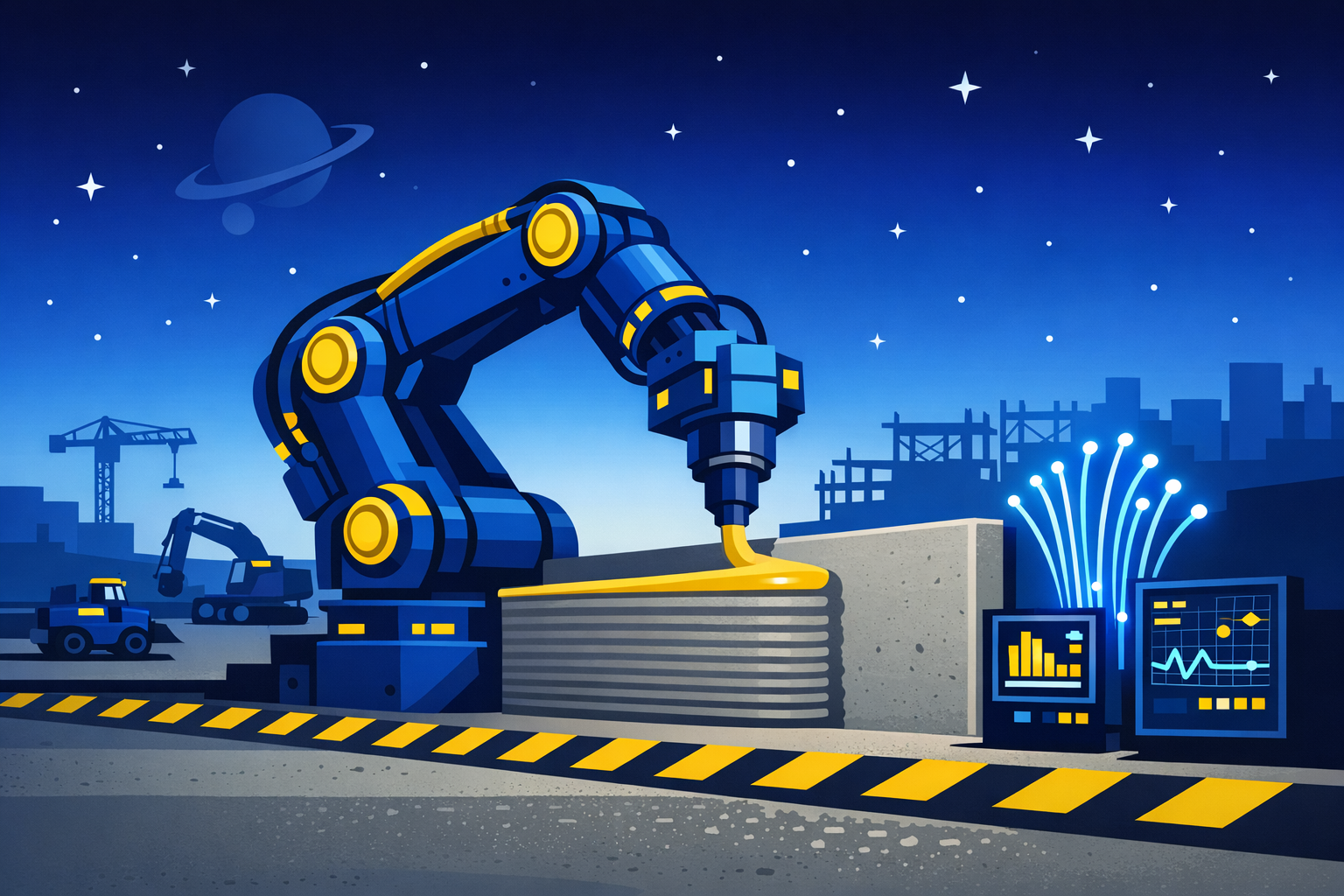
Space-developed robotics, advanced fiber optic sensors, and autonomous 3D printing systems are moving from NASA research programs to commercial construction sites across the United States, driven by a growing series of technology transfer agreements and industry partnerships.
NASA's Technology Transfer program - which identifies roughly 1,600 new technologies a year with diverse commercial applications according to the agency's own records - has accelerated the flow of space-grade instrumentation into terrestrial industry, with construction emerging as a primary beneficiary.
Background
The pipeline from orbit to job site is not new, but its pace and commercial depth have intensified. NASA's annual Spinoff publication, which has documented more than 2,000 commercial technologies since it began in 1976, highlighted in its 2025 edition that at least one company had invented lunar 3D printing technology and was now deploying it to print large-scale structures on Earth. That company - Austin, Texas-based ICON Technology - has become the most prominent example of space tech crossing into mainstream construction.
NASA awarded ICON a six-year, $57.2 million Phase III SBIR contract for lunar surface construction technology, building on a collaboration that began with the agency's 3D Printed Habitat Challenge. Under the agreement, ICON's Vulcan 3D printing system was used to construct a 1,700-square-foot simulated Martian habitat at NASA's Johnson Space Center in Houston as part of the CHAPEA program. The same core technology - a robotic concrete extrusion system - has since been used to build more than 200 homes and structures on Earth, including a 100-home community in Georgetown, Texas, developed with homebuilder Lennar.
The construction robotics sector is absorbing these developments within an already expanding market. The construction robotics market was valued at $14.8 billion in 2025 and is projected to reach $52.7 billion by 2034, growing at a compound annual growth rate of 15.2%, according to market research firm Dataintelo. The infrastructure segment is the fastest-growing category, forecast to expand at a CAGR of 17.3% as public investment programs drive adoption of autonomous machinery across roads, bridges, tunnels, and utilities.
Labor shortages are reinforcing demand for automation. The Associated Builders and Contractors reported that more than 454,000 additional construction workers are needed to meet industry demand in 2025, according to Texas A&M University's College of Architecture, which cited the figure in a July 2025 review of construction robotics. Autonomous machines have demonstrated productivity gains of 20% to 35% compared with conventionally operated machinery on major infrastructure projects, according to Dataintelo data citing deployments by companies including Built Robotics and Komatsu.
Details
Beyond 3D printing, NASA's Fiber Optic Sensing System (FOSS) - originally developed at Armstrong Flight Research Center to monitor stress in test aircraft - has entered commercial construction applications. FOSS uses optical fibers embedded with thousands of sensors to measure real-time engineering parameters including shape, stress, temperature, pressure, and operational load, according to NASA's Technology Transfer Portal. The system processes information at rates up to 100 times per second along a fiber the thickness of a human hair, providing up to 2,000 data points per 40-foot length.
The technology was licensed to Austin-based company 4DSP in 2011, which commercialized it before spinning off Sensuron in 2015 to continue development and sell products worldwide. The sensor system is now being applied to monitor structural integrity in bridges - a direct parallel to structural health monitoring on high-rise and infrastructure construction sites. NASA's Armstrong Flight Research Center is actively seeking additional commercial licensing partners for the full FOSS portfolio.
On the robotics front, NASA's Fly Foundational Robots (FFR) mission will fly and operate a commercial robotic arm from Motiv Space Systems in low Earth orbit, with a planned launch in late 2027, according to a December 2025 NASA announcement. The agency stated that advancing such robotic systems in space "could also enhance our understanding of similar technologies on Earth across industries including construction, medicine, and transportation," according to NASA's Space Technology Mission Directorate. Motiv Space Systems received a NASA Small Business Innovation Research Phase III award to supply the mission's robotic arm system.
In February 2025, ICON launched an experiment called Duneflow aboard a Blue Origin reusable rocket as part of NASA's Flight Opportunities program, testing how lunar soil behaves in reduced gravity - findings that will inform autonomous construction techniques for both Moon and Earth applications.
For the broader industry, semi-autonomous platforms are enabling one operator to supervise multiple machines simultaneously from a remote control center, guided by cameras and GPS, according to a May 2025 review of autonomous construction equipment trends. Self-driving site vehicles use sensors to detect hazards and automatically shut down or reroute, reducing exposure to the construction industry's leading accident causes including falls, struck-by incidents, and electrocutions.
Outlook
NASA's MMPACT (Moon to Mars Planetary Autonomous Construction Technologies) project, managed at Marshall Space Flight Center, continues to fund large-scale robotic 3D printing research with ICON and academic partners, with additional funding possible upon demonstrated performance milestones. Construction technology professionals should expect NASA's Patent Remix Challenge - which drew 45 submissions across 26 U.S. states between October and December 2025 - to generate further licensing leads connecting space-grade innovations with commercial builders. Workforce training pipelines will require parallel investment: an existing post on this publication has examined how data standardization gaps continue to slow construction robotics adoption even as hardware capabilities advance.