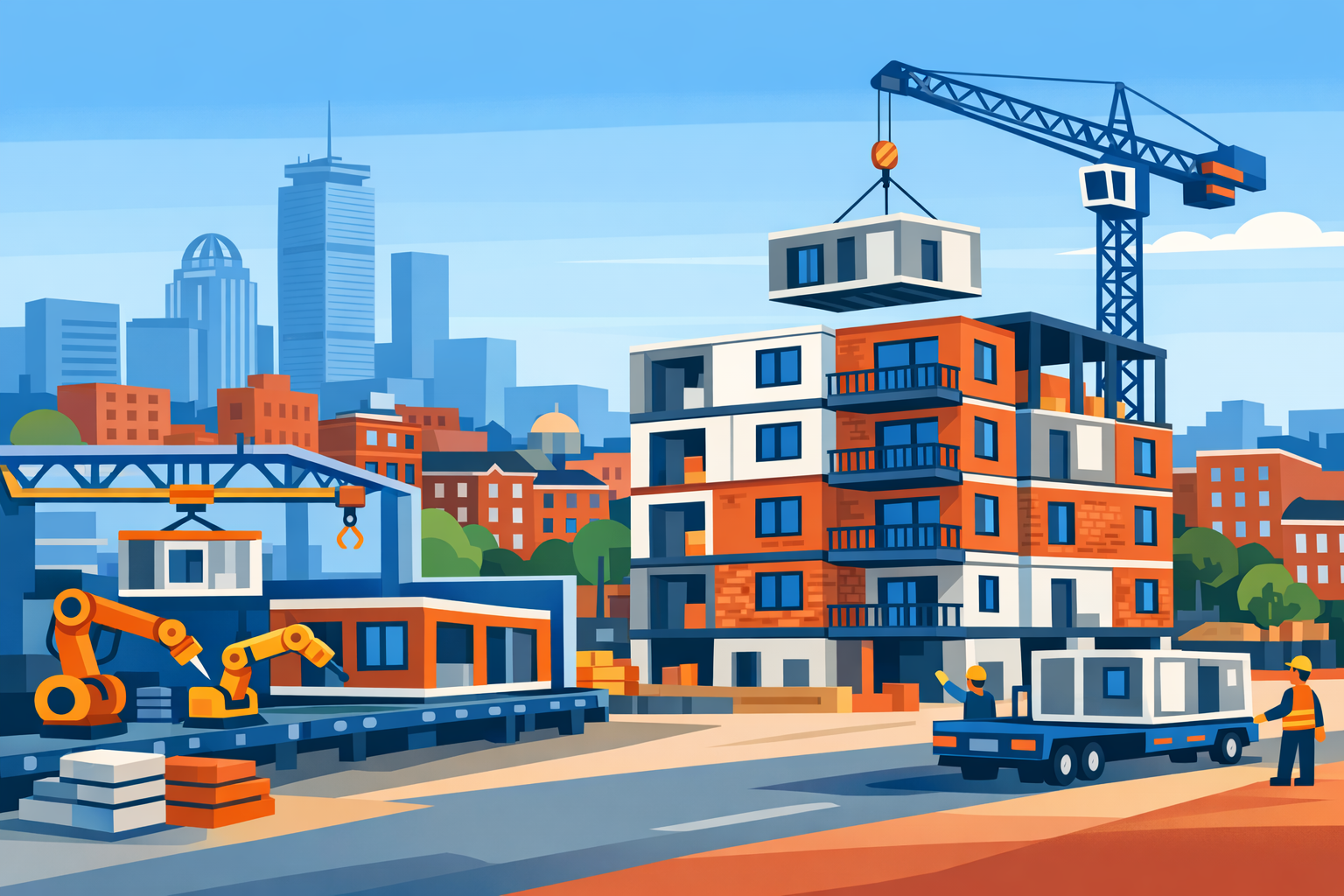
South Korea's Hyundai Elevator has commercialized the world's first modular elevator system certified for high-rise buildings - a milestone that could reshape installation timelines, on-site safety protocols, and permitting frameworks across the global construction industry.
The company announced the official launch of its proprietary ENOBLOC system - an acronym for Elevator Innovate Block Construction - completing a quality control inspection for its first 27-story deployment at the Songdo Hillstate Centerpark construction site in Incheon, South Korea. The launch marks the first commercial application of a modular elevator in a building exceeding 20 stories.
Background
Modular construction - in which major structural components are prefabricated off-site and assembled on location - has gained significant traction globally as developers contend with persistent labor shortages, cost pressures, and compressed project schedules. Until now, however, modular techniques had not been validated for elevator installation in true high-rise applications, leaving a critical bottleneck in vertical construction workflows.
Hyundai Elevator previously signed a memorandum of understanding with affiliate Hyundai E&C to introduce modular elevators for residential housing, first verifying technical stability through a pilot installation at the low-rise Hillstate Icheon Station project before advancing to the 27-story Songdo application. Hyundai E&C has completed installation of a 16-passenger, high-speed model with a rated load of 1,200 kg at the Hillstate Songdo Central Park site - the first commercial deployment of its kind in an apartment complex of more than 600 units.
Details
ENOBLOC centers on a "mobile assembly station" that functions as a compact on-site mini-factory. The station occupies less than 33 square meters and transports components in planar units, enabling a compact, controlled assembly process. Approximately 90 percent of key components are prefabricated in Hyundai's factories, shifting the bulk of labor risk from narrow, high-altitude elevator shafts into controlled factory environments.
The performance figures are significant. ENOBLOC reduces elevator installation time by up to 80 percent compared with conventional methods, which can require up to 190 days. In its partial application at Songdo, ENOBLOC cut the construction period by 40 working days and is projected to shorten overall construction by more than two months upon full deployment. Transporting factory-assembled structures to the site and stacking them takes just two days, with the complete process - including adjustments, finishing, and test runs - taking approximately one month.
"The overall construction schedule has been shortened, and on-site work safety and quality have improved," a Hyundai E&C official said, adding that the company plans to expand application to additional projects.
CEO Cho Jae-cheon described ENOBLOC as a system that "alleviates high risks, boosts efficiency and lowers environmental impact," and said it would "shift the paradigm of construction and development." Hyundai Elevator has filed approximately 50 patents linked to its modular system, high-rise building application, and mass-production technologies, and plans to seek additional patent protection in the United States and the Middle East.
On April 9, 2026, Hyundai Elevator and GS Construction signed a formal agreement to apply ENOBLOC at the Siheung Geomo residential project - a six-building, 801-unit complex where three buildings will be constructed as steel modular apartments, with one reaching 14 floors, making it the tallest steel modular apartment building in South Korea. The two firms also committed to joint R&D to extend modular elevator technology from low-rise to high-rise applications.
The system's implications extend beyond schedule savings. High-altitude shaft welding and field assembly - among the highest-risk activities in conventional elevator installation - are significantly reduced under ENOBLOC. Factory manufacturing also raises component precision and reduces quality variation, according to Hyundai E&C.
Outlook
Hyundai Elevator's global ambitions for ENOBLOC will require engagement with building code frameworks outside South Korea, where elevator installation in high-rise buildings is governed by standards such as ASME A17.1/CSA B44 and local authority requirements that mandate acceptance testing and plan review before commissioning. How regulators in the U.S., Middle East, and European markets evaluate prefabricated elevator assemblies for high-rise compliance will be a defining factor in the system's international uptake. With patent filings underway in multiple jurisdictions, the construction industry will be watching the Siheung Geomo and Songdo projects closely as proof-of-concept benchmarks for modular vertical mobility at scale.
Related reading: Off-Site Advantage: When Modular Construction Delivers Real Value · Modular Housing Market Set to Reach $200.6 Billion by 2033