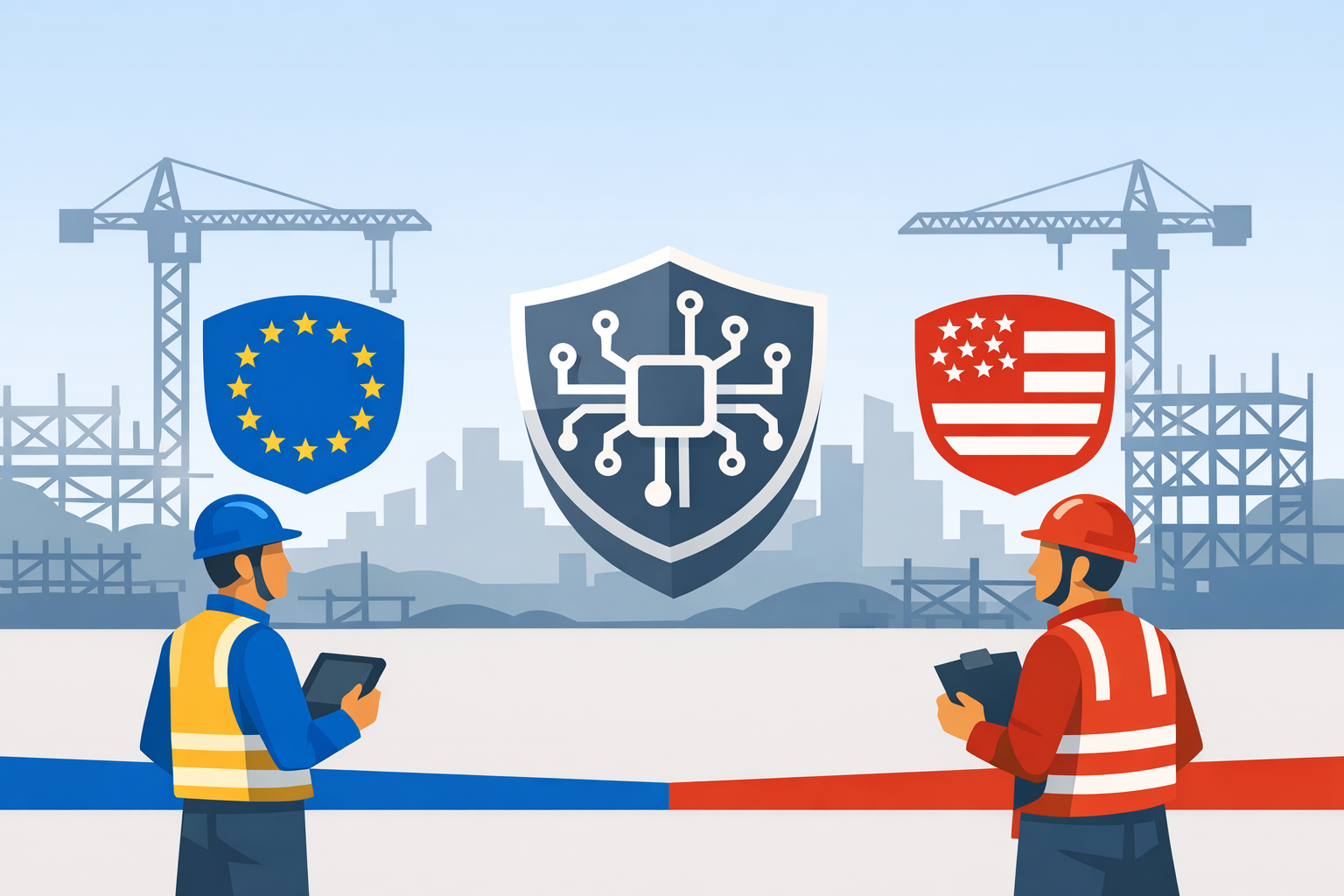
The European Union and the United States are pursuing fundamentally different regulatory paths for AI systems used on construction sites, creating a compliance gap that cross-border contractors and technology suppliers must now navigate.
The EU AI Act entered into force on August 1, 2024, and will be fully applicable on August 2, 2026, with phased deadlines for different categories of AI systems. In Washington, the federal stance runs in the opposite direction. The Trump administration revoked predecessor executive orders on AI and has directed agencies to remove barriers to U.S. AI leadership, updating existing regulatory frameworks to encourage adoption of AI applications across sectors.
Background
The EU AI Act is the first comprehensive AI regulation by a major regulator anywhere in the world. It uses a tiered risk model that lays out four categories of AI risk; compliance requirements and penalties vary depending on the level of risk associated with a given AI use.
For construction specifically, AI-powered site monitoring systems that inform employment decisions or worker management fall squarely under the Act's most demanding tier. Most workplace AI monitoring qualifies as high-risk under Annex III, Category 4, requiring conformity assessments, risk management, and human oversight before August 2026. Critically, the EU AI Act bans emotion recognition in the workplace under Article 5(1)(f). Employers cannot deploy AI systems that infer employee emotions from facial expressions, voice patterns, or biometric signals during work. These bans took effect February 2, 2025, and violations carry fines up to €35 million or 7% of global annual turnover.
No equivalent federal prohibition exists in the U.S. Although there is no national law yet, agencies are stepping in to address AI risks in domains like finance, healthcare, and child safety - but not construction AI specifically. OSHA's existing framework presents a related challenge: many OSHA construction standards mandate a "competent person" on site to identify hazards and make safety decisions, such as inspecting excavations and scaffolds. AI-based vision systems can now monitor sites around the clock, detecting risks like unstable trenches or missing fall protection in real time. Where regulation explicitly requires a competent human to perform an inspection, it remains unclear whether an AI detection system could satisfy the rule - causing project managers to underutilize such technology since it lacks official recognition as equivalent to human oversight.
Details
The divergence creates layered problems for firms working in both markets. On the EU side, on May 19, 2026, the European Commission published draft guidelines on classifying high-risk AI systems under the EU AI Act and launched a public consultation open until June 23, 2026, aimed at helping providers, deployers, and market surveillance authorities determine whether an AI system falls within a high-risk category.
Providers of AI hardware and software for European job sites must also prepare for registration and incident-reporting obligations. Once an AI system is on the market, authorities handle market surveillance, deployers ensure human oversight and monitoring, and providers maintain post-market monitoring systems. Providers and deployers must also report serious incidents and malfunctions.
The EU's extraterritorial reach amplifies the compliance burden for U.S.-based suppliers. Like GDPR, the EU AI Act applies to organizations outside the EU if their AI systems are placed on the EU market or if the output of their AI is used within the EU. U.S., U.K., and Asian companies serving European customers must comply.
On worker training, the gap is equally wide. AI literacy obligations under the EU AI Act took effect August 2, 2025, requiring firms to ensure that workers engaging with AI tools have the knowledge to understand and oversee them. The U.S. has no federal equivalent for construction sites. At the state level, fines for violating AI safety frameworks in California can reach $1 million per violation, and companies must report critical safety incidents to the state within 15 days - or within 24 hours if they believe a risk poses an imminent threat of death or injury.
Enforcement infrastructure is also developing unevenly across EU member states. In January 2026, Finland became the first member state to confer enforcement powers on its market surveillance authority under the AI Act, with others following. This decentralized model means enforcement priorities and interpretive approaches may differ from country to country.
In 2022, construction fatalities accounted for 21% of all U.S. workplace fatalities despite the sector employing only 7% of the workforce, according to the Bureau of Labor Statistics. AI-enabled site monitoring tools are being deployed to close that gap - tools like DroneDeploy's Safety AI, which analyzes daily reality-capture imagery and flags conditions that violate OSHA rules with a claimed 95% accuracy. The system has been deployed on hundreds of U.S. construction sites since October 2024.
Outlook
The most impactful deadline for enterprises operating in Europe is now December 2, 2027, when high-risk Annex III system requirements become fully enforceable under the Digital Omnibus agreement. For cross-border contractors, the practical priority is data governance: systems collecting biometric or behavioral data on European job sites must be audited against EU AI Act prohibited practices now, while suppliers must obtain CE-marking and register systems in the EU database ahead of enforcement deadlines. State-by-state regulation in the U.S. creates a patchwork of regimes that complicates compliance, particularly for technology startups - a dynamic that, combined with the EU's binding framework, makes a unified internal compliance strategy essential for any contractor operating in both markets.