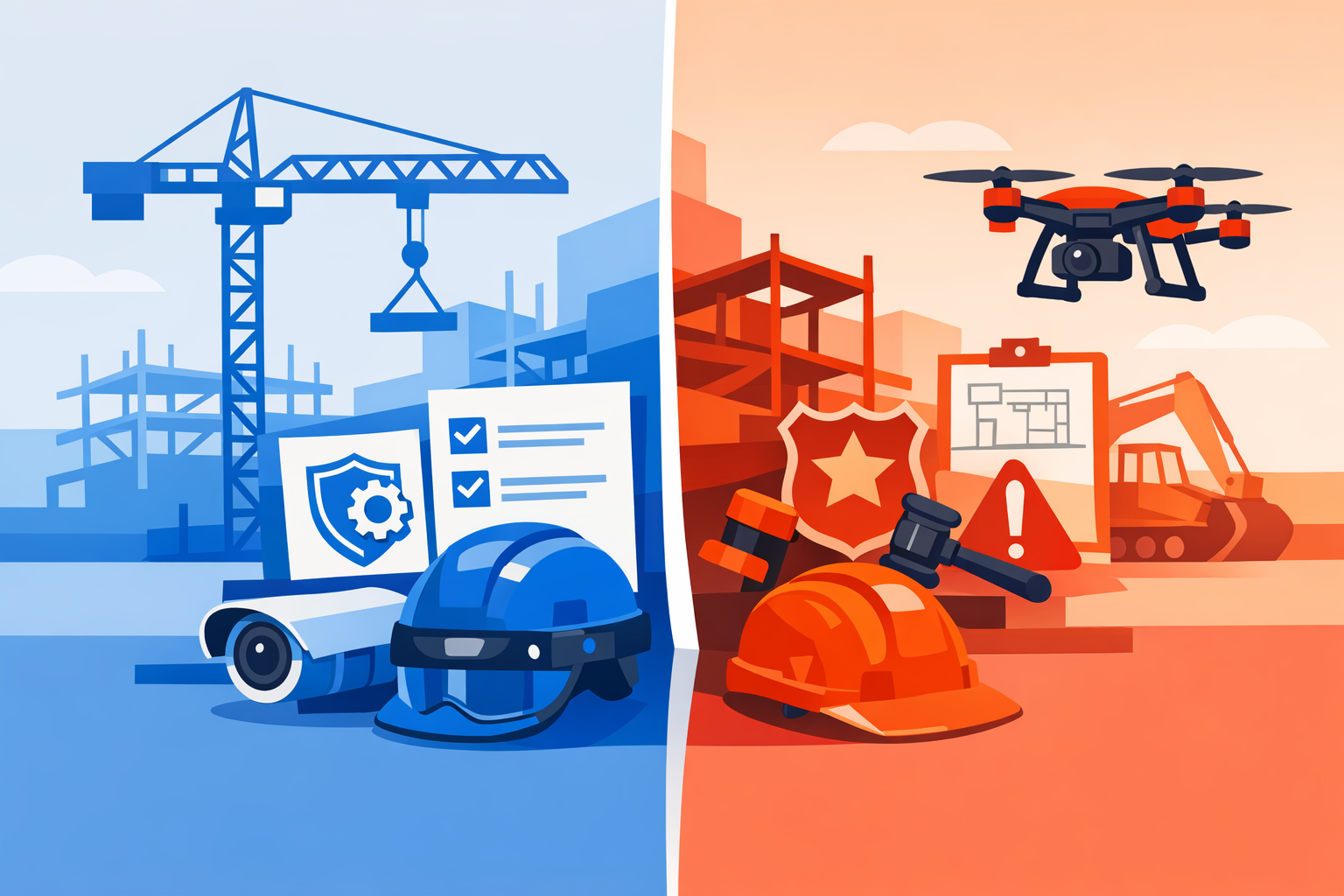
Regulatory bodies on both sides of the Atlantic are moving in opposite directions on standards governing AI-powered safety tools on construction sites, creating a fragmented compliance landscape for global contractors and technology providers as adoption of sensors, computer vision, and real-time analytics accelerates.
Background
AI tools-including computer vision cameras, wearables, and equipment monitoring systems-are already reducing incidents on active construction sites, with real-time hazard detection and predictive analytics becoming standard on larger projects.[1] Some construction firms reported incident reductions of up to 40-50% following AI safety technology deployments in 2025, according to industry data. The surge in deployment has outpaced formal regulatory guidance, leaving contractors, insurers, and technology vendors operating under frameworks not written with autonomous or semi-autonomous systems in mind.
A central friction point involves automated decision-making. OSHA standards mandate a "competent person" on site to identify hazards and make safety decisions, including inspecting excavations and scaffolds. AI-based vision systems can now monitor sites continuously, detecting risks like unstable trenches or missing fall protection in real time. Yet where regulations explicitly require a competent human to perform an inspection, it remains unclear whether an AI detection system can satisfy the rule.
Details
In Europe, the EU AI Act is establishing the most comprehensive binding framework. The Act entered into force on August 1, 2024, and becomes fully applicable on August 2, 2026, with some exceptions. Prohibited AI practices and AI literacy obligations took effect on February 2, 2025, while governance rules and obligations for general-purpose AI models became applicable on August 2, 2025. Construction firms operating in the EU market must assess whether AI tools used for safety-critical applications, worker monitoring, or automated decision-making fall within the Act's high-risk category, which carries the most demanding compliance obligations.
AI-powered safety monitoring is expanding rapidly: computer vision cameras detect PPE violations, drones conduct structural assessments, and predictive analytics identify hazards before incidents occur. These systems generate substantial personal data about workers, requiring careful compliance with GDPR and emerging AI-specific regulations around transparency and human oversight. Independent analyses suggest large enterprises may face initial investments of $8-15 million to bring high-risk AI systems into EU conformity, with ongoing annual costs of $1-5 million. Mid-size organizations face proportionally lower but still significant initial burdens of $2-5 million. These figures cover quality management system implementation, technical documentation, conformity assessment procedures, EU database registration, post-market monitoring, and incident reporting processes.
In the United States, the regulatory trajectory has diverged sharply from the European approach. In July 2025, OSHA launched a broad deregulatory initiative, publishing 26 proposed rules aimed at streamlining standards, reducing regulatory burdens, and clarifying enforcement priorities. One final rule, effective July 1, 2025, removes the requirement for the agency's administrator to consult with the Advisory Committee on Construction Safety and Health before promulgating, modifying, or revoking construction standards. OSHA stated this change eliminates procedural steps not mandated by statute and streamlines the regulatory process. Legal analysts note it may result in a looser federal regulatory environment but also introduces new risk for contractors.
Cybersecurity and data governance are emerging as secondary compliance battlegrounds. Legal challenges around intellectual property, liability, and cybersecurity rank among the critical concerns for industry leaders in 2025. Construction firms are being advised to invest in workforce training to adapt to AI-driven changes and maintain compliance with evolving labor laws. This year's OSHA updates reflect a shift from reactive enforcement to proactive prevention, with inspectors emphasizing real-time verification and continuous monitoring aided by wearables, smart helmets, and geofencing systems.
On the technology supply side, contractors like Skanska have begun integrating generative AI directly into safety planning workflows. Skanska introduced its Safety Sidekick tool in 2025, a generative AI system drawing on the company's EHS Manual, OSHA construction standards, and supplemental safety documentation, according to Brian Karas, national environmental health and safety director for Skanska USA Building.
Outlook
The EU AI Act becomes generally applicable on August 2, 2026, when high-risk AI system obligations take effect. Construction firms operating in or supplying the EU market must assess whether their AI tools fall within the high-risk category, particularly those used for safety-critical applications, worker monitoring, or automated decision-making. Despite a November 2025 European Commission proposal to delay certain deadlines to late 2027, this extension has not been enacted into law, and enterprises should treat August 2026 as the operative deadline. In the United States, the absence of AI-specific construction safety regulations means insurers, state-level agencies, and project owners are increasingly filling the governance gap through contract language and risk-allocation clauses-a patchwork approach that industry groups warn is unsustainable as autonomous site monitoring becomes routine.