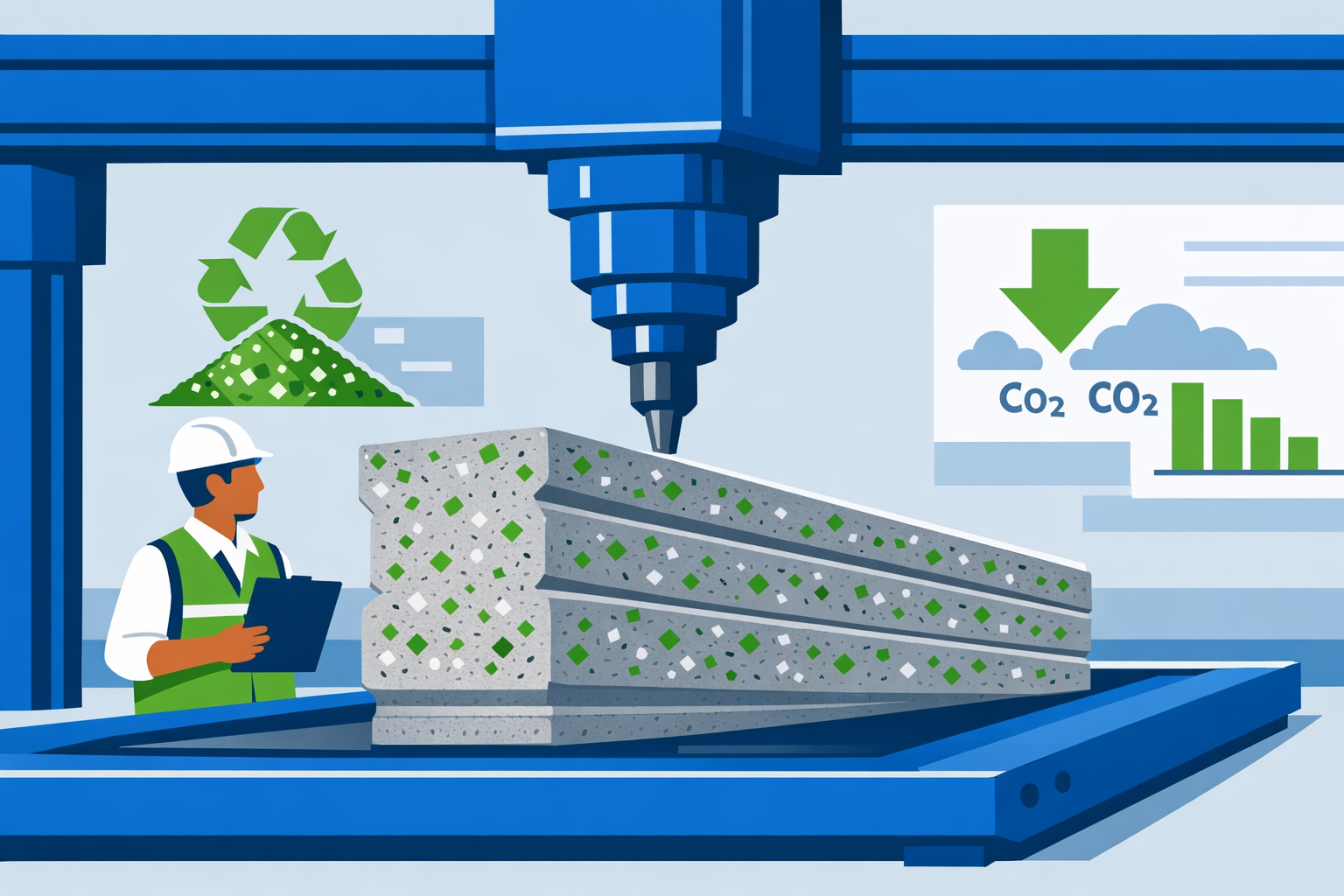
Researchers at the National University of Singapore have developed a 3D-printable concrete mix that cuts carbon dioxide emissions by 52% compared to conventional printable concrete, bringing structural-grade additive manufacturing closer to mainstream construction.
In a study published in Construction and Building Materials on 30 January 2026, the team detailed a mix that replaces 60% of ordinary Portland cement with recycled waste glass powder while retaining the printability and structural performance required for construction applications. Led by Senior Lecturer Dr Du Hongjian and Associate Professor Pang Sze Dai from the Department of Civil and Environmental Engineering in NUS CDE, the researchers demonstrated that 3D concrete printing (3DCP) can fabricate structural building components that are greener, use less material, and require fewer workers - all while meeting structural performance requirements. The implications include faster project delivery, lower labour dependence, and greater flexibility in modular building design.
Background
A persistent challenge in 3D concrete printing is its notably higher consumption of ordinary Portland cement (OPC) compared to cast concrete - a problem because OPC production involves high energy use and significant CO₂ emissions, contradicting low-carbon construction goals. Cement production and use in construction account for up to 77% and 8% of emissions respectively across the entire lifecycle of cement and concrete. In Singapore, 3DCP has remained limited to non-structural applications in the built environment. The NUS research was carried out in collaboration with construction firm Woh Hup and supported by the Building and Construction Authority (BCA) and the National Additive Manufacturing Innovation Cluster (NAMIC), a national platform hosted by the Agency for Science, Technology and Research (A*STAR).
Details
The NUS mix replaces 60% of ordinary Portland cement with recycled waste glass powder and reduces CO₂ emissions by 52% and embodied energy by 44% compared to conventional printable concrete. Laboratory tests showed the material could be 3D-printed into full-scale elements without collapse or deformation, achieving compressive strengths exceeding 50 megapascals - a level suitable for structural components. The mix also demonstrated significantly improved resistance to chloride penetration, indicating longer service life and lower maintenance demands.
The team's approach integrates formwork-free 3D printing with conventional construction, allowing structural elements to be fabricated with greater design freedom and material efficiency. Addressing both material formulation and construction workflow, the researchers developed printable concrete mixes optimised for extrusion and buildability, structural reinforcement, and compatibility with current production methods. In parallel, the team defined a fabrication workflow aligned with existing prefabrication and on-site processes, ensuring printed components are structurally viable and practical to produce and deploy at scale.
3DCP has been demonstrated as a viable method for fabricating structural building components, achieving required load-bearing performance while reducing material use by 30%, manpower by over 40%, and increasing efficiency by more than 60%, according to NUS.
Industry partner Woh Hup worked closely with the NUS team to validate real-world deployment. Mr Yong Derong, Executive Director of Woh Hup, stated that "testing the novel technology beyond the lab enables all parties to pinpoint practical constraints and opportunities for improving productivity and reducing manual labour in construction." A company representative added that understanding practical requirements, cost implications, and scalability is "critical for responsible adoption in the industry."
Outlook
The team is also developing lower-carbon 3D printing materials using locally available waste resources, further strengthening the sustainability case for scaling 3DCP in Singapore's construction industry. The study demonstrates how 3DCP can be paired with low-carbon material design to support Singapore's broader sustainability goals while making digital construction more viable for real-world deployment. Whether the findings accelerate revisions to structural standards for 3D-printed concrete - currently restrictive in Singapore and many other markets - will be closely watched by contractors and regulators seeking scalable paths to construction decarbonization.