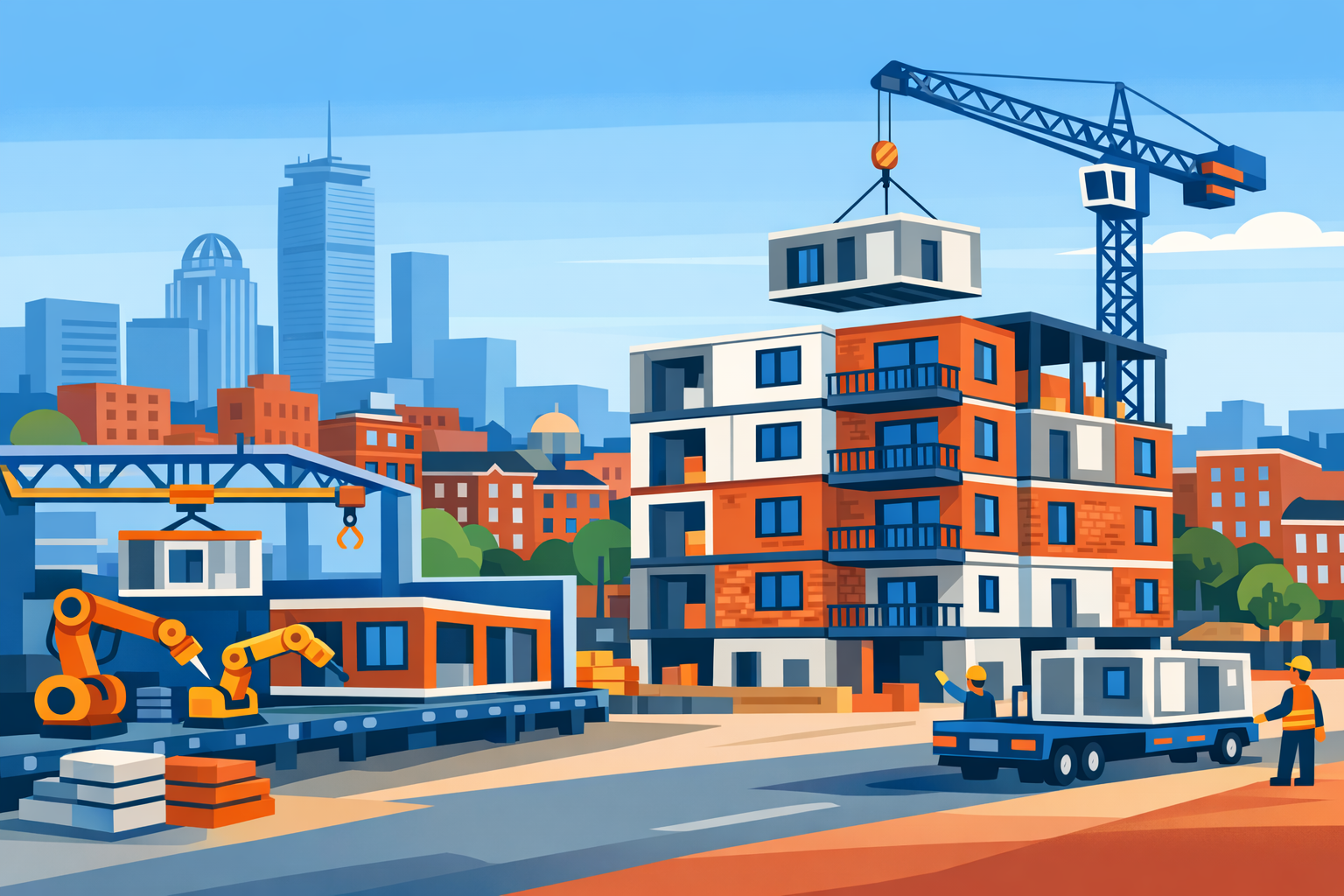
Massachusetts is accelerating the use of factory-built, robotics-enabled housing to address a state housing deficit that officials describe as the most severe in decades. A 2025 report from the Massachusetts Executive Office of Housing and Livable Communities estimated the state needs approximately 222,000 additional homes over the next decade, while permitting rates remain among the lowest nationwide. Modular construction firms, regional planning agencies, and state policymakers are converging around prefabricated methods as a faster, lower-cost path to closing that gap - though zoning restrictions and constrained financing continue to slow adoption.
Background
In Boston, the average time to complete a multifamily construction project is about three years, according to the Metropolitan Area Planning Council (MAPC). That timeline, combined with high construction costs, has long constrained supply. Multifamily housing construction costs in Massachusetts run 20% above the national average, limiting the ability of private developers to produce at scale.
In July 2024, the U.S. Department of Housing and Urban Development awarded MAPC a $3 million Pathways to Removing Obstacles to Affordable Housing (PRO Housing) grant to explore innovative approaches to building and installing modular housing in the Greater Boston region. Of more than 175 applications from states, communities, and territories, only 21 were selected - MAPC among five regional projects. That federal grant now funds the Greater Boston Regional Offsite Construction Strategy, which is evaluating sites for a new modular manufacturing facility.
Separately, Governor Maura Healey's Affordable Homes Act - signed in 2023 - authorized billions of dollars in state borrowing for housing and eased restrictions on accessory dwelling units. A state commission created by Healey subsequently called for stronger incentives for modular, factory-made housing as part of more than 50 policy recommendations published in early 2025.
Industry Activity
The most active private player in Massachusetts' modular-robotics space is Andover-based Reframe Systems. Founded in 2022, the company deploys microfactories that bring housing fabrication closer to the regions where homes are needed. The first homes produced in Reframe's initial microfactory have been fully built in Arlington and Somerville, Massachusetts.
The Andover microfactory produces structural panels, with robotics completing wall and ceiling framing while workers handle wiring and plumbing. The company aims to automate more of the building process through expanded use of robotics over time. Reframe CEO Vikas Enti stated that "thirty-five percent of the walls and ceilings were robotically fabricated for these units, and our percentages have kept improving."
Reframe is currently seeking a location for a larger manufacturing facility capable of producing up to 200 homes annually - a significant increase from its current capacity of 30 to 40 units per year. The company also plans to begin construction on a dozen single-family homes in Devens, Massachusetts, priced around $789,000.
Elsewhere in the state, modular construction is advancing through publicly supported affordable housing projects. In April 2025, a second three-story duplex was being stacked on Clemente Street in Holyoke - assembled from modular units shipped from Pennsylvania - as part of a broader initiative combining approximately 60 modular pieces into 20 affordable townhomes across ten duplexes.
Barriers: Zoning, Financing, and Labor
Despite these projects, structural impediments are limiting broader adoption. Zoning rules, permitting requirements, and inspection processes continue to slow development regardless of construction method. Sukanya Sharma of MAPC said bureaucratic processes continue to add time and cost.
On the financing side, missing-middle housing presents a bottleneck, with traditional lenders viewing these projects as too small, too risky, or too unconventional. Harvard's Joint Center for Housing Studies has recommended the state consider a middle-housing tax credit and expanded eligibility under existing housing-finance programs - modeled on approaches already piloted in Colorado and Oregon.
Labor dynamics add further complexity. While Reframe's projects have largely avoided union labor so far, industry leaders anticipate increased scrutiny as modular construction scales. Enti acknowledged that the model "can be seen as a threat" to traditional construction jobs, and union leaders have expressed concern about oversight and quality control when construction shifts away from job sites.
Outlook
Updating zoning, building codes, and approval processes to fully enable modular construction could help Massachusetts accelerate housing production, according to the Harvard Joint Center for Housing Studies. Permit data underscores the urgency: the number of building permits issued in Massachusetts has fallen sharply over the past four years, from a peak of nearly 20,000 in 2021 to just over 14,000 in 2024. Sharma of MAPC framed modular construction as one part of a broader response, noting it "is one of the strategies that can help with the housing crisis" - but "not the silver bullet."