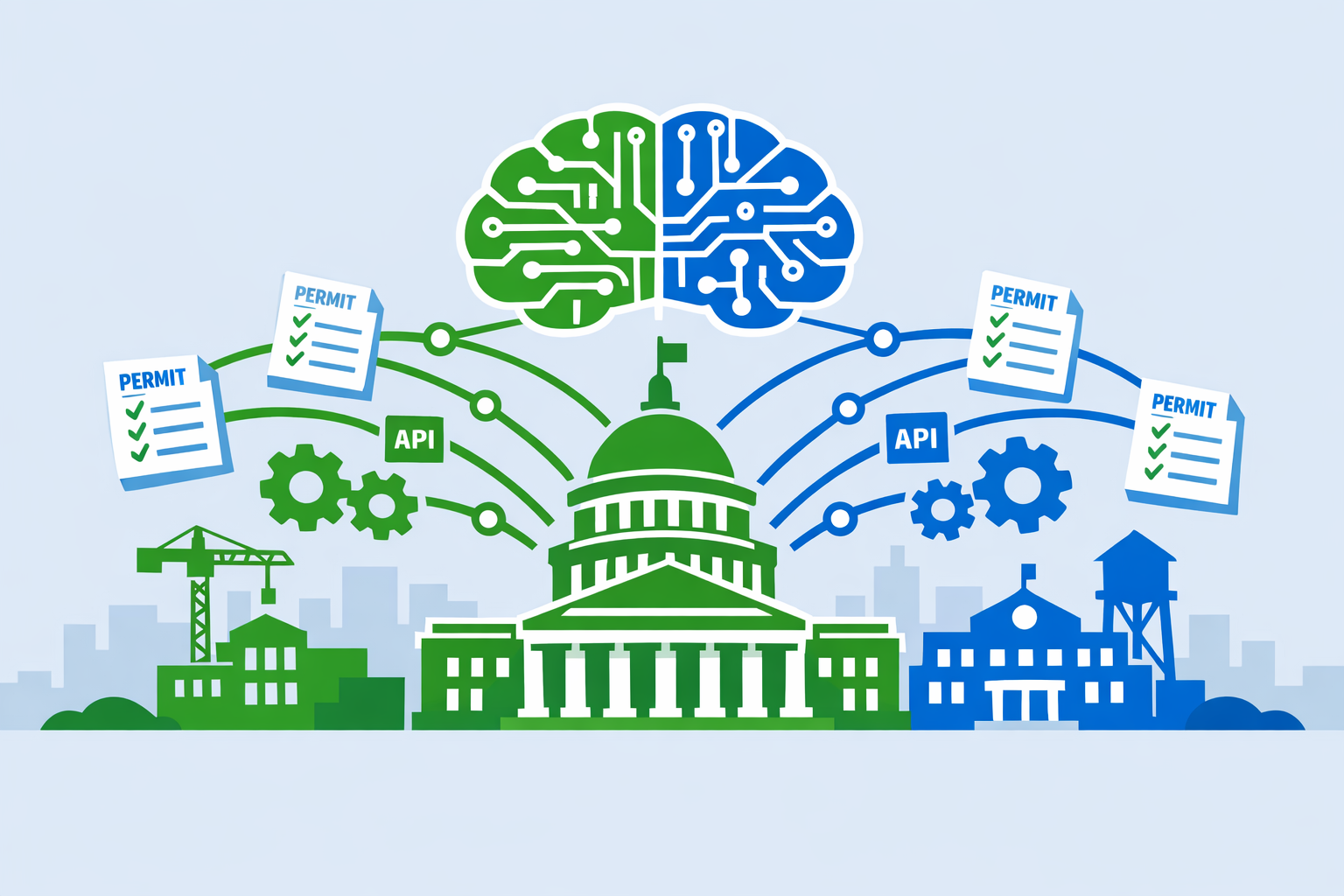
Federal directives requiring open, standardized data exchange are triggering a wave of state and local pilot programs that embed AI-assisted tools into public construction permitting workflows. Early deployments are already cutting plan review times from months to days.
The White House Office of Management and Budget issued two memoranda in April 2025-M-25-21 and M-25-22-directing all executive branch agencies to accelerate AI adoption while mandating interoperability and open data standards. OMB M-25-22 explicitly requires agencies to ensure "open and standard data formats and application programming interfaces (APIs) are used so that foundational components can be used without obscure proprietary" formats, laying the groundwork for standardized permitting data exchange between federal, state, and local systems.
Background
The federal push follows years of fragmented permitting infrastructure. For more than 15 years, pressure has been growing on a shrinking municipal development workforce to carry a heavier, more complex regulatory load, resulting in a national underinvestment in permitting capacity measured in tens of billions of dollars in missing labor and delayed construction value, according to analysis published by HousingWire.
OMB M-25-21, issued April 3, 2025, directs agencies to develop enterprise AI strategies, designate Chief AI Officers, maintain public AI use-case inventories, and apply minimum risk management practices for "high-impact" AI, according to the OMB memorandum. Chief AI Officers across agencies are also encouraged to coordinate "on criteria for data interoperability and standardization of data formats as a means of increased AI adoption," according to ML Strategies' analysis of the directive.
On the procurement side, OMB M-25-22 applies to all AI contracts awarded pursuant to solicitations issued on or after September 30, 2025, and mandates contract terms barring vendors from using non-public government data to train commercial AI algorithms-a safeguard directly applicable to permitting platforms handling sensitive project documentation.
Details
State and local agencies have moved quickly to build on the federal framework. In Honolulu, the Department of Planning and Permitting deployed CivCheck-an AI plan review platform-on December 8, 2025, cutting per-application review time from 60-90 minutes to 15-20 minutes and clearing a backlog of 174 projects within weeks, according to AI Home Building. Officials also reported that AI guidance for applicants cut residential review times by roughly 60% by flagging compliance issues before plans reached staff reviewers, according to StateScoop.
California moved on a parallel track. In April 2025, Governor Gavin Newsom announced the launch of an AI-driven permitting tool developed by Archistar to accelerate rebuilding approvals following the Los Angeles wildfires, with Los Angeles County committing to generate review reports for many building plans within one business day, according to the California Governor's office.
In Texas, Harris County commissioners in November 2025 approved a two-year AI permitting pilot at an estimated cost of approximately $1 million annually, citing successes in Austin and Los Angeles, according to Houston Public Media. Austin had separately approved a contract of more than $3.5 million for AI building plan evaluation, according to the same reporting. In the Pacific Northwest, Seattle Mayor Bruce Harrell signed an executive order in June 2025 directing a dedicated Permitting and Customer Trust (PACT) team to pilot AI tools across all development applications, with full rollout expected in 2026, according to HousingWire.
The data safeguards accompanying these pilots align with the federal framework. Under M-25-22, contracts must clearly delineate ownership and IP rights of the government and contractor, data portability, and long-term interoperability, according to Ogletree. Agencies must also permanently prohibit vendors from using non-public agency data to train publicly or commercially available AI algorithms-a protection covering permit drawings, project specifications, and applicant information.
According to a global study of 250 cities cited by the National League of Cities, 56% of cities are actively piloting or using AI to upgrade government operations, and 83% plan to do so over the next three years.
Outlook
A December 2025 executive order titled "Ensuring a National Policy Framework for Artificial Intelligence" reinforced the drive toward standardization by directing White House officials to prepare legislative recommendations that would establish a uniform federal AI policy framework and preempt conflicting state AI laws, according to the National Governors Association. If enacted, the legislative push could further consolidate data exchange standards across public-sector permitting systems. Agencies that have not yet published AI strategies face a compliance deadline, while the construction industry is watching whether standardized digital plan review formats will be codified into procurement requirements for federally funded public works projects.