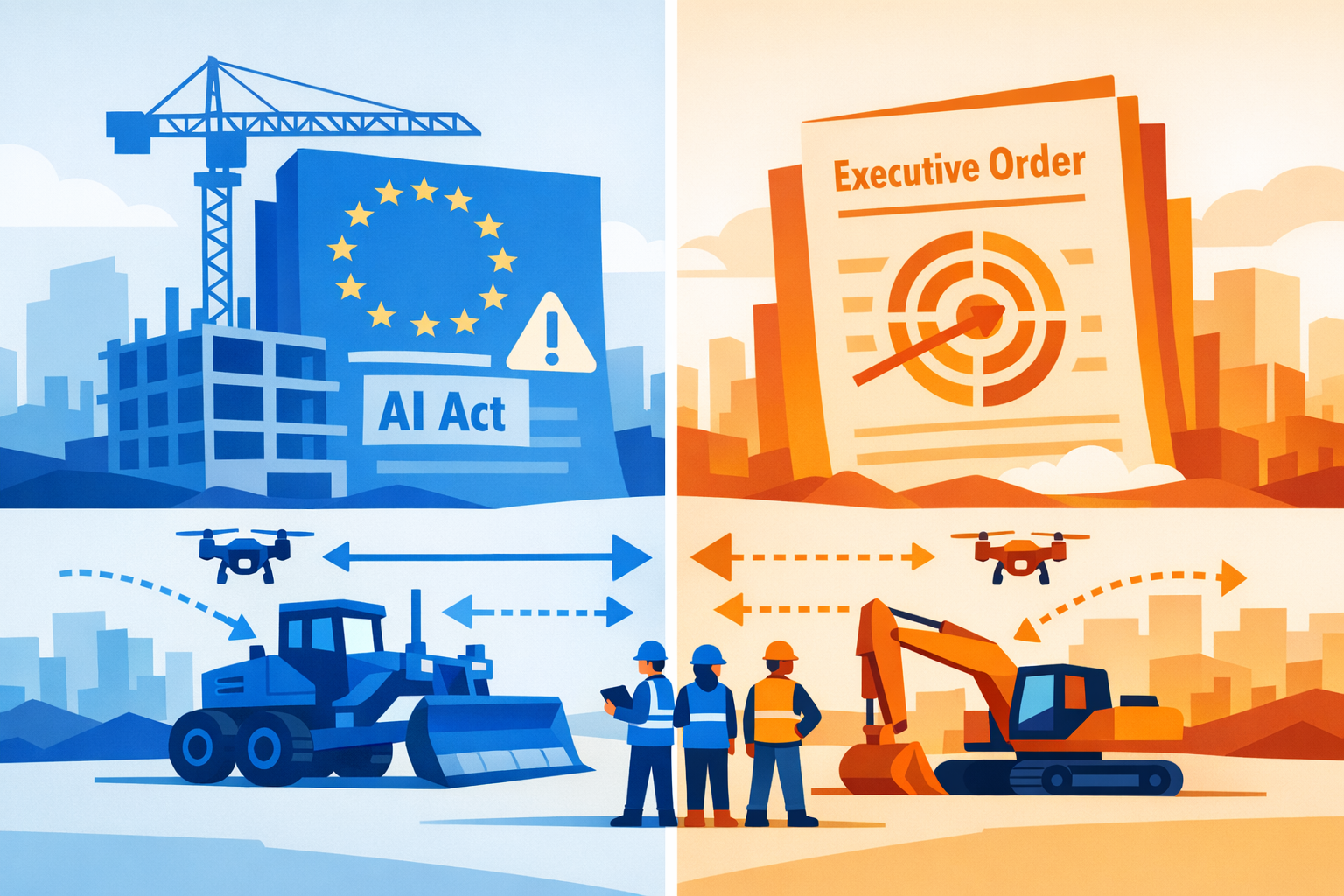
A widening regulatory gap between the European Union's prescriptive AI Act and the United States' outcomes-based approach to artificial intelligence governance is creating compliance complexity for contractors, equipment manufacturers, and technology developers operating across both markets. The divergence affects how autonomous and semi-autonomous construction equipment is certified, how site data is governed, and how much project teams must spend to remain compliant on cross-border work.
Background
The EU AI Act (Regulation EU 2024/1689), which entered into force in August 2024, establishes the world's first comprehensive legal framework for AI, imposing graduated obligations based on a risk-based classification system. For construction, the regulation carries direct implications: two categories have been added to the high-risk list for AI-enabled machinery - safety components with fully or partially self-evolving behavior using machine learning, and machinery with embedded AI systems ensuring safety functions. These provisions interact closely with the broader EU AI Act framework, which also classifies certain AI systems as high-risk.
The U.S. is moving in a different direction. Executive Order 14179, issued in January 2025, reoriented federal AI policy toward promoting innovation and revoked portions of the 2023 Biden administration AI executive order that emphasized safety testing and reporting requirements. The United States lacks a single comprehensive federal AI law; regulation instead comes from a patchwork of state laws, federal agency guidance, and voluntary standards.
Details
For construction firms deploying AI-enabled site analytics, autonomous graders, or semi-autonomous inspection drones on European projects, the EU framework imposes concrete obligations. Article 10 requires training, validation, and testing data to be relevant, representative, and free from errors or bias. Article 14 mandates human oversight of high-risk systems. AI-powered safety monitoring is expanding rapidly - computer vision cameras detecting PPE violations, drones conducting structural assessments, and predictive analytics identifying hazards before incidents occur - but these systems generate substantial personal data about workers, requiring careful compliance with GDPR and emerging AI-specific rules on transparency and human oversight.
Following the EU's "AI Omnibus" political agreement reached on May 7, 2026, enforcement timelines have shifted. Rules for high-risk AI systems embedded in regulated products now carry an extended transition period: systems used in certain high-risk areas will apply from December 2, 2027, while those integrated into products such as lifts or machinery will apply from August 2, 2028. The Omnibus clarifies the interplay between the AI Act and EU product safety laws - in particular the Machinery Regulation - avoiding duplication between sectoral and AI rules.
Despite the extended deadlines, compliance costs are mounting. Cross-border firms dedicate 20-25% of total AI compliance budgets specifically to EU-market entry requirements. SMEs typically face compliance costs between €50,000 and €500,000, depending on use-case complexity. Cross-border compliance complexity continues to rise due to diverging U.S., EU, and UK regulatory models, with some firms forced to run separate AI stacks across regions.
On the standards front, the picture remains unsettled. CEN and CENELEC have not completed the harmonized standards the Commission requested within the original August 2025 timeline, and standardization work is still ongoing. The standards are voluntary but decisive for legal certainty, helping companies understand requirements and authorities know what to check.
Construction firms should audit AI deployments against EU AI Act risk classifications, move beyond generic AI clauses to bespoke contractual provisions addressing specific deployed systems, review insurance coverage - noting that professional indemnity insurers increasingly require AI disclosure - and establish governance frameworks for AI tool selection and human oversight.
Outlook
Any organization, regardless of location, must comply with the EU AI Act if its AI systems are used within the EU or produce outputs affecting EU residents - a provision that brings U.S.-headquartered contractors and equipment manufacturers squarely into scope for European projects. Volvo Autonomous Solutions has noted that AI regulations inspired by the EU Act are likely to be adopted elsewhere, mirroring the worldwide influence GDPR had on privacy standards. Industry observers expect equipment manufacturers to pursue dual-certification strategies, aligning products with both the EU's conformity assessment process and the U.S. NIST AI Risk Management Framework to preserve market access on both sides of the Atlantic while managing documentation and audit costs.