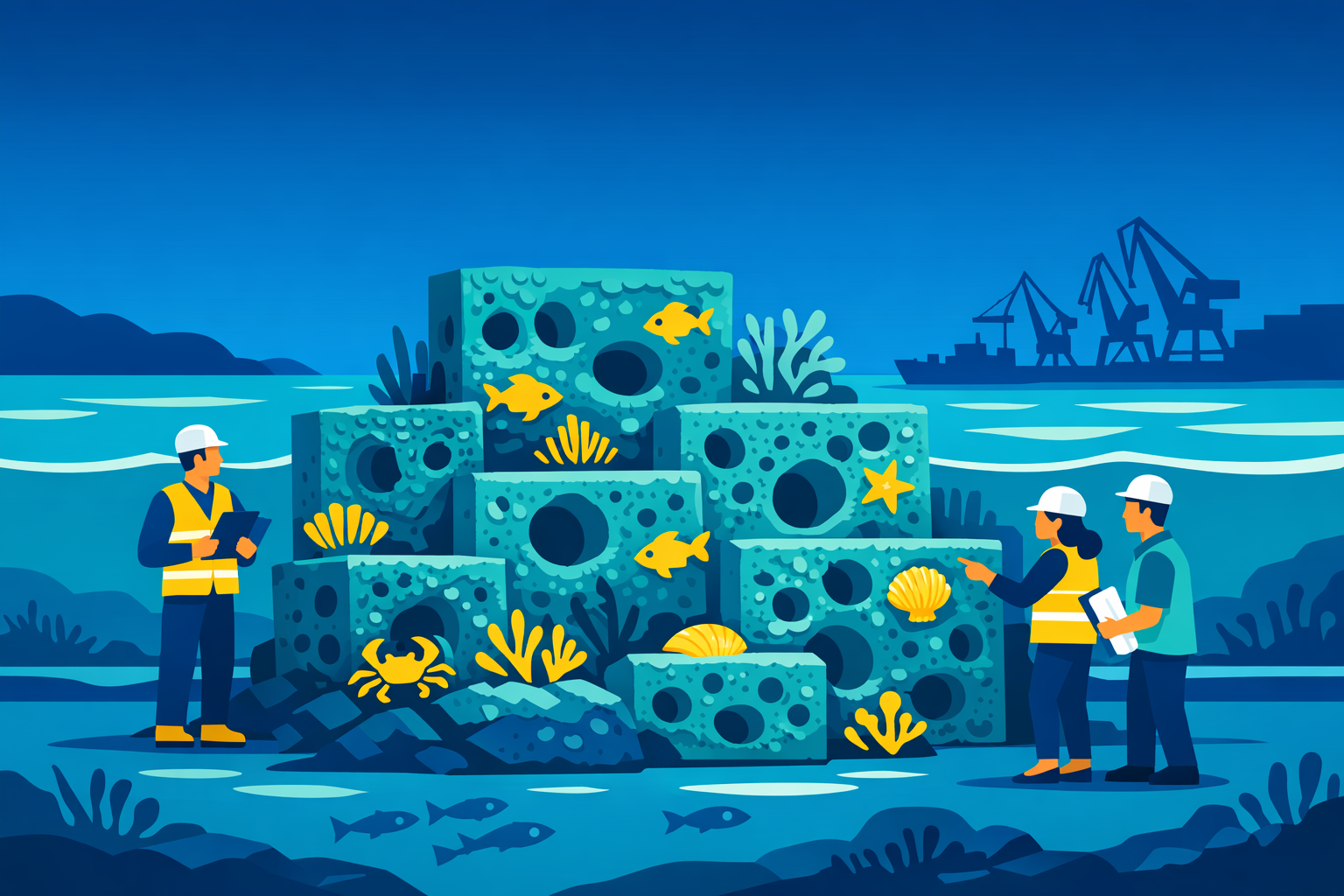
New York-based ECOncrete has closed a $14 million funding round to accelerate global deployment of its bio-enhancing concrete technology for coastal and offshore infrastructure. The round is led by Builders Vision, with participation from Barclays Climate Ventures, the Prince Albert II of Monaco Foundation's ReOcean Fund, BDT & MSD Partners through its Oceans Catalyst vehicle, and Open Road Impact. Proceeds will fund geographic expansion into Europe, the Middle East, and other key markets, according to the company.
Background
Cement accounts for approximately 8% of global CO2 emissions, and roughly 70% of coastal and marine infrastructure (CMI) is built with concrete - a material that standard construction practices treat as ecologically inert or actively harmful to underwater ecosystems. Pressure on coastal assets has intensified as more frequent storm surges, shoreline erosion, and sea-level rise prompt port authorities, municipalities, and offshore developers to seek materials that deliver structural durability alongside environmental compliance. Stricter permitting regimes in the U.S. and EU have added financial incentives: traditional concrete marine projects can face mitigation penalties of up to €900,000 per acre, according to European Commission data, while nature-inclusive designs can compress permitting timelines and reduce those penalties significantly.
ECOncrete was founded in 2012 by two marine biologists to develop concrete products that meet engineering performance standards while actively promoting colonization by marine organisms. The company's core technology combines a proprietary bio-enhancing admixture - composed of 92% recycled materials - with specialized surface textures and three-dimensional mold designs that mimic natural reef and tide-pool formations. Barclays Climate Ventures has backed ECOncrete for five years, making the latest round a continuation of long-term institutional commitment to the company's approach.
Details
Over the past 18 months, ECOncrete delivered its technology across more than 20 marine infrastructure projects globally, creating over 90,000 m² of marine habitat and recording 3.4x revenue growth, according to the company. Active deployments span the quay walls of the Port of Rotterdam, shoreline protection works in New York, Denmark, and New Zealand, subsea cable infrastructure in the Mediterranean and Atlantic, and biodiversity programs at the Port of San Diego and Port of San Francisco.
The technical case for the material rests on several claimed performance advantages. ECOncrete's admixture, when incorporated at 10% of cementitious materials in combination with 60% slag cement or fly ash, can reduce the carbon footprint of marine infrastructure by up to 70%, according to the company's published data. Surface colonization by calcifying organisms - oysters, barnacles, serpulid worms - reinforces the structure over time and creates a natural carbon sink. ECOncrete reports carbon sequestration capacity up to seven times greater than standard concrete.
The commercial implications for project owners are tangible. In New York City's Living Breakwaters project, a Staten Island coastal resilience initiative co-funded by U.S. and New York State agencies, the inclusion of ECOncrete's ecological design reduced mitigation penalties from $18 million to $4 million, according to company figures. At the Port of San Diego, the company's Coastalock system replaced traditional shoreline armoring at Harbor Island, providing both structural performance for an active port environment and nursery habitat for local marine species.
Dr. Ido Sella, co-founder and CEO of ECOncrete, stated that the company's patented technology "delivers both ecological and structural impact in a single solution," adding that ecology is "built in, not bolted on." Cristin Pacifico, vice president of investments at Builders Vision, cited "increasing investment in coastal protection, offshore wind and cables, ports and other forms of shoreline infrastructure" as the basis for expanding demand for high-performance adaptive materials.
Outlook
ECOncrete plans to expand into Europe, the Middle East, and additional global markets using the new capital, targeting sectors including offshore wind, ports, and subsea cable infrastructure where environmental permitting requirements are increasingly restrictive. The company's model of integrating local labor and regional supply chains to produce its ecological concrete could offer procurement advantages for project owners navigating import costs and carbon accounting requirements. As international biodiversity frameworks and coastal resilience standards evolve, the treatment of nature-inclusive materials in procurement specifications and testing protocols will determine how quickly products like ECOncrete's move from niche applications into standard practice on major infrastructure programs.