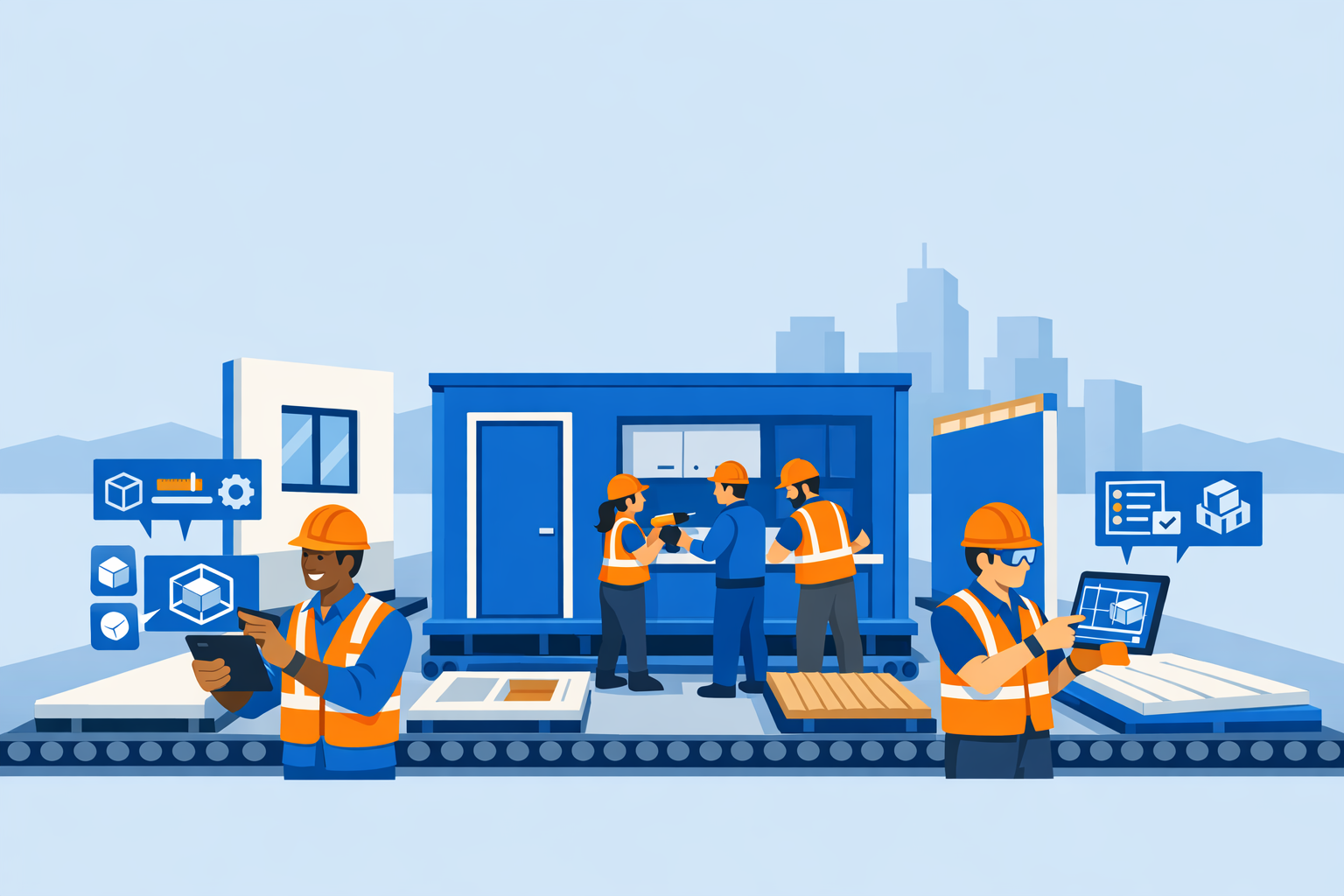
The U.S. Department of Energy's Advanced Building Construction (ABC) Initiative has expanded its scope and cumulative federal investment across multiple funding phases, positioning offsite manufacturing, digital construction tools, and workforce retraining as central pillars of a federal strategy to modernize the nation's building sector. The initiative, led by DOE's Building Technologies Office (BTO), targets both new construction and deep energy retrofits, with demonstrations now active across the country.
Background
America's roughly 118 million homes and 5.6 million commercial buildings account for approximately 40% of the nation's total energy demand and consume 75% of its electricity, according to the DOE. About half of those structures were built before 1980, before modern efficiency standards existed - a gap the ABC Initiative was created to close.
DOE launched the first ABC Funding Opportunity Announcement in 2019, committing up to $33.5 million for early-stage research and development of advanced building construction techniques. That round structured funding across three areas: deep energy retrofit technologies, new construction methods including offsite manufacturing and robotics, and field validation of advanced practices paired with workforce training and regional delivery models, according to DOE documentation. A subsequent round awarded $26.3 million to 40 competitively selected projects, followed by a $31.8 million award to seven project teams focused on next-generation whole-building retrofit solutions, and a further $32 million to accelerate building upgrades in low-income communities.
The fragmented U.S. building code landscape has long constrained offsite construction adoption. In 2021, the International Code Council (ICC) and the Modular Building Institute (MBI) created Standards 1200 and 1205 to reduce code complexity and improve compliance pathways for offsite manufacturers and contractors. More recently, the ICC and the Center for Offsite Construction at the New York Institute of Technology began developing the CFOC/ICC 1220 Standard on Configurations and Connections for Off-Site Construction, with publication targeted for May 2026.
Details
The initiative's technical scope spans offsite construction, design for manufacturing and assembly, packaged mechanical systems, robotics, and 3D printing, paired with low-carbon materials, according to DOE. New construction funding specifically targets homes and buildings that are 50% more energy-efficient compared to current code, with additional emphasis on manufactured and mobile homes.
To coordinate industry-wide adoption, DOE funded the ABC Collaborative. The Collaborative was launched with $5 million in DOE funding over five years, led by the Rocky Mountain Institute in partnership with ADL Ventures, the Passive House Institute U.S., the Association for Energy Affordability, and Vermont Energy Investment Corporation. The Collaborative connects building owners, developers, manufacturers, contractors, labor organizations, utilities, financiers, and code officials in a shared network designed to scale high-performance construction practices.
The initiative also links modular manufacturers directly to national laboratories. The National Renewable Energy Laboratory (NREL) partnered with modular construction companies to explore integration of energy efficiency and distributed energy resource measures into factory processes. In one documented project, a NREL-led team applying machine learning to prefabricated insulation panels projected a 50% reduction in construction time and project costs. Oak Ridge National Laboratory won a 2024 R&D 100 Award for its Real-Time Evaluator for Fast and Accurate Installation of Prefabricated Components.
Workforce development forms an explicit component of the ABC Initiative, which coordinates stakeholders to address workforce training, business models, demand growth, and service delivery. A NREL workforce analysis identified cross-disciplinary skill sets in building physics, energy systems, and digital fabrication as critical gaps that construction workers will need to fill as offsite and automated methods scale.
Rhode Island became the first U.S. state to adopt an ICC building code standard advancing offsite construction of mechanical, electrical, and plumbing systems, signaling that state-level code adoption is accelerating alongside federal investment.
Outlook
The ABC Collaborative is expected to continue convening annual stakeholder summits to align manufacturers, developers, and utilities on shared technical standards and procurement frameworks. With CFOC/ICC 1220 due for publication imminently, developers and general contractors may face growing pressure to demonstrate interoperability compliance in federally funded projects. DOE's stated goal is a carbon-neutral U.S. building stock by 2050, with the ABC Initiative serving as a primary mechanism for accelerating the industrialized construction methods needed to reach that target at scale.