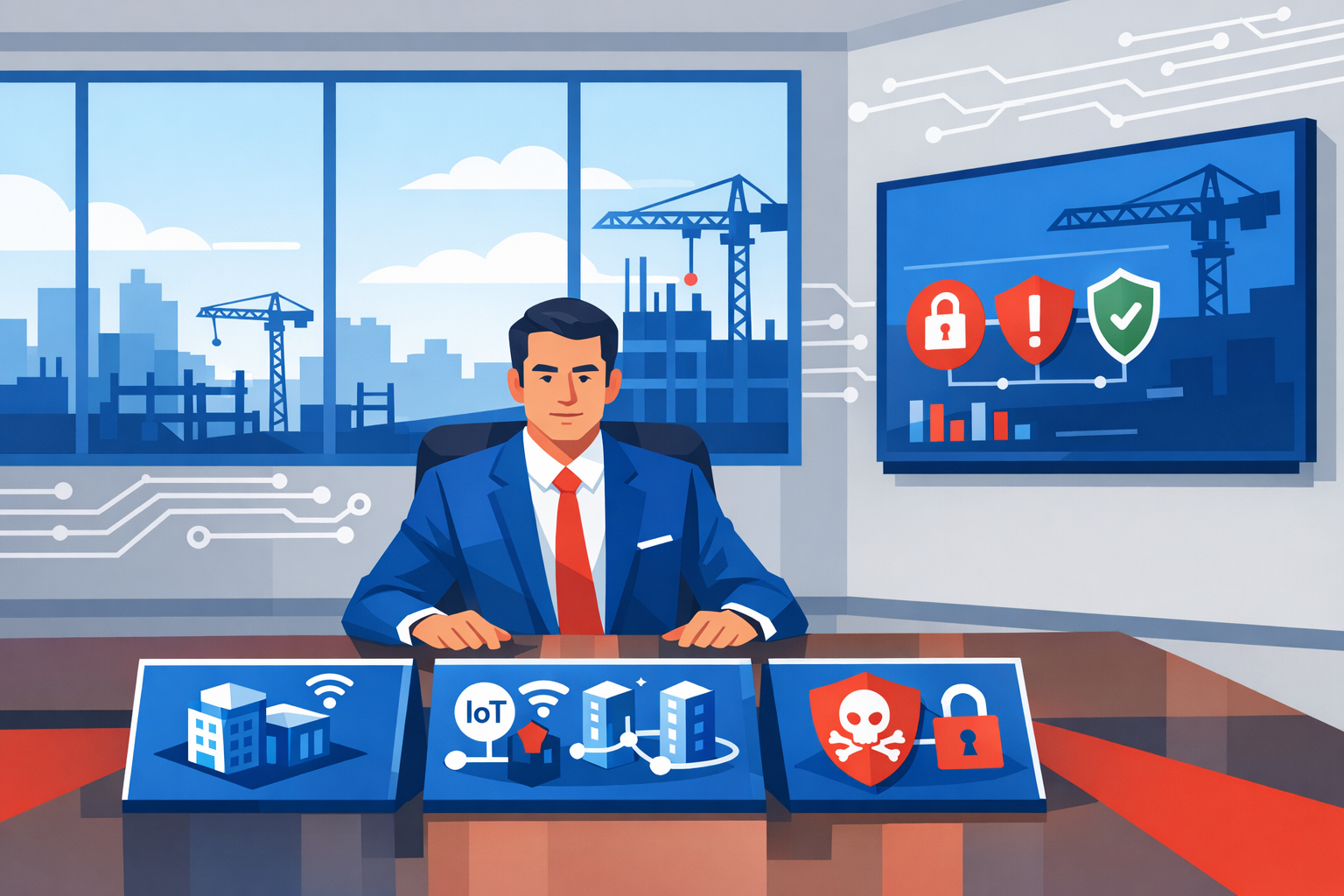
The construction sector now ranks among the three most targeted industries for cyberattacks globally, according to Rapid7, forcing firms to elevate cybersecurity leadership from an IT function to a core pillar of project governance. As modular fabrication, digital twins, and IoT-enabled machinery proliferate across healthcare, infrastructure, and commercial projects, a new category of cyber-physical risk has emerged - one where a compromised sensor or ransomware strike during a critical milestone can halt a job site, endanger workers, and cascade across fragmented supply chains.
Background
The construction industry faces an average of 226 cyber incidents annually, more than any other sector, according to managed detection and response provider ReliaQuest. That exposure has grown sharply alongside the industry's digital transformation. A 2025 report identified a 410% year-on-year increase in IoT malware activity targeting the construction sector, according to QBE European Operations. Ransomware appearances on data-leak sites for construction firms rose 41% over the prior year, according to ReliaQuest.
The convergence of information technology (IT) and operational technology (OT) systems - connecting BIM platforms, smart sensors, automated machinery, and cloud-based project management tools - has expanded the attack surface well beyond traditional IT perimeters. According to the UK's National Cyber Security Centre, a single compromised sensor can expose entire networks, and attackers can hijack connected equipment through "siegeware" attacks to freeze operations or demand ransom. If crane telemetry is breached or a safety system is shut down, the consequences extend into physical hazard territory, according to Giatec Scientific.
A peer-reviewed study published in Digital Applications in Archaeology and Cultural Heritage (ScienceDirect) warns that the transition from static BIM to dynamic digital twins introduces cybersecurity vulnerabilities, "especially in sectors like construction that are just beginning" to adopt them - and that technology-optimism bias has driven much of the industry's digital twin investment without adequate adversarial assessment.
Details
Despite the scale of exposure, only 35% of construction companies have a dedicated Chief Information Security Officer (CISO), according to Elliott Davis. That gap is closing under pressure. Among organizations broadly, the share of CISOs responsible for OT security has risen to 52%, up from just 16% in 2022, according to Help Net Security. In construction, industry gatherings such as the Advancing Construction Cybersecurity Summit have drawn participation from CISOs and security leaders at major contractors including Turner Construction, Kiewit Corporation, Baker Construction Enterprises, and MYR Group, reflecting board-level engagement with the issue.
In September 2025, a ransomware resurgence resulted in 562 publicly reported attacks in a single month, with construction and engineering as the most impacted sector, accounting for 11.4% of victims, according to Engineering News-Record. Ransomware incidents in 2025 resulted in an average of 24 days of operational downtime, according to QBE European Operations. The average cost of a ransomware attack on a small-to-mid contractor exceeds $240,000, excluding lost business and reputational harm, according to Vilogics.
Supply chain vulnerabilities represent a distinct and widening attack vector. In 2021, a widely used construction accounting platform was compromised, pushing malware to multiple contractors through a trusted software update, according to Giatec Scientific. State-sponsored threat actors compound the risk: according to Rapid7, adversaries linked to China, Russia, Iran, and North Korea have targeted BIM systems, cloud project platforms, and IoT-enabled heavy machinery to exfiltrate blueprints, bid documents, and infrastructure schematics.
Security researchers and practitioners have aligned on governance structures to reduce exposure without stalling digital programs. These include:
- IT/OT network segmentation - placing sensors and machinery on dedicated VLANs isolated from project files and financial systems
- Mandatory vendor risk clauses requiring cyber incident notification
- Incident response frameworks tested through tabletop exercises timed to construction milestones, now being integrated into project schedules at firms aligning with the NIST Cybersecurity Framework and ISO/IEC 27001 standards
According to a 2025 study published by Stanford University, 60% of organizational leaders identified cybersecurity as a key concern in technology adoption programs.
Researchers publishing in Digital Applications in Archaeology and Cultural Heritage argue that cybersecurity in the digital twin paradigm "should be viewed as a socio-technical challenge," requiring construction firms to foster a security culture that balances technological innovation, regulatory compliance, and infrastructure protection - extending accountability to engineers, subcontractors, and field operations teams, not only IT departments.
Outlook
Regulatory pressure is accelerating governance changes. Global frameworks including the EU's NIS2 Directive, the Cyber Resilience Act, and the U.S. Cyber Incident Reporting for Critical Infrastructure Act (CIRCIA) now impose obligations directly relevant to construction firms operating connected systems on critical projects. According to the World Economic Forum, some regulations explicitly require board-level reporting by the CISO. Firms that integrate incident playbooks and third-party risk assessments into procurement and project delivery are positioned to meet both compliance requirements and client demands - and to scale modular and AI-enabled construction programs without compounding cyber exposure.