Washington State Building Code Council targets 16 October adoption of 2024 IBC amendments extending single-stair multifamily provisions statewide
Washington's SBCC is targeting 16 October 2026 final adoption of 2024 IBC amendments that would extend single-stair multifamily construction statewide, building on Seattle's 1977 building code precedent.
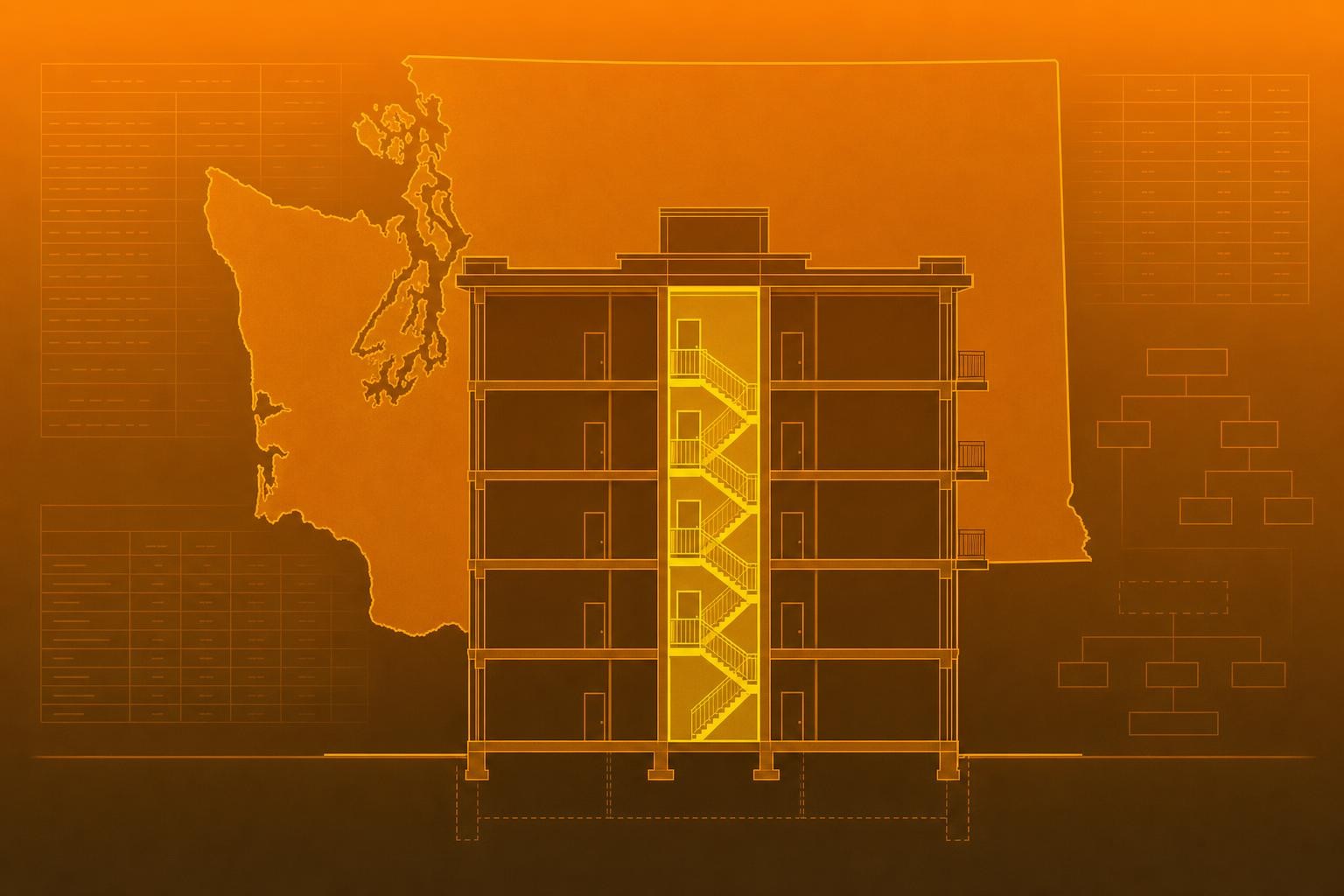
Washington State's Building Code Council (SBCC) is targeting 16 October 2026 for final adoption of its 2024 International Building Code amendments, a package that includes statewide single-stair provisions for multifamily residential buildings up to six stories - a reform mandated by the legislature in 2023 and modelled directly on a Seattle local amendment that has been in place since 1977. The rules, once adopted, will bind all jurisdictions across the state that do not maintain their own locally amended building codes.
Background: the Seattle precedent
Seattle's building code has permitted a single exit stairway to serve up to five stories of R-2 residential occupancy - with a maximum of four units per floor - in buildings up to six stories in height since 1977, under what is now codified as Section 1006.3.3, item 7 of the 2018 Seattle Building Code. The provision traces to a 1973 advisory committee convened by Mayor Wes Uhlman to examine how the building code could encourage in-city living and new construction on small urban lots.
The Pike and Virginia Building, completed in 1978 with a view of Seattle's Pike Place Market, initiated the housing style locally known as the "Seattle Special" - a multifamily dwelling built up to six stories in height on a small urban infill lot, served by a single staircase. Until recently, Seattle, Honolulu, and New York City were the only US cities to allow single-stair housing up to six stories in height.
The single-stair configuration matters for infill economics. On many infill sites, a second stairwell means fewer windows for residents, fewer units, less ventilation, more blank exterior walls, and ultimately higher rent - because the buildings are much less efficient. Multifamily buildings with two stairways typically need more than a quarter of an acre per floor to meet underwriting requirements in North American markets, which is far larger than many small infill lots, even before accounting for setbacks, landscaping, and other design criteria that limit the buildable area of a lot.
The legislative mandate and SBCC rulemaking
Washington's legislature directed the SBCC to act through Senate Bill 5491, enacted in 2023. The SBCC was required to convene a technical advisory group to recommend modifications and limitations to the International Building Code that would allow a single exit stairway to serve multifamily residential structures up to six stories above grade plane. The recommendations were required to include considerations for adequate and available water supply, the presence and response time of a professional fire department, and any other provisions necessary to ensure public health, safety, and general welfare. The council was required to take action to adopt additions and amendments to rules or codes as necessary by 1 July 2026.
The SBCC's technical advisory group developed a draft appendix to the 2024 IBC that mirrors the core parameters of Seattle's existing local amendment. The provision would allow apartment buildings up to six stories to be served by a single staircase - rather than the two required by conventional building codes - when enhanced safety requirements are met, including full sprinkler systems, fire-resistant construction, a maximum of four units per floor, and pressurised elevator lobbies.
The SBCC filed its CR-102 proposed rules for the 2024 IBC, IRC, IMC, IFC, and Uniform Plumbing Code on 6 May 2026. The public comment period opened on 6 May 2026 and closed on 12 June 2026. Hearings were held on 10 June and 12 June 2026. Final adoption for these codes is targeted for 16 October 2026.
The single-stair appendix is included in that package. If adopted on schedule, the 2024 Washington State Building Code would make single-stair multifamily construction available to any jurisdiction in the state, not just Seattle. Jurisdictions that maintain their own locally amended codes - including Seattle itself - would need to separately adopt or align with the new statewide appendix, or continue under their existing local provisions.
What the code change affects
The single-stair provisions apply to Group R-2 multifamily residential occupancies. Affected trades include:
- Architects and structural engineers designing multifamily buildings on lots under approximately 5,000 square feet, where a second stairwell would consume a disproportionate share of the floor plate
- General contractors and developers working on urban infill sites in cities across Washington that currently lack Seattle's local amendment
- Fire protection contractors, given that the appendix requires full automatic sprinkler systems and fire-resistance-rated construction as compensating measures
- Building officials in jurisdictions that will need to determine whether to adopt the new appendix locally or defer to the statewide standard
The authority having jurisdiction determines how the appendix applies to specific projects; the SBCC's adopted text will be the reference instrument.
Broader context
Washington's move is part of a wider national shift. At least 19 states have considered some version of single-stair reform, and major cities such as New York, Seattle, and Honolulu allow single stairways in up to six-story buildings. In 2025, Colorado Governor Jared Polis signed the bipartisan HB 1273 into law, requiring municipalities of at least 100,000 people to adopt building code language that allows the construction of five-story apartment buildings served by a single stairway. Municipalities are given until 1 December 2027 to adopt the new building code language.
In the past two years, Colorado, Connecticut, Maine, Montana, New Hampshire, Oregon, and Texas have also approved the single-staircase code change for small multifamily buildings four to six stories tall. Connecticut subsequently reversed its decision, according to the same source.
Washington's SBCC is also running a separate rulemaking track for the 2024 Washington State Energy Codes. The SBCC filed CR-102 for the commercial and residential energy codes on 1 July 2026, with a public comment period that closed on 7 August 2026. Final adoption for the energy codes is targeted for 20 November 2026.
The 16 October target date for the 2024 IBC package - including the single-stair appendix - is the date to watch for contractors, developers, and building officials working on multifamily infill projects across Washington State. The SBCC has not published a proposed effective date for the adopted code; that determination will follow adoption.
Written by Construction Trade News's automated desk from the sources above and reviewed before publication. How we work.
Related
Kleemann's MOBIREX MR 100 NEOe electric impact crusher makes its market première at Asphaltica 2026
Kleemann unveiled the MOBIREX MR 100 NEOe at Asphaltica 2026 in Bologna - a fully electric compact impact crusher with 160 kW crushing power and up to 250 t/h feed capacity.
15 Oct 2026 News
NewsIcon closes $200M Series D to manufacture its Titan robotic printer in Austin
Austin-based Icon raised $200M in Series D funding to manufacture its Titan multi-story 3D-printing system and open a new R&D facility in Texas.
15 Oct 2026 News
NewsArcosa stockholders approve CRH's $8.5bn all-cash takeover, clearing the way for a Q1 2027 close
Arcosa stockholders voted on 4 September 2026 to approve CRH's $8.5bn all-cash acquisition of the Dallas-based aggregates and infrastructure products group, with closing now subject to regulatory clearance.
15 Oct 2026