San Diego adopts 2025 California Building Standards Code with local WUI and geotechnical amendments, effective April 2026
San Diego's City Council adopted the 2025 California Building Standards Code with local amendments in March-April 2026. Here is what the ordinances say and who they bind.
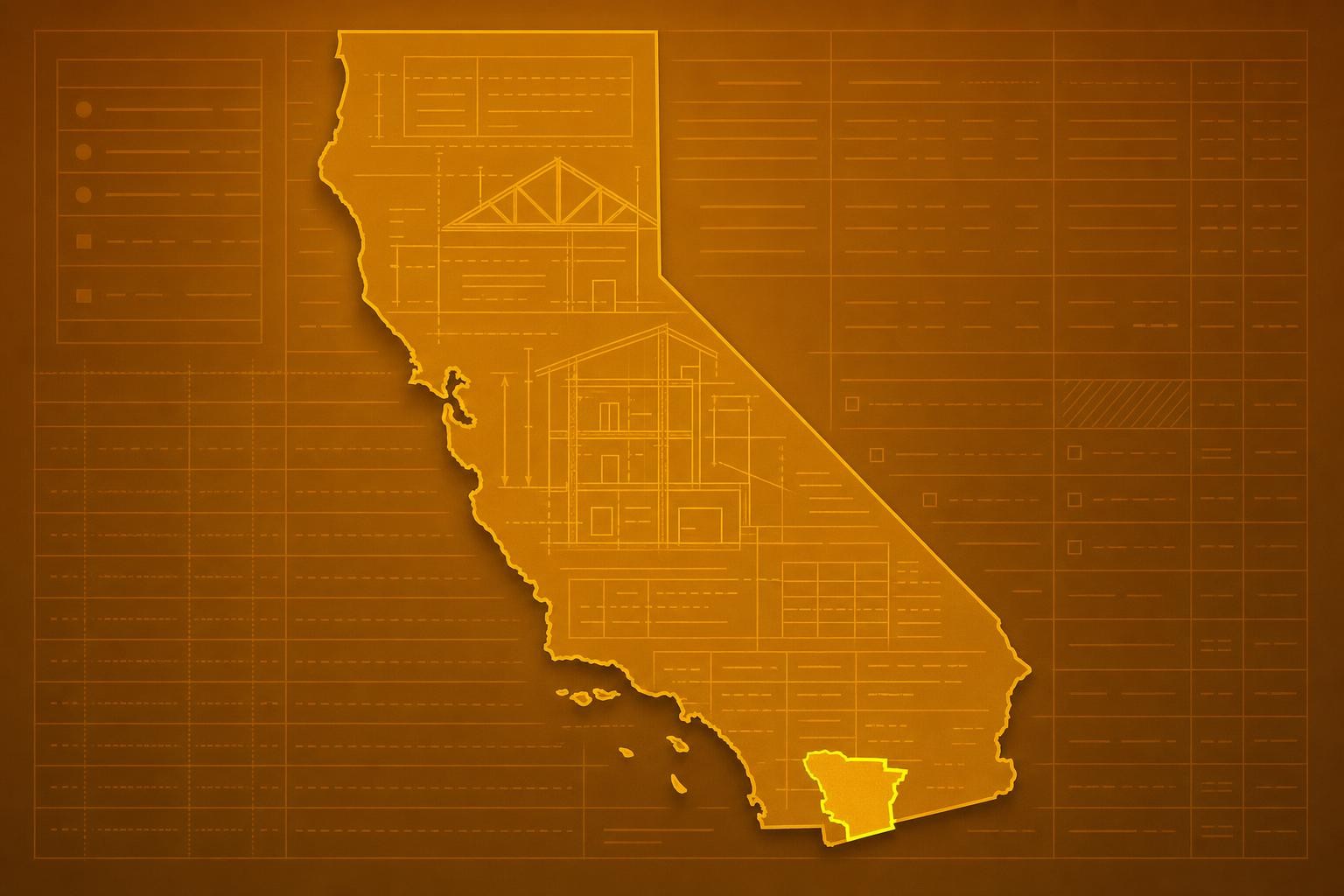
The City of San Diego, a municipal jurisdiction in California, has adopted the 2025 California Building Standards Code (Title 24) with local amendments, with the WUI and Fire Code amendments taking effect first and the broader building code local amendments following in April 2026. The 2025 California Building Standards Code took effect statewide on 1 January 2026 for all permit applications submitted on or after that date; projects submitted before 1 January 2026 remain governed by the 2022 edition. The local amendments bind contractors, designers, and building officials working on permitted construction within city limits.
What the city adopted and when
San Diego's adoption proceeded in two tracks. The City Council first enacted Ordinance O-22042, which codified the city's local amendments to the 2025 California Wildland-Urban Interface Code (Title 24, Part 7) and the California Fire Code, in the San Diego Municipal Code (SDMC) Chapter 5, Article 12. The California Building Standards Commission received the Notice of Exemption on 25 March 2026, confirming final passage.
The broader building code local amendments - covering the 2025 California Building Code, Electrical Code, Plumbing Code, Mechanical Code, Residential Code, Green Building Standards Code, and Existing Building Code - were published in April 2026 and are codified in SDMC Chapters 12 and 14.
The 2025 California Building Standards Code is based on the 2024 International Building Code (IBC), amended extensively by the state before local jurisdictions added their own modifications.
The WUI amendments: what changed
The most consequential local action is San Diego's adoption of the 2025 California Wildland-Urban Interface Code (CWUIC) with city-specific additions. The 2025 CWUIC is itself a new standalone code - Title 24, Part 7 consolidates wildfire safety requirements that were previously scattered across CBC Chapter 7A, CRC Chapter R337, CFC Chapter 49, and other sections into a single instrument.
San Diego's local additions go beyond the state baseline on several points:
- Zone 0 landscaping: No landscape materials likely to be ignited by embers are permitted within the immediate defensible space zone (Zone 0) around a structure. The requirement applies to new structures from 1 January 2026 and to existing structures one year thereafter, with a compliance plan available.
- Vinyl window reinforcing (CFC Section 504.8.3, added locally): Glazing frames made of vinyl materials must have welded corners and metal reinforcement - a home-hardening measure justified by San Diego's climatic and topographical wildfire exposure.
- Setback provisions: SDMC Chapter 5, Article 12, Division 06 (sections 512.0601 et seq.) includes local setback reduction and setback-from-slope provisions at CWUIC Sections 608.2.1 and 608.2.2.
The WUI code applies to all new buildings in any Fire Hazard Severity Zone or Wildland-Urban Interface Fire Area designated by the enforcing agency, including residential, commercial, educational, and institutional occupancies, as well as accessory structures.
In 2025, CAL FIRE released updated Fire Hazard Severity Zone maps that significantly expanded designated areas, particularly in neighborhoods adjacent to open space, meaning more San Diego parcels now fall under WUI requirements than under the prior cycle.
Other substantive local amendments
The April 2026 building code local amendments address three additional areas of substance:
- Geotechnical investigations: Exemptions in SDMC Chapter 14, Article 5, Division 18 were updated to align with AB 1046 (Alquist-Priolo) requirements for additions and alterations, bringing San Diego into line with other large California cities.
- Efficiency dwelling units: The city repealed its prior local amendment that set a minimum habitable space area for efficiency units. These units are now regulated solely by the California Building Code, removing a layer of local restriction.
- Drowning prevention: The city adopted amendments from the CBC appendix on swimming pool safety and added a local clarification on simultaneous use, codified in SDMC Chapter 12.
Trades directly affected include general contractors, structural engineers, geotechnical engineers, fire protection contractors, landscape contractors working in WUI zones, and pool and spa installers.
Code cycle freeze and permit transition
California Assembly Bill 130 froze updates to all residential building codes, making the 2025 edition the last update until at least 2031 - a six-year cycle rather than the standard three. That freeze amplifies the compliance significance of this adoption: design decisions made now under the 2025 CBSC will govern permitted work for an extended period.
For permit timing, the state rule is clear: applications submitted before 1 January 2026 are reviewed under the 2022 California Building Standards Code. Applications submitted on or after 1 January 2026 are subject to the 2025 CBSC. San Diego's local amendments layer on top of the state baseline once each ordinance reaches final passage and is filed with the California Building Standards Commission.
The authority having jurisdiction for code interpretation and enforcement within city limits is the City of San Diego Development Services Department. Questions about which Fire Hazard Severity Zone designation applies to a specific parcel should be directed to the San Diego Fire-Rescue Department or verified against the OSFM Fire Hazard Severity Zone Viewer.
San Diego County - a separate jurisdiction from the City - held its second reading for triennial building code adoption on 4 March 2026, with its own set of local amendments that differ from the city's. Contractors working across both jurisdictions should verify which instrument governs each project site.
Written by Construction Trade News's automated desk from the sources above and reviewed before publication. How we work.
Related
Kleemann's MOBIREX MR 100 NEOe electric impact crusher makes its market première at Asphaltica 2026
Kleemann unveiled the MOBIREX MR 100 NEOe at Asphaltica 2026 in Bologna - a fully electric compact impact crusher with 160 kW crushing power and up to 250 t/h feed capacity.
15 Oct 2026 News
NewsIcon closes $200M Series D to manufacture its Titan robotic printer in Austin
Austin-based Icon raised $200M in Series D funding to manufacture its Titan multi-story 3D-printing system and open a new R&D facility in Texas.
15 Oct 2026 News
NewsArcosa stockholders approve CRH's $8.5bn all-cash takeover, clearing the way for a Q1 2027 close
Arcosa stockholders voted on 4 September 2026 to approve CRH's $8.5bn all-cash acquisition of the Dallas-based aggregates and infrastructure products group, with closing now subject to regulatory clearance.
15 Oct 2026