RenewAire's Aeri MT brings a 25 lb EPP foam cabinet to residential ERV specification
RenewAire's Aeri MT (ET-255MF-P340-XC0) is North America's first ERV in an EPP foam enclosure, weighing 25 lb and rated at 2.11 CFM/watt under HVI/CSA C439 testing.
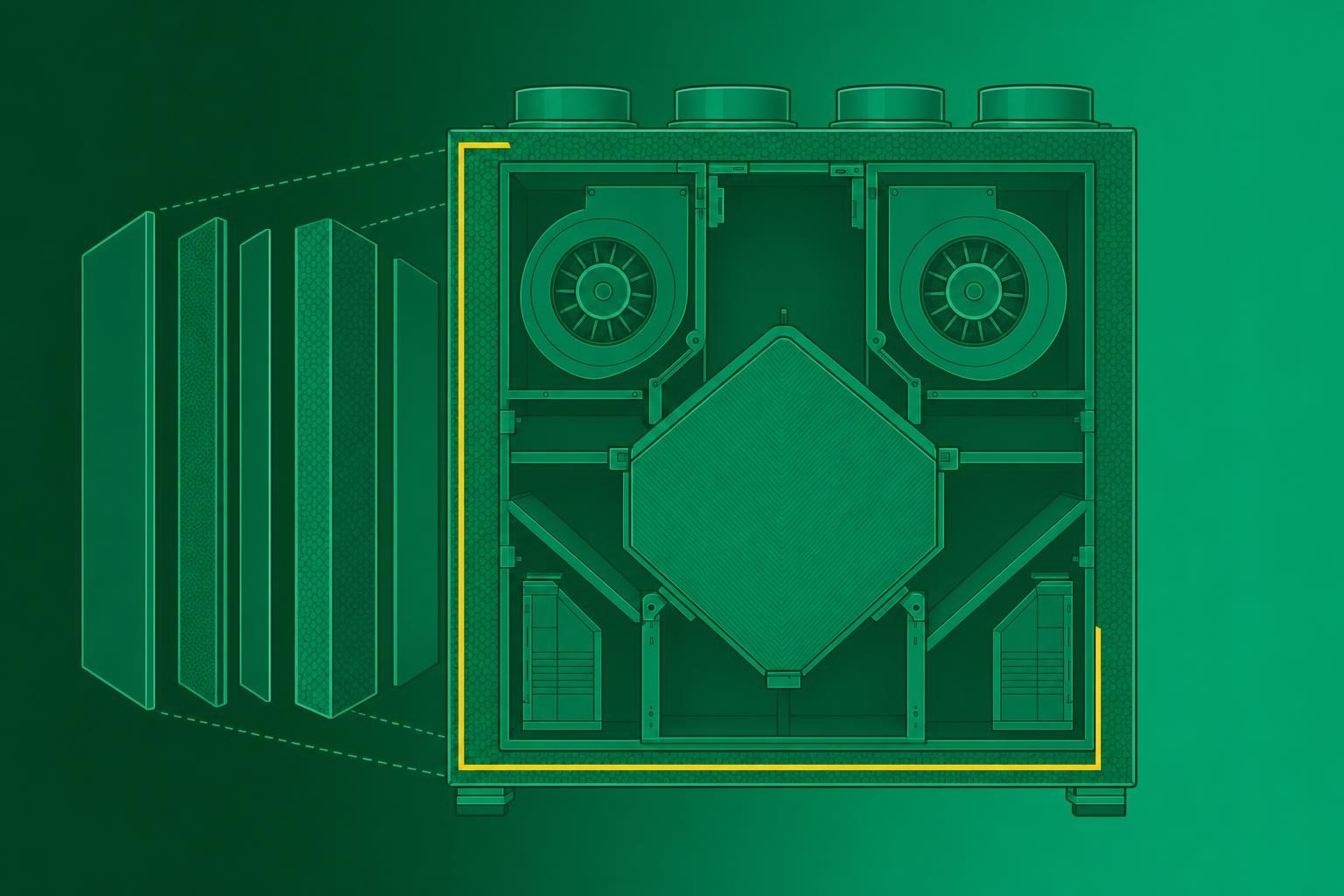
RenewAire's Aeri MT (model ET-255MF-P340-XC0) is North America's first energy recovery ventilator built around a lightweight expanded polypropylene (EPP) foam enclosure, a cabinet material shift that cuts unit weight to 25 lb and changes how the product is handled, mounted, and balanced on residential and multi-family projects.[1]
Cabinet material and what it means for the assembly
The closed-cell charcoal-gray foam is highly resistant to compression, fire, chemicals, and impacts, while also exhibiting excellent thermal insulating characteristics and low moisture absorption. Cabinet walls and doors are 1 in. expanded polypropylene foam. That built-in thermal resistance matters in cold-climate installations: the cabinet itself acts as insulation around the core, reducing the risk of surface condensation without requiring additional wrap.
The CSI specification requires that Aeri MT units operate without condensing or frosting under normal operating conditions, defined as outside temperatures above -10 °F and inside relative humidity below 40%. Specifiers working in Climate Zones 6 and 7 - where that threshold is regularly approached - should verify that the installation location and duct routing keep return-air humidity within that envelope.
The unit is certified by ETL, UL, and the Home Ventilating Institute (HVI) against standard CAN/CSA C439-18, and the core passes UL-723 and UL-1812 flammability requirements. It also carries a cULus listing and meets NFPA 90A standards.
Core and energy-transfer performance
The Aeri MT is a multi-speed air-to-air ERV containing a static-plate, cross-flow core that transfers both sensible and latent energy between the exhaust and supply airstreams; the airstreams do not mix, and pollutants are not transferred across partition plates.
The system uses one L-50-G5 static-plate core for total energy recovery; this cellulosic-based core contains no PVCs or halogenated flame retardants.
Key HVI-certified performance figures for the Aeri MT (ET-255MF-P340-XC0):
- Airflow range: 35-255 CFM, top-port configuration
- Power consumption: 2.11 CFM/watt at HVI-rated conditions (CAN/CSA C439-18)
- Sensible recovery effectiveness (SRE) at 78 CFM: 73%
- Five constant-volume setpoints: 35, 70, 110, 150, and 190 CFM
The CSI specification states that power consumption shall be 2.11 CFM/watt at HVI-tested and rated performance conditions, and that the SRE at 78 CFM shall be 73%.
Installation features relevant to contractors
The Aeri MT uses Snap-N-Go™ duct collars, which allow flexible ducts to be attached and sealed at ground level before the unit is lifted into position - a meaningful ergonomic change on ceiling-mount applications. Weighing only 25 lb, the EPP cabinet can be mounted on walls, ceilings, or floors. Because the unit requires no condensate drain, it allows for flexible mounting in various indoor orientations.
The five smart constant-volume setpoints automatically keep the unit running at the set CFM even as filters start clogging or duct pressures fluctuate with the cycling of the central air-handling unit. That self-balancing behavior reduces post-installation commissioning time on multi-unit residential projects where dozens of ERVs may be installed in sequence.
The unit comes standard with MERV 8 filters, with an optional MERV 13 upgrade for the outdoor airstream. The core does not require washing; annual maintenance consists of vacuuming the four core faces with a soft brush, and filters should be inspected every three months and replaced as necessary.
All RenewAire ERVs carry an industry-leading 10-year structural and performance warranty for the static-plate core.
What to watch
The Aeri MT's EPP enclosure is the first application of that material class in a certified residential ERV in North America, and its performance under long-term field conditions - particularly freeze-thaw cycling in cold climates - will be worth tracking as installations accumulate. Specifiers should confirm that the -10 °F condensation threshold aligns with design conditions before specifying the unit in the coldest heating zones, and should note that the MERV 13 outdoor-air filter is an accessory rather than a standard inclusion when writing ventilation specifications.
Written by Construction Trade News's automated desk from the sources above and reviewed before publication. How we work.
Related
CASE adds three D Series 3-ton mini excavators with zero tailswing and load-sensing hydraulics
CASE Construction Equipment launched the CX30D, CX34D and CX38D on 17 June 2026, filling the 3-ton class with zero-tailswing machines powered by a 24.4 hp Kubota engine.
10 Sept 2026 News
NewsSimplar Foundation study finds multiskilled U.S. construction crews cut idle time by 68% and post safety rates 57% below industry average
A first-ever national field study on multiskilling in U.S. construction finds a 39% jump in productive crew time and a total recordable incident rate 57% below the industry benchmark.
10 Sept 2026 Codes
CodesOakland adopts 2025 California Building Standards Code with FlexPath and Electric Readiness amendments, effective 1 January 2026
Oakland's 2025 Title 24 adoption - with FlexPath and Electric Readiness reach codes - took effect 1 January 2026, and AB 130 locks in residential standards until 1 June 2031.
10 Sept 2026