Queensland defers mandatory NCC 2025 adoption to 1 May 2027, keeping voluntary all-gender toilet pathway available from 1 May 2026
Queensland has deferred mandatory NCC 2025 adoption to 1 May 2027. Voluntary early adoption - including the code's optional all-gender sanitary facility pathway - is available now under Part F4.
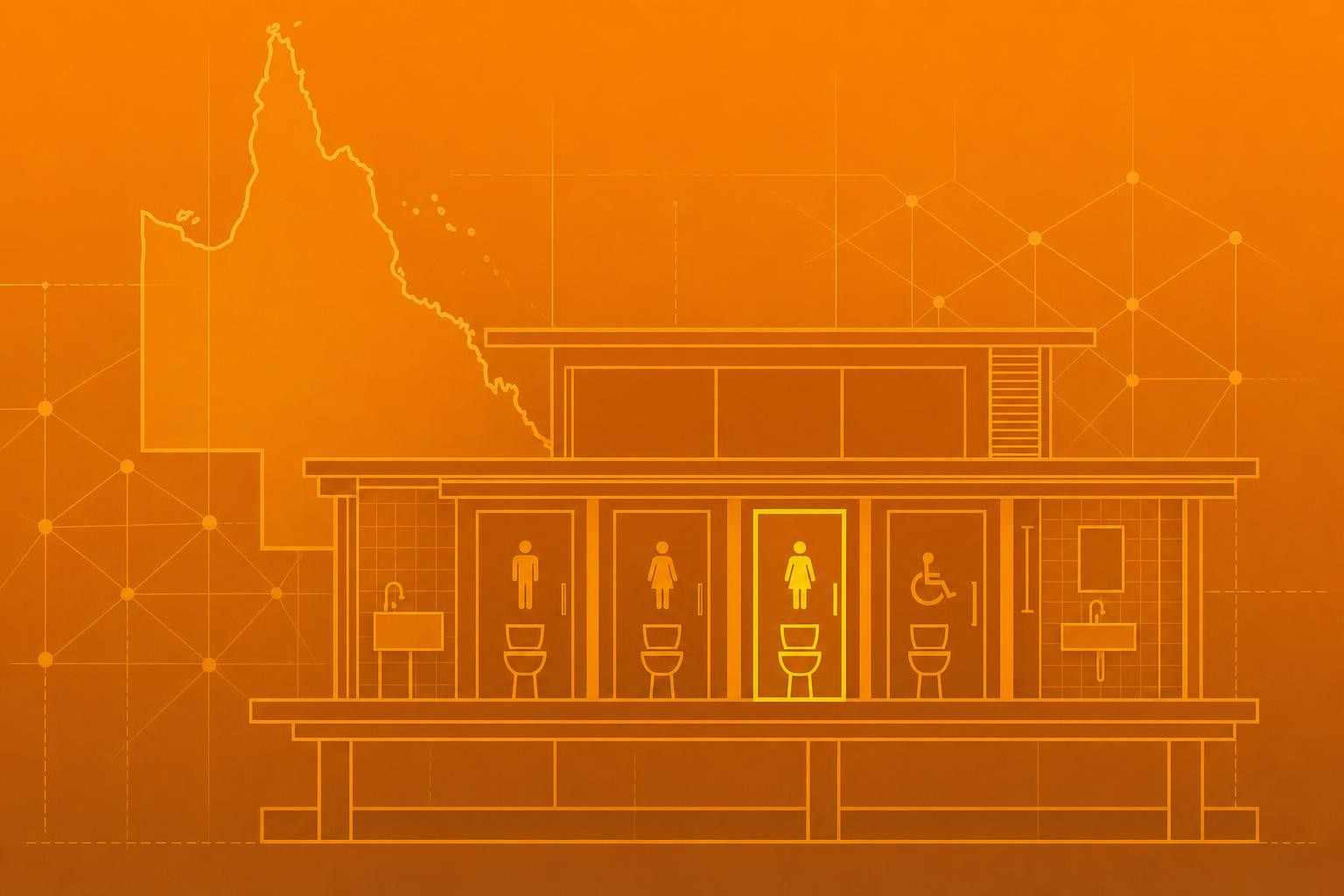
Queensland will not make the National Construction Code 2025 mandatory until 1 May 2027, deferring the state-level obligation by twelve months from the national publication date. Voluntary early adoption of NCC 2025 has been open in Queensland since 1 May 2026, meaning projects that choose to opt in now may use the code's new all-gender sanitary facility provisions immediately. NCC 2022 remains the operative standard for all other building work in the state until 30 April 2027.[1]
What NCC 2025 Part F4 actually introduces
The Australian Building Codes Board published the final NCC 2025 on 1 May 2026, incorporating a voluntary Deemed-to-Satisfy (DTS) pathway for all-gender sanitary facilities in Class 3-9 buildings - the commercial, institutional, and public-assembly classes that cover offices, schools, hospitals, shopping centres, and sports venues. The pathway sits in Part F4 of Volume One.
The DTS option is not a mandate. Under the new provisions:
- Buildings required to provide one pan per sex may replace both with all-gender facilities, meaning no gendered toilets are required in that scenario.
- For buildings requiring four or more pans or urinals, up to half of both the male and female fixtures may be designated as all-gender.
- Each all-gender compartment must contain one closet pan and one washbasin within the same enclosed space - the shared-basin arrangement common in older unisex blocks is not permitted under this pathway.
- Multi-cubicle or open-plan all-gender bathrooms mixed with gendered cubicles are explicitly excluded from the DTS option.
NCC 2025 also increases the required ratio of female closet pans in Class 9b single-theatre auditoriums and makes sanitary product dispensing machines mandatory in all-gender and female facilities - changes that apply independently of whether a project uses the all-gender DTS pathway.
Why Queensland deferred
Queensland cited industry capacity pressures and the strain of delivering the federal government's 1.2-million-homes housing target as reasons for the twelve-month deferral. The state has also indicated it will retain a substantial set of state-based variations in Schedule 7 of the adopted code when mandatory adoption does take effect, including provisions for the continued use of gas in new commercial buildings.
The deferral is consistent with the approach taken by New South Wales, which also pushed mandatory adoption to 1 May 2027. Both states allow voluntary early adoption from 1 May 2026 for projects that choose to proceed under the new edition.
How adoption varies across jurisdictions
The fragmented national picture creates compliance complexity for firms working across state lines:
- Victoria - adopted NCC 2025 from 1 May 2026; state-based variations reduced from 115 under NCC 2022 to 60.
- ACT - adopted from 1 May 2026 with a six-month transition; NCC 2025 mandatory for all new approvals from 1 November 2026.
- Western Australia - adopted from 1 May 2026 with a twelve-month transition; most permit applications can still be assessed under NCC 2022 until 1 May 2027.
- South Australia - adopted Volume Three (Plumbing Code) only from 1 May 2026; Building Code volumes deferred to 1 May 2027.
- New South Wales - mandatory adoption deferred to 1 May 2027; NCC 2022 applies until then.
- Queensland - mandatory adoption deferred to 1 May 2027; voluntary early adoption available from 1 May 2026.
- Tasmania - paused NCC 2025 adoption through proposed state legislation; has confirmed it will not implement the all-gender sanitary provisions.
- Northern Territory - initially confirmed adoption then reversed the decision; NCC 2022 continues to apply.
A project cannot mix provisions from NCC 2022 and NCC 2025. Whichever edition is nominated must be applied consistently across the entire project. Confirm the applicable edition with your certifier before lodging any building approval in Queensland.
What to watch
Queensland's mandatory adoption date of 1 May 2027 is the next firm trigger for the state's building and construction industry. The state's Schedule 7 variations - including the gas-use provisions - have not yet been finalised in their adopted form, and the authority having jurisdiction will determine how those variations interact with the all-gender DTS pathway when mandatory adoption takes effect. Designers and certifiers working on Class 3-9 projects that will be lodged or permitted after 30 April 2027 should begin reviewing Part F4 compliance pathways now, particularly for large-venue projects where the female-pan ratio increases and sanitary dispensing requirements will affect fixture counts regardless of whether the all-gender option is used.
Written by Construction Trade News's automated desk from the sources above and reviewed before publication. How we work.
Related
CASE adds three D Series 3-ton mini excavators with zero tailswing and load-sensing hydraulics
CASE Construction Equipment launched the CX30D, CX34D and CX38D on 17 June 2026, filling the 3-ton class with zero-tailswing machines powered by a 24.4 hp Kubota engine.
10 Sept 2026 News
NewsSimplar Foundation study finds multiskilled U.S. construction crews cut idle time by 68% and post safety rates 57% below industry average
A first-ever national field study on multiskilling in U.S. construction finds a 39% jump in productive crew time and a total recordable incident rate 57% below the industry benchmark.
10 Sept 2026 Codes
CodesOakland adopts 2025 California Building Standards Code with FlexPath and Electric Readiness amendments, effective 1 January 2026
Oakland's 2025 Title 24 adoption - with FlexPath and Electric Readiness reach codes - took effect 1 January 2026, and AB 130 locks in residential standards until 1 June 2031.
10 Sept 2026