Morocco renames its $1bn Tiznit-Dakhla expressway the Donald J. Trump Highway
Morocco has renamed its 1,055 km Atlantic coast expressway the Donald J. Trump Highway, honouring US recognition of Moroccan sovereignty over Western Sahara.
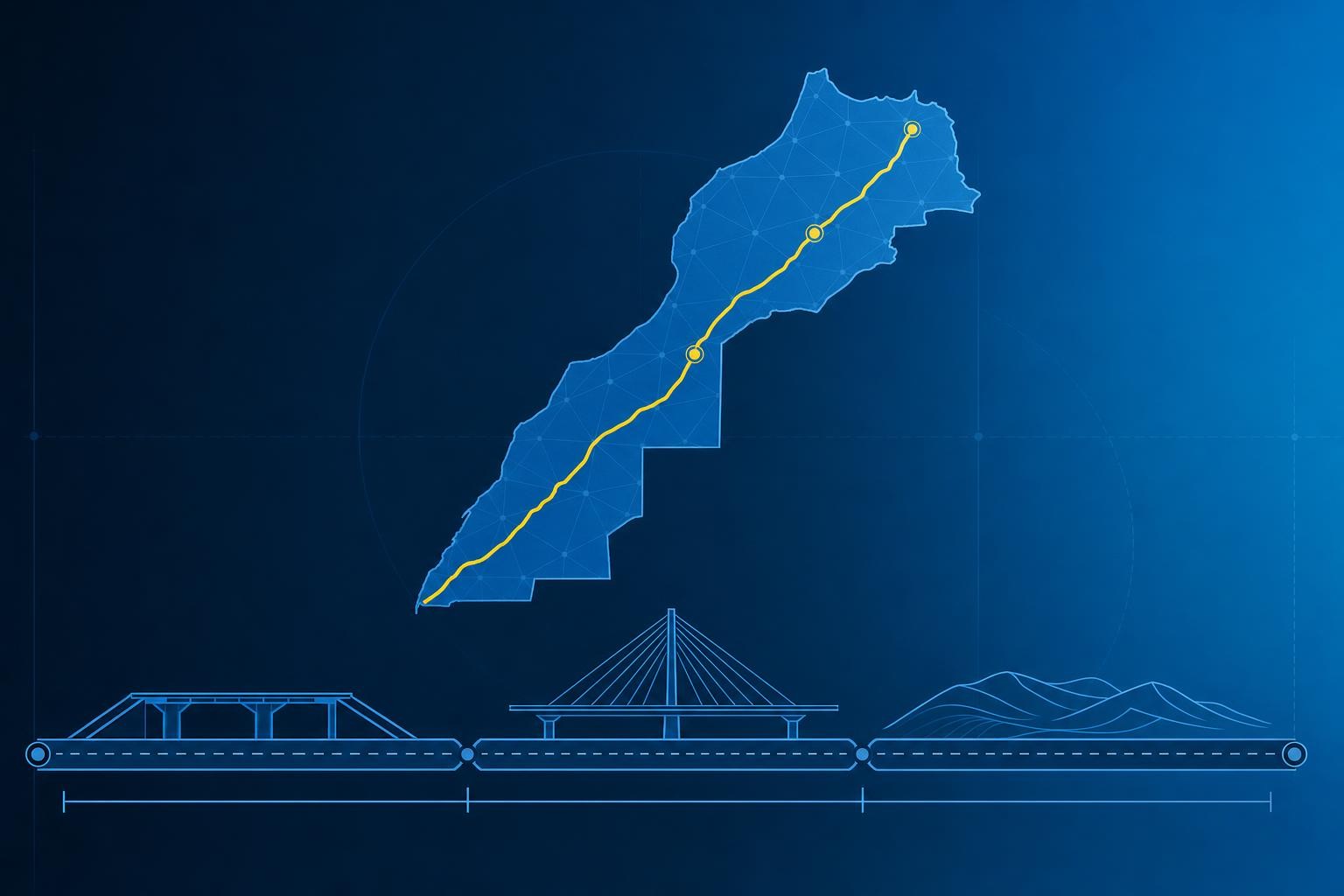
Morocco has renamed its flagship Atlantic coast expressway the Donald J. Trump Highway, King Mohammed VI confirmed in a letter to the US president dated 2 July 2026[1]. The road, formerly known as the Tiznit-Dakhla expressway, stretches 1,055 km along Morocco's Atlantic seaboard from Tiznit in the south-west down through Western Sahara to Dakhla[1]. It became fully operational on 10 January 2026 after nearly a decade of construction[1].
A decade-long build at roughly $1bn
Morocco launched the project in 2015 as part of a development programme for its southern provinces, at a total cost of approximately 10 billion dirhams (around $1bn). The expressway was built in three sections:
- Laayoune-Dakhla: 500 km, completed first at a cost of 1 billion dirhams
- Guelmim-Laayoune: 436 km, costing 5 billion dirhams ($500m) and requiring multiple river bridges across difficult desert terrain
- Tiznit-Guelmim: the final 114 km link, finished in November 2025 and opened to traffic on 10 January 2026
The project involved more than 36 contractors, study offices and laboratories, all Moroccan, and generated approximately 2.5 million working days of labour. King Mohammed VI has described it as Africa's "longest road infrastructure"[1].
The diplomatic backdrop
The renaming is a direct acknowledgement of the Trump administration's December 2020 decision to recognise Moroccan sovereignty over Western Sahara - a move made as part of the Abraham Accords, under which Morocco normalised relations with Israel[1]. Since then, Israel and Paraguay have also recognised Moroccan sovereignty over the territory[1].
In his letter, Mohammed VI said the highway "unifies our country, in much the same way your leadership has brought our two nations closer to each other in unprecedented ways"[1]. Trump publicly thanked the king on Truth Social, calling the honour "such a great honor" and expressing hope to travel the road's full length.
The gesture is not without controversy. In June 2026, the UN Special Committee on Decolonisation issued a statement noting it remained divided over the future of Western Sahara[1]. The Polisario Front, backed by Algeria, continues to contest Moroccan control of the territory.
The road as trade artery
The highway's commercial rationale is inseparable from its political symbolism. The expressway feeds directly into the Dakhla Atlantic Port, a deep-water facility under construction roughly 40 km north of Dakhla city. The port, valued at between $1.2bn and $1.6bn, had reached 62% completion as of June 2026, with its 1.3 km maritime bridge 85% complete. The Ministry of Equipment and Water is overseeing the build, with full commercial operations targeted for 2029. Designed to handle 35 million tonnes of cargo annually, the port is intended to serve as a gateway linking landlocked Sahel nations to Atlantic trade routes[1].
The highway also forms part of Morocco's broader Royal Vision programme to develop the Atlantic coast of Africa[1].
The pace of terminal-operator tendering at Dakhla port - expected to begin in 2027 - will be the clearest near-term signal of whether the infrastructure corridor is attracting the international commercial interest Morocco is counting on.
Written by Construction Trade News's automated desk from the sources above and reviewed before publication. How we work.
Related
CASE adds three D Series 3-ton mini excavators with zero tailswing and load-sensing hydraulics
CASE Construction Equipment launched the CX30D, CX34D and CX38D on 17 June 2026, filling the 3-ton class with zero-tailswing machines powered by a 24.4 hp Kubota engine.
10 Sept 2026 News
NewsSimplar Foundation study finds multiskilled U.S. construction crews cut idle time by 68% and post safety rates 57% below industry average
A first-ever national field study on multiskilling in U.S. construction finds a 39% jump in productive crew time and a total recordable incident rate 57% below the industry benchmark.
10 Sept 2026 Codes
CodesOakland adopts 2025 California Building Standards Code with FlexPath and Electric Readiness amendments, effective 1 January 2026
Oakland's 2025 Title 24 adoption - with FlexPath and Electric Readiness reach codes - took effect 1 January 2026, and AB 130 locks in residential standards until 1 June 2031.
10 Sept 2026