Komatsu and AIM Intelligent Machines move autonomous bulldozers and excavators into commercial deployment in the U.S.
Komatsu and its Earthbrain subsidiary have entered a strategic partnership with AIM Intelligent Machines to bring autonomous bulldozers and hydraulic excavators to U.S. jobsites, with commercial deployment already underway.
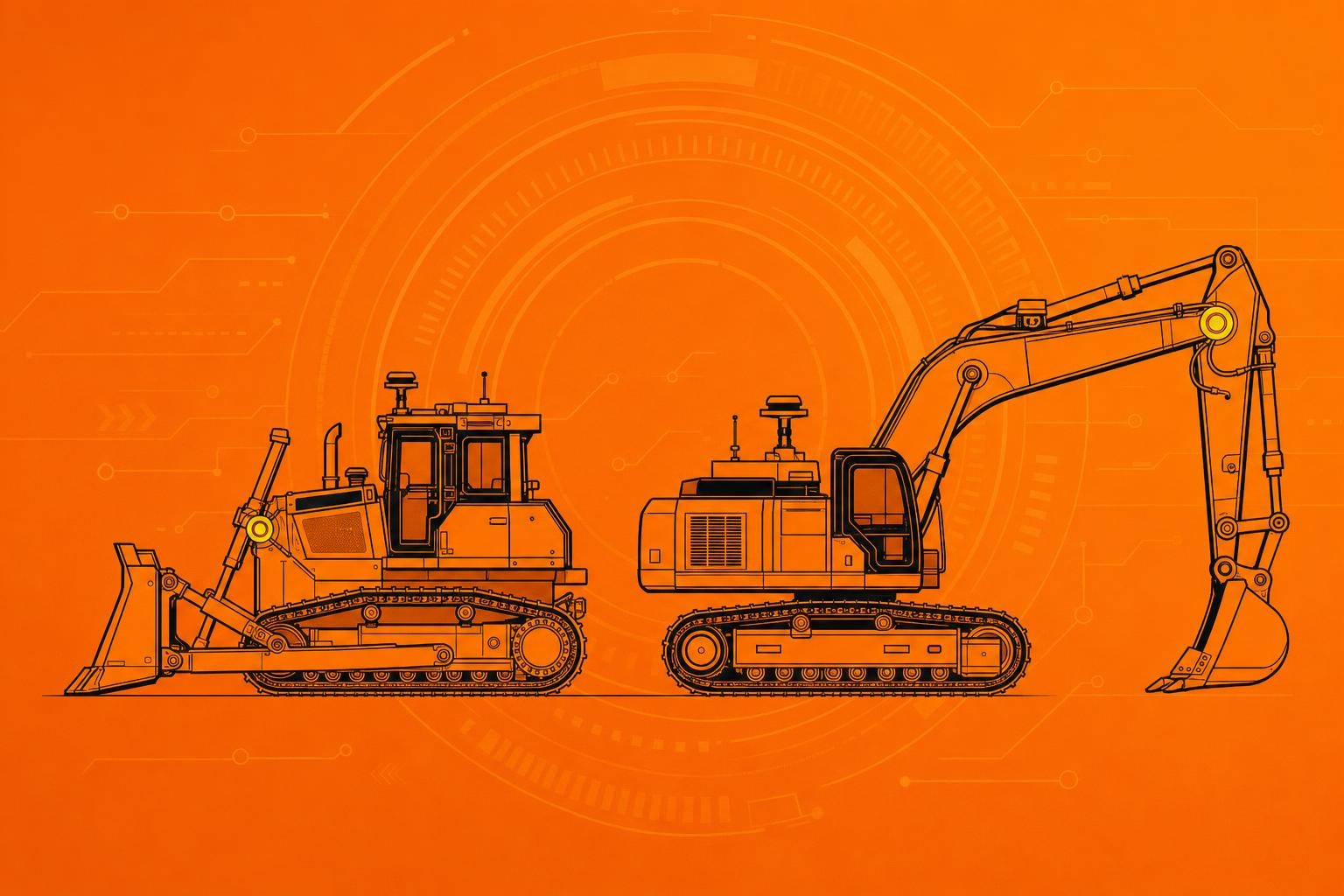
Komatsu Ltd. and its subsidiary Earthbrain Ltd. announced a strategic partnership with AIM Intelligent Machines on 3 August 2026 to deliver autonomous operation technology for bulldozers and hydraulic excavators, with the collaboration already in the commercial deployment phase in the U.S. market.Komatsu autonomous machines built on AIM's platform are already operating at customer jobsites in the United States as of August 2026, with a Japanese market introduction planned from 2027.
What the partnership delivers
The solution integrates Smart Construction-generated construction plans and target terrain data with AIM's physical AI platform to enable autonomous operation of bulldozers and hydraulic excavators. Once connected, machines can interpret project objectives, autonomously determine construction methods and travel routes, and execute earthmoving tasks independently.
The workflow is designed as a single end-to-end pipeline. Customers manage every stage - from planning and autonomous operation through to progress visualization and performance data - without switching between separate tools. Komatsu and Earthbrain supply the Smart Construction digital management layer; AIM supplies the autonomy stack that sits on the machine itself.
A key commercial feature is retrofit compatibility. AIM's technology can be retrofitted to existing bulldozers and hydraulic excavators regardless of make, model, size, or age, which means contractors can introduce autonomous operation across a current fleet without waiting for a capital replacement cycle. For an industry where a single large excavator is a six-figure asset with a working life measured in thousands of hours, that changes the adoption economics significantly.
How AIM's hardware works
AIM's retrofit kit - marketed as the Bedrock Operator - mounts to existing machines and combines LiDAR sensors, GPS, cameras, and onboard edge compute to build real-time 3D maps of a site. The system then executes dig, haul, plow, fill, and grade tasks without an operator in the cab. A remote supervision platform allows one operator to monitor an entire site of autonomous machines simultaneously.
AIM was founded in 2021 by Adam Sadilek, who spent nine years at Google working on AI and autonomous vehicle systems, and operates from a facility in Redmond, Washington. The company's engineering team draws on backgrounds at Waymo, SpaceX, Tesla, and Apple.
The retrofit approach also means the solution is not confined to Komatsu's latest models. Contractors running mixed fleets - a common reality on large civil sites - can apply the technology across machines from multiple manufacturers, which broadens the addressable market considerably.
Where this sits in Komatsu's autonomy strategy
Komatsu has a longer history in autonomous haulage than in autonomous earthmoving. Its FrontRunner system put the first commercial autonomous haul trucks into mines in 2008, and in April 2026 the company became the first manufacturer to commission a thousand ultra-class driverless haul trucks, machines that have collectively shifted more than 11.5 billion tonnes of material. The AIM partnership extends that autonomy record from structured mine haul roads into the more complex, unstructured environment of construction earthmoving - a considerably harder problem.
The three companies - Komatsu, Earthbrain, and AIM - have been jointly advancing technology validation and business development ahead of this announcement. The move to commercial deployment in the U.S. signals that validation work is complete, at least for the initial machine types and applications.
- Machines covered: bulldozers and hydraulic excavators
- Markets: U.S. (commercial deployment active); Japan (planned from 2027)
- Retrofit: works across any make, model, size, or age of existing machine
- Integration: Smart Construction terrain data + AIM physical AI platform
- Workflow: single digital pipeline from planning through autonomous execution and progress reporting
What to watch
The Japanese market rollout in 2027 will be the next concrete milestone. More immediately, the pace at which Komatsu expands the range of compatible machine types - and whether the retrofit offer extends to wheel loaders and motor graders - will indicate how broadly the companies intend to push autonomous earthmoving beyond the initial dozer-and-excavator scope. Caterpillar's parallel autonomy push, which includes an AI assistant and an expanded NVIDIA collaboration unveiled at CES and CONEXPO earlier this year, means the competitive pressure to move quickly is real on both sides.
Written by Construction Trade News's automated desk from the sources above and reviewed before publication. How we work.
Related
CASE adds three D Series 3-ton mini excavators with zero tailswing and load-sensing hydraulics
CASE Construction Equipment launched the CX30D, CX34D and CX38D on 17 June 2026, filling the 3-ton class with zero-tailswing machines powered by a 24.4 hp Kubota engine.
10 Sept 2026 News
NewsSimplar Foundation study finds multiskilled U.S. construction crews cut idle time by 68% and post safety rates 57% below industry average
A first-ever national field study on multiskilling in U.S. construction finds a 39% jump in productive crew time and a total recordable incident rate 57% below the industry benchmark.
10 Sept 2026 Codes
CodesOakland adopts 2025 California Building Standards Code with FlexPath and Electric Readiness amendments, effective 1 January 2026
Oakland's 2025 Title 24 adoption - with FlexPath and Electric Readiness reach codes - took effect 1 January 2026, and AB 130 locks in residential standards until 1 June 2031.
10 Sept 2026