JCB's hydrogen Hydromax breaks the Bonneville SCTA class record at 368.347 mph, then sets an FIA world mark at 406.320 mph
JCB's hydrogen-combustion Hydromax set an SCTA class record of 368.347 mph at Bonneville Speed Week, then returned days later to post an FIA world record of 406.320 mph.
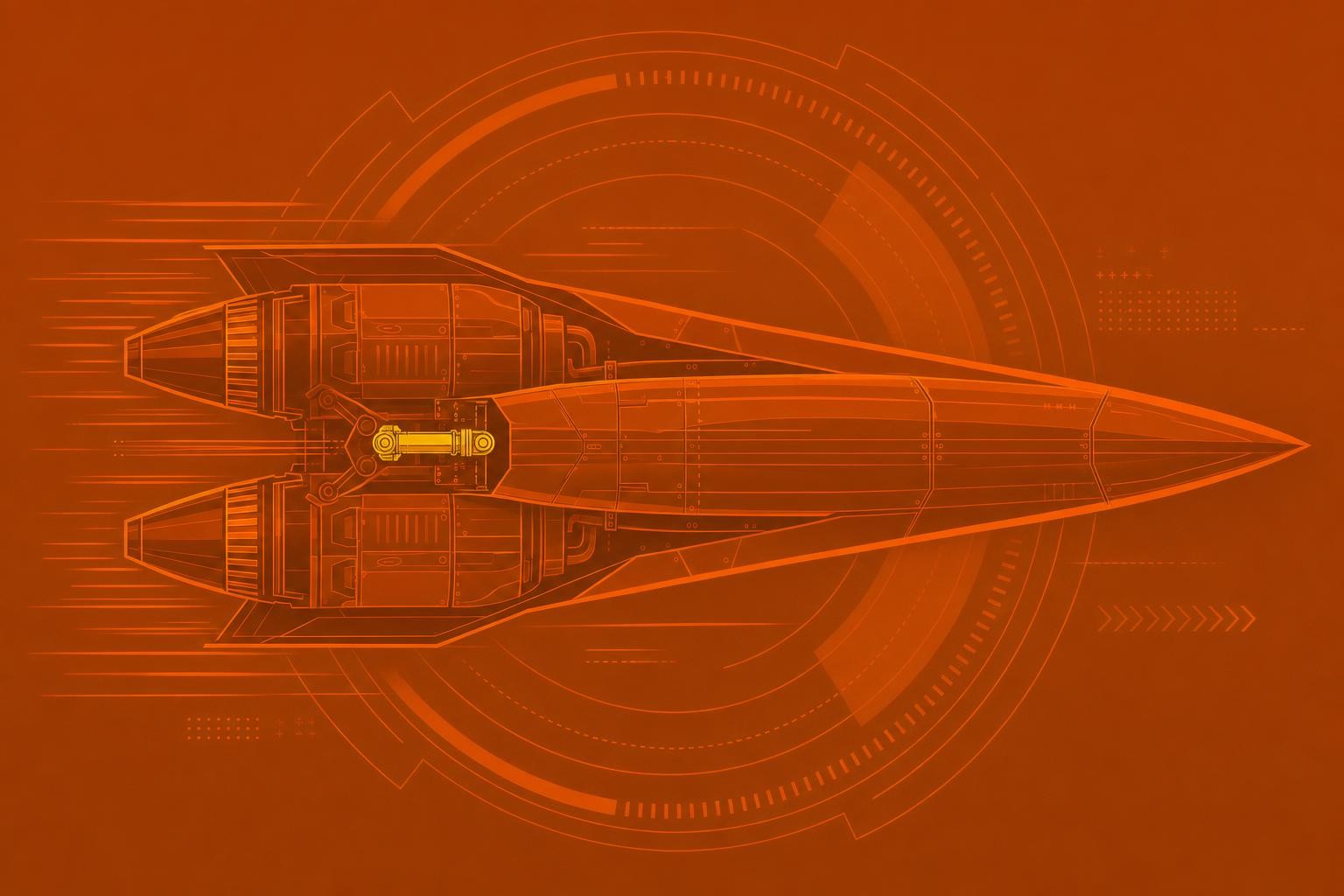
JCB's hydrogen-powered Hydromax streamliner set a new Southern California Timing Association (SCTA) class record of 368.347 mph at the Bonneville Salt Flats on 7 August 2026, during the SCTA's annual Bonneville Speed Week.[1] The run was the first major public validation of JCB's hydrogen combustion engines at extreme speed - and it was only the opening act.
The SCTA record: two runs, two days
The SCTA format requires teams to make two runs on consecutive days and takes the average of the maximum speeds reached. The Hydromax completed its record runs over two consecutive days, recording 367.141 mph on the first run before reaching a maximum speed of 369.554 mph on the second.
Wing Commander Andy Green OBE drove the car to the new SCTA Blown Gas Streamliner (AA/BGS, 500+ cubic inches) class record at 8:50 am MDT. The result surpassed the previous SCTA record of 348.342 mph set by the Spectre Streamliner in 2010, marking the first time in 16 years the class record had been broken.
The 32-foot-long, twin-engined streamliner broke the record during Bonneville Speed Week, regarded as the world's premier land speed racing event.
FIA world record follows days later
The SCTA mark was a deliberate stepping stone. Hydrogen combustion technology powers JCB's record-setting Hydromax, and the team was already preparing to increase power output for an FIA-sanctioned world record attempt.
That attempt succeeded. Just days after the Hydromax hit 368.347 mph (592.797 km/h), the hydrogen-powered vehicle set a new FIA world land speed record of 406.320 mph (653.91 km/h) at the Bonneville Salt Flats. Powered by two production-based turbocharged digger engines and driven by Green, the car recorded an average speed of 400.623 mph on its first run and then 412.135 mph on its second run to give the 406.320 mph FIA average in Category A, Group XIV - Class 7.
The Hydromax is now the fastest hydrogen-powered car and the fastest zero-emission car ever, and in doing so it also broke the previous diesel record - coincidentally set by the same driver, Green, twenty years earlier at the same location, where a JCB Dieselmax hit 317 mph.
Production-based engines, not purpose-built racers
The engineering story matters for the construction market. The Hydromax is powered by two hydrogen combustion engines producing 800 hp each - a dramatic increase over the company's 55 kW (74 hp) hydrogen engine developed for construction equipment such as the hydrogen-powered 3CX backhoe loader. The race engine is not a modified version of the production unit but an entirely new engine, though JCB used the architecture and lessons from five years and £100 million worth of hydrogen engine development to create the dedicated racing powerplant.
Hydromax represents another milestone in JCB's hydrogen program, which began in 2019. The company has invested roughly $135 million USD developing hydrogen combustion technology.
On the commercial side, JCB secured full EU type approval for its hydrogen engines, allowing sales for non-road mobile machinery across European markets, and more than 130 evaluation engines were operating in prototype construction machines. Those engines have powered backhoe loaders, Loadall telescopic handlers, and generator sets in development and customer trials.
JCB argues hydrogen combustion allows it to retain much of the architecture, performance, serviceability, and operator familiarity of conventional diesel equipment while eliminating carbon dioxide emissions at the tailpipe.
What to watch
The Bonneville records come as JCB prepares to expand its U.S. presence with a new $500 million, one-million-square-foot factory in San Antonio, Texas, on a 400-acre site expected to employ around 1,500 people manufacturing machines for the U.S. market. The FIA record is pending ratification. Whether the Bonneville results accelerate commercial hydrogen machine orders - particularly from rental fleets evaluating alternatives to battery-electric for high-duty-cycle applications - is the number to track over the next 12 months.
Written by Construction Trade News's automated desk from the sources above and reviewed before publication. How we work.
Related
CASE adds three D Series 3-ton mini excavators with zero tailswing and load-sensing hydraulics
CASE Construction Equipment launched the CX30D, CX34D and CX38D on 17 June 2026, filling the 3-ton class with zero-tailswing machines powered by a 24.4 hp Kubota engine.
10 Sept 2026 News
NewsSimplar Foundation study finds multiskilled U.S. construction crews cut idle time by 68% and post safety rates 57% below industry average
A first-ever national field study on multiskilling in U.S. construction finds a 39% jump in productive crew time and a total recordable incident rate 57% below the industry benchmark.
10 Sept 2026 Codes
CodesOakland adopts 2025 California Building Standards Code with FlexPath and Electric Readiness amendments, effective 1 January 2026
Oakland's 2025 Title 24 adoption - with FlexPath and Electric Readiness reach codes - took effect 1 January 2026, and AB 130 locks in residential standards until 1 June 2031.
10 Sept 2026