University of Minnesota hydrovac technique cuts exterior foundation insulation cost by up to 50%
The University of Minnesota's NorthernSTAR team used a water-knife and truck-mounted vacuum to trench a 4-inch slot around a Minneapolis home's foundation, cutting retrofit cost by 23-50% versus conventional excavation.
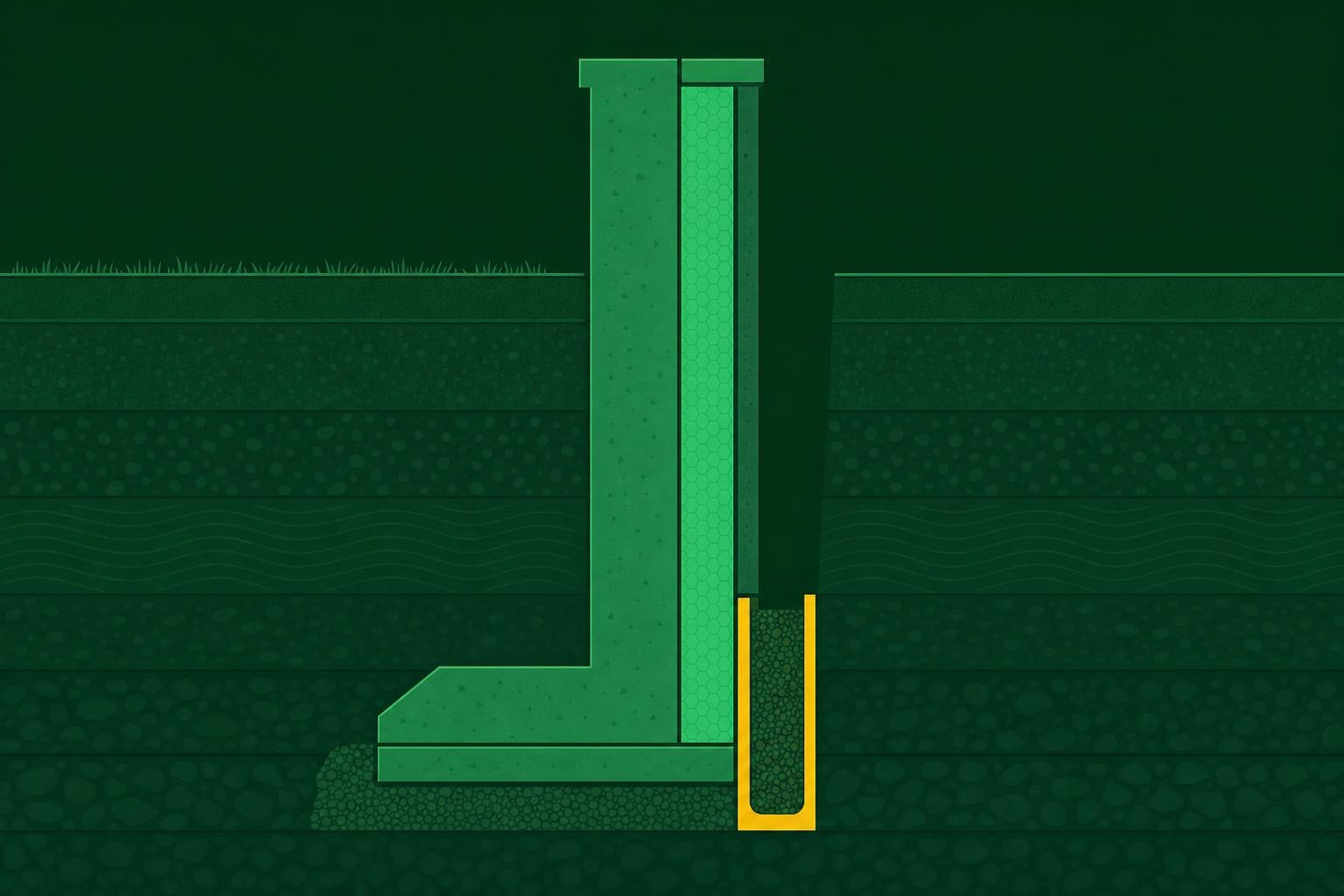
A technique developed by the University of Minnesota's NorthernSTAR Building America Partnership uses high-pressure water and a truck-mounted hydrovac to cut a narrow slot along a home's foundation perimeter, then fills it with pourable closed-cell polyurethane foam - delivering exterior foundation insulation at 23% to 50% lower cost than conventional backhoe excavation, according to a field study published by the National Renewable Energy Laboratory (NREL) in October 2014.[1]
The problem with conventional exterior foundation insulation
Adding insulation to the outside of an existing home's foundation typically requires a wide trench around the building perimeter to allow workers to damp-proof and secure rigid foam or drainable fiberglass boards. Common obstructions make that excavation difficult or impossible in many cases:
- Concrete steps, stoops, and driveways abutting the foundation
- Decks, porches, and attached garages
- Utility connections and meters
- Tree roots and unstable or sandy soils
On average, roughly 25% of the perimeter of a typical house surveyed in the NorthernSTAR study was obstructed, some sections to a degree that made conventional excavation infeasible. Interior insulation avoids the excavation problem but is the less preferred option from a building-science standpoint: exterior insulation keeps the foundation wall within the thermal envelope, manages bulk water more effectively, and reduces the risk of condensation on the cold side of the assembly.
How the hydrovac slot-trench method works
The NorthernSTAR team used a "water knife" - a pressurized-water lance - to loosen soil along the foundation edge, then removed the resulting slurry with a truck-mounted vacuum. On the Minneapolis field project, the crew excavated a continuous 4-inch-wide by 4- to 5-foot-deep trench around 128 linear feet of foundation perimeter, stopping only at one section blocked by concrete debris under a stoop.
Where the water knife encountered rubble from an earlier addition, trench walls opened wider than intended; a piece of OSB was used to contain the foam pour and maintain uniform thickness. At concrete steps and other fixed obstacles, the water knife tunneled underneath so the foundation could still be insulated continuously.
The insulation assembly used in the field study consisted of:
- Pourable closed-cell polyurethane foam filling the below-grade slot (a slow-curing, low-expansion formulation that can be applied in thick lifts without the exothermic risk of standard spray-applied foam)
- A 1.5-inch layer of XPS rigid board serving as a leave-in-place form above grade
- A liquid foam/rigid foam hybrid system extending up to and terminating at the top of the rim joist
The closed-cell foam also functions as the water-control layer of the assembly, a necessary trade-off because the narrow slot cannot accommodate perimeter drain tile.
Limitations and open questions
The technique is not yet widely available. Practitioners in some markets report that both the hydrovac equipment and the pourable closed-cell foam formulation can be difficult to source locally. The narrow trench also precludes installing new perimeter drainage - acceptable where the existing home has no drain tile and soils drain freely, but a calculated risk in wetter conditions. Whether rigid mineral wool or another non-foam material could substitute in the below-grade slot remains an open question; the foam's ability to conform to irregular rubble foundations and adhere simultaneously to stone and rigid board has so far made it the only practical fill identified by researchers.
The NorthernSTAR team's 2016 field study dataset, archived through NREL and the DOE's Open Energy Data Initiative, remains the primary published evidence base. Broader contractor uptake and cost data across different climate zones and soil types would sharpen the cost-savings range and help establish whether the 23%-50% figure holds outside cold-climate Minnesota conditions.
Written by Construction Trade News's automated desk from the sources above and reviewed before publication. How we work.
Related
CASE adds three D Series 3-ton mini excavators with zero tailswing and load-sensing hydraulics
CASE Construction Equipment launched the CX30D, CX34D and CX38D on 17 June 2026, filling the 3-ton class with zero-tailswing machines powered by a 24.4 hp Kubota engine.
10 Sept 2026 News
NewsSimplar Foundation study finds multiskilled U.S. construction crews cut idle time by 68% and post safety rates 57% below industry average
A first-ever national field study on multiskilling in U.S. construction finds a 39% jump in productive crew time and a total recordable incident rate 57% below the industry benchmark.
10 Sept 2026 Codes
CodesOakland adopts 2025 California Building Standards Code with FlexPath and Electric Readiness amendments, effective 1 January 2026
Oakland's 2025 Title 24 adoption - with FlexPath and Electric Readiness reach codes - took effect 1 January 2026, and AB 130 locks in residential standards until 1 June 2031.
10 Sept 2026