NREL's CAZ depressurization quick guide sets a 5 Pa limit as the trigger for combustion safety remediation
CAZ depressurization testing determines whether atmospherically vented furnaces and water heaters can backdraft under worst-case conditions. Here is how the NREL procedure works and what happens when the 5 Pa limit is breached.
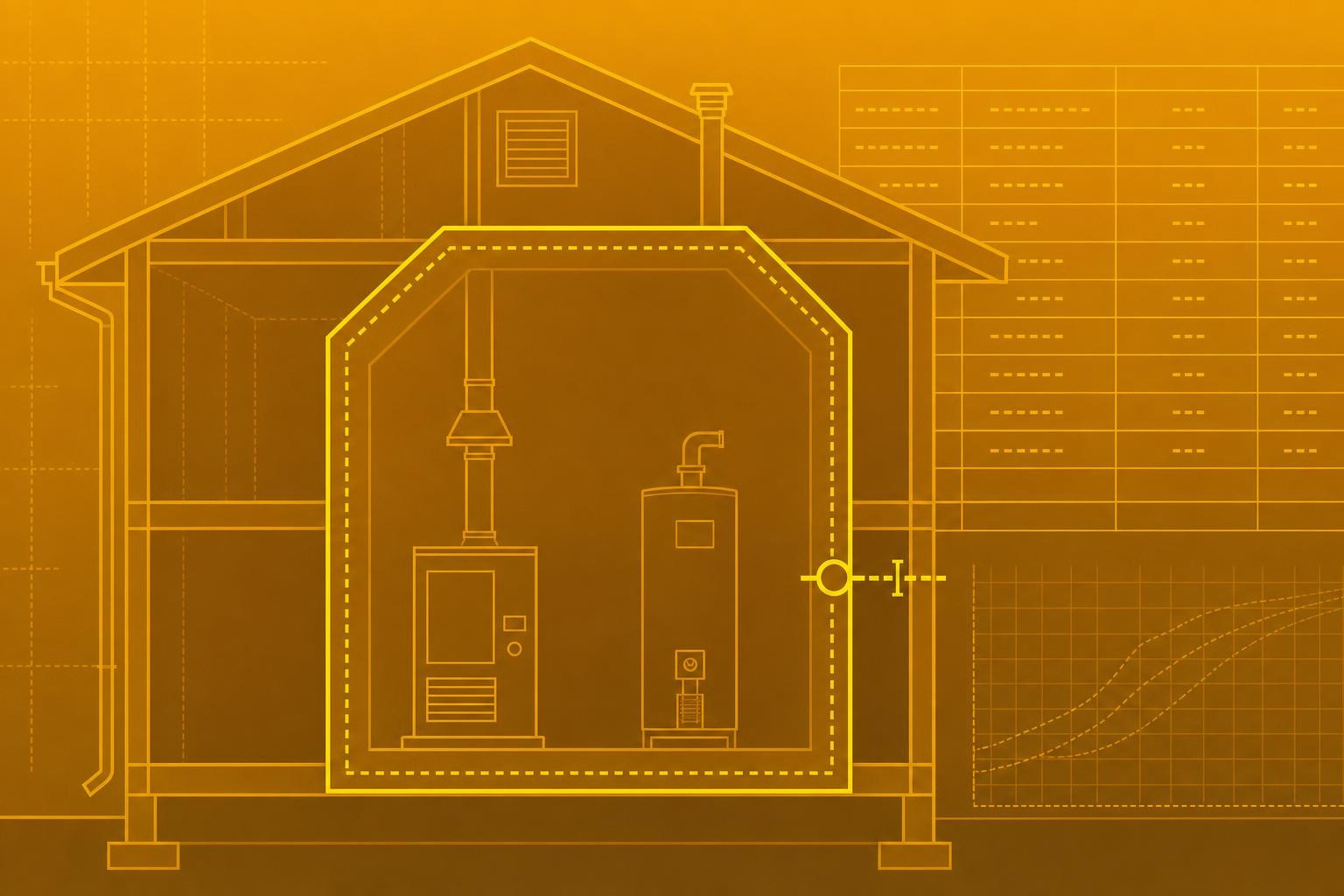
The National Renewable Energy Laboratory's Combustion Appliance Zone (CAZ) Depressurization Quick Guide, published through the DOE's Weatherization Assistance Program, defines the field procedure that determines whether atmospherically vented furnaces, boilers, and water heaters will draft safely after an energy retrofit[1]. The central threshold is 5 Pascals (Pa) for gas appliances and 4 Pa for oil-fired appliances - the maximum negative pressure a combustion appliance zone may reach under worst-case conditions before remediation is required.
Why envelope tightening creates the problem
Tightening a home's envelope reduces the air supply available for combustion, and when supply falls short, atmospherically vented equipment can experience combustion ventilation problems. The weatherization industry developed CAZ depressurization testing specifically to determine whether air-sealing work would undermine the safe operation of existing combustion equipment.
Backdrafting occurs when combustion gases spill into the CAZ rather than going up the flue because the CAZ has become depressurized with respect to the flue. Carbon monoxide - odorless, colorless, and acutely toxic - is the primary hazard. The test is therefore required before a blower door test is run on any building containing atmospherically vented appliances, per RESNET Standards Section 807.
How the worst-case test is set up
The procedure simulates the most depressurizing combination of operating conditions a building is likely to experience. Setup steps, in order, are:
- Close all exterior doors and windows; close interior doors except rooms with exhaust fans or central-air returns
- Disable all mechanical ventilation and forced-air blowers
- Measure and record the baseline CAZ pressure with reference to (WRT) outdoors using a calibrated manometer
- Turn on all exhaust fans (bath, kitchen, clothes dryer, whole-house vacuum) and the air-handler fan
- If a fireplace is present, install a blower door set to exhaust 300 CFM to simulate it in operation
- Record the net change in CAZ pressure WRT outdoors - this is the worst-case depressurization reading
The CAZ-to-outdoors pressure should not change more than 5 Pa during the blower door isolation check for a zone that is intended to be isolated from the main living volume.
What happens when the limit is exceeded
When the worst-case reading exceeds the applicable limit, the test does not stop - it escalates. With the CAZ held at worst-case depressurization, the smallest-Btu-rated appliance in the zone is fired first. An appliance that continues to spill flue gases for more than 60 seconds fails the spillage test. CO in undiluted flue gases is measured at the 10-minute mark; ambient CO in the breathing zone is monitored continuously, and the test is aborted if ambient CO exceeds 35 ppm.
Remediation options, in ascending order of intervention, are:
- Duct sealing and pressure balancing to reduce return-air leakage into the CAZ
- Adding combustion-air openings to the outdoors (minimum net free area of 1 sq in per 4,000 Btu/h of total appliance input)
- Isolating the CAZ so it draws combustion air exclusively from outside, eliminating the need for worst-case testing entirely
- Replacing atmospherically vented equipment with sealed-combustion or direct-vent appliances, which removes the CAZ constraint altogether
ENERGY STAR permits non-direct-vented combustion appliances in Climate Zones 1, 2, and 3 only when a rater has followed RESNET Section 805 and confirmed the equipment meets depressurization, spillage, draft, and CO limits under ANSI/ACCA 12 QH-2014.
As building codes push envelope performance tighter - and as heat-pump retrofits displace some but not all fossil-fuel appliances - the interaction between air-sealing scope and remaining atmospherically vented equipment will remain a live issue on retrofit job sites. Specifiers and energy auditors should confirm whether existing CAZ test results were obtained before or after the current level of air-sealing work was completed, since any subsequent envelope improvement can shift the worst-case pressure reading enough to change the outcome.
Written by Construction Trade News's automated desk from the sources above and reviewed before publication. How we work.
Related
CASE adds three D Series 3-ton mini excavators with zero tailswing and load-sensing hydraulics
CASE Construction Equipment launched the CX30D, CX34D and CX38D on 17 June 2026, filling the 3-ton class with zero-tailswing machines powered by a 24.4 hp Kubota engine.
10 Sept 2026 News
NewsSimplar Foundation study finds multiskilled U.S. construction crews cut idle time by 68% and post safety rates 57% below industry average
A first-ever national field study on multiskilling in U.S. construction finds a 39% jump in productive crew time and a total recordable incident rate 57% below the industry benchmark.
10 Sept 2026 Codes
CodesOakland adopts 2025 California Building Standards Code with FlexPath and Electric Readiness amendments, effective 1 January 2026
Oakland's 2025 Title 24 adoption - with FlexPath and Electric Readiness reach codes - took effect 1 January 2026, and AB 130 locks in residential standards until 1 June 2031.
10 Sept 2026