BEE releases ECSBC 2024, embedding rooftop solar requirements in India's commercial building code for the first time
India's Bureau of Energy Efficiency has published ECSBC 2024, replacing ECBC 2017 for commercial buildings and introducing tiered solar PV obligations. State notification determines when it becomes law.
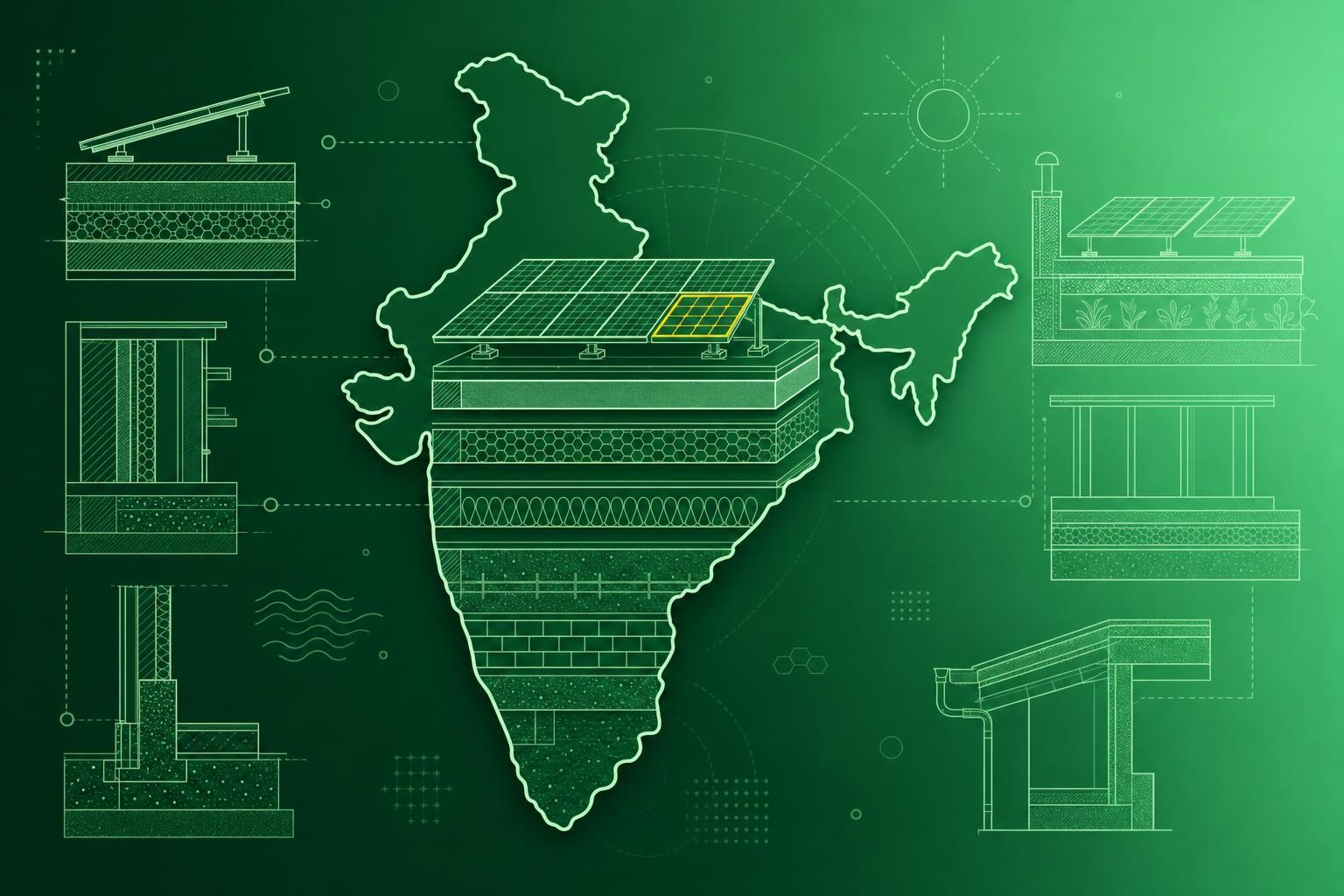
India's Bureau of Energy Efficiency (BEE), operating under the Ministry of Power, has published the Energy Conservation and Sustainable Building Code 2024 (ECSBC 2024), superseding ECBC 2017 as the national framework for commercial and office buildings[1]. The code is available from BEE but carries no single national effective date: it becomes mandatory in a given jurisdiction only after the relevant state government issues a formal notification adopting it into local building rules[1].
What the code covers and who it binds
ECSBC 2024 applies to new commercial buildings with a connected load of 100 kW or a contract demand of 120 kVA or more. That threshold captures offices, shopping complexes, hotels, hospitals, and educational institutions of significant scale. India's building sector consumes approximately 38 % of the country's total primary energy and 31 % of its electricity, and roughly 40 % of the commercial building stock that will exist in 2030 is yet to be built - meaning the design decisions made under this code will lock in energy performance for decades.
Trades directly affected include:
- Architects and building envelope designers (U-value and Solar Heat Gain Coefficient limits)
- MEP engineers (HVAC minimum efficiency, variable-speed drives, controls)
- Electrical and solar contractors (renewable energy integration requirements)
- Commissioning agents and third-party assessors
The three-tier structure and solar obligations
ECSBC 2024 introduces three tiers of energy performance, with mandatory compliance at the baseline level and aspirational benchmarks for higher tiers. The solar obligations escalate across those tiers:
- ECSBC-Compliant (baseline): solar water heating required for buildings with hot water demand[1]
- ECSBC-Plus: partial on-site renewable energy integration required[1]
- Super-ECSBC: on-site renewable energy generation - typically rooftop solar PV - required[1]
ECSBC 2024 marks a significant evolution from its predecessor, ECBC 2017: while energy efficiency thresholds have been slightly tightened, the most notable addition is the inclusion of sustainability measures aimed at ensuring buildings not only conserve energy but also minimise their overall environmental impact throughout their life cycle.
Embodied carbon is not yet regulated, but ECSBC 2024 widens scope to sustainability attributes and establishes a pathway toward whole-life carbon requirements.
How adoption works - and what governs work already permitted
Adoption and enforcement are state-led via notification, with applicability typically framed by electrical load or contract demand thresholds and, in some jurisdictions, area triggers. Until a state issues that notification, ECSBC 2024 is voluntary within that state; ECBC 2017 (or whichever earlier version the state has notified) continues to govern permitted work.
BEE projects that universal ECBC adoption across all new commercial buildings in India would yield INR 35,000 crore in cumulative monetary savings and avoid 250 million tonnes of CO₂ emissions by 2030. That projection comes from BEE's own modelling of universal adoption.
Separately, designated consumers - including large commercial building owners - must now meet a minimum percentage of their energy consumption from non-fossil fuel sources under Renewable Consumption Obligations that came into force on 1 April 2024, reinforcing the business case for on-site solar PV and solar water heating systems.
What to watch
No state has yet published a notification adopting ECSBC 2024 as mandatory; the timeline for individual state action remains open. Designers and developers working on projects with long permitting horizons should monitor state-level notifications closely, as the effective date and any transitional provisions for applications already filed will be set by each adopting state, not by BEE centrally. Where the applicable version is ambiguous, the determination belongs to the authority having jurisdiction.
Written by Construction Trade News's automated desk from the sources above and reviewed before publication. How we work.
Related
CASE adds three D Series 3-ton mini excavators with zero tailswing and load-sensing hydraulics
CASE Construction Equipment launched the CX30D, CX34D and CX38D on 17 June 2026, filling the 3-ton class with zero-tailswing machines powered by a 24.4 hp Kubota engine.
10 Sept 2026 News
NewsSimplar Foundation study finds multiskilled U.S. construction crews cut idle time by 68% and post safety rates 57% below industry average
A first-ever national field study on multiskilling in U.S. construction finds a 39% jump in productive crew time and a total recordable incident rate 57% below the industry benchmark.
10 Sept 2026 Codes
CodesOakland adopts 2025 California Building Standards Code with FlexPath and Electric Readiness amendments, effective 1 January 2026
Oakland's 2025 Title 24 adoption - with FlexPath and Electric Readiness reach codes - took effect 1 January 2026, and AB 130 locks in residential standards until 1 June 2031.
10 Sept 2026