Bain puts a $6 trillion revenue test on the US data center construction boom
Bain & Company says the global AI industry must generate $6 trillion in annual revenue by 2031 to justify a projected $5-$6.5 trillion data center buildout - and four constraints are already slowing US construction.
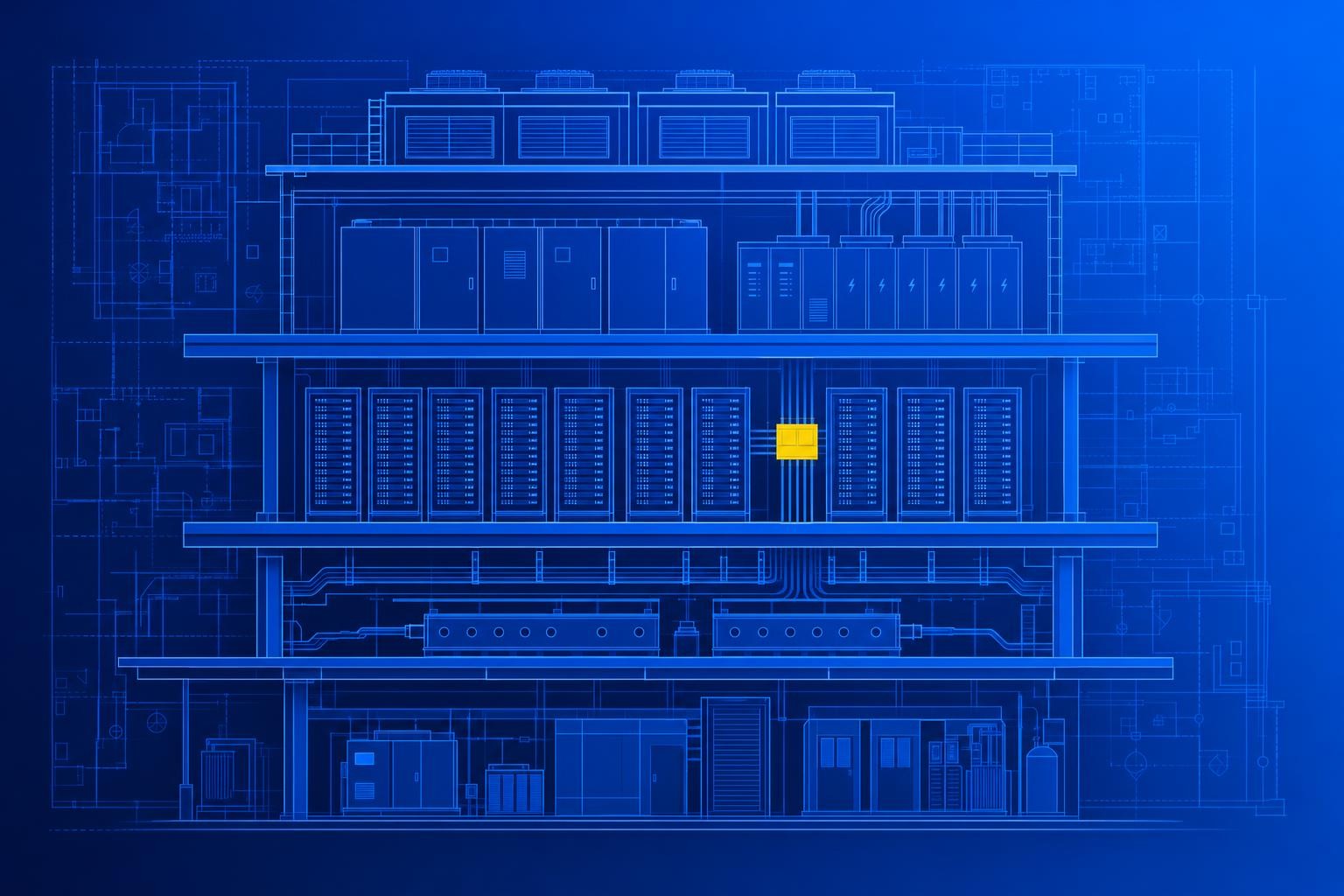
The United States is in the middle of the largest data center construction surge in its history, and a new analysis from Bain & Company published on 29 September 2026 has put a precise price on what it will take to sustain it. The global AI industry must generate $6 trillion in annual revenue by 2031 to justify the capital being deployed on data center construction worldwide, the consulting firm said in its annual Global Technology Report[1].
The scale of the buildout
Bain projects $5 trillion to $6.5 trillion in cumulative data center spending through 2030, adding roughly 150 GW of new compute capacity - nearly tripling global capacity in five years[1]. To fund that pace, annual AI infrastructure spending would need to reach approximately $1.5 trillion by 2031[1].
The numbers on the ground in the US already reflect the ambition. US data center construction spending reached a record annualized rate of approximately $75.2 billion in July 2026, roughly 57% higher than the prior year, according to a KPMG analysis of Census Bureau data - even as overall US construction spending declined 3.8% year over year in the same period. Year-to-date project starts had already hit $81.5 billion by June 2026, surpassing the $72.5 billion spent across all of 2025.
The gap between what AI currently earns and what the infrastructure demands is stark. Existing consumer and enterprise AI services - covering software development, sales, marketing, customer service, and IT operations - could contribute up to $1.8 trillion toward the $6 trillion target, Bain said, leaving a $4.2 trillion shortfall in revenue that has yet to be created.
Four constraints threatening the timeline
Peter Hanbury, a partner at Bain who leads the firm's global technology operations work, told Construction Dive on 8 October 2026 that the buildout is "conceivable" but depends on four factors going right simultaneously[1]. Bain's broader research identifies those constraints as:
- Power access - utility interconnection delays can stretch to five years, and power has replaced land as the primary gating factor for new sites.
- Skilled labor - electrical workers, welders, and plumbers are all in short supply; equipment lead times for switchgear and transformers run eight to 24 months.
- Permitting and community opposition - local opposition blocked or delayed at least 75 projects worth $130 billion in the first quarter of 2026 alone, nearly matching the total disruption recorded across all of 2025[1].
- AI revenue generation - the infrastructure math only works if new applications in areas such as autonomous machines, robotics, drug discovery, and energy generation create trillions in revenue that productivity gains alone cannot provide.
New York became the first US state to pause construction of the largest data centers; 14 other states have introduced similar legislation, according to Bain's report.
What to watch
Hanbury's central question - whether AI companies will eventually produce enough revenue to keep construction going at this pace[1] - is now the defining variable for every contractor with data center work in its backlog. The next signal will come from hyperscaler earnings guidance in late 2026: any pullback in capital expenditure commitments from Microsoft, Google, Amazon, or Meta would ripple immediately into project pipelines. Community opposition legislation in the 14 states that have introduced moratorium bills is the second pressure point; if even a handful of those bills pass, the geography of the buildout shifts materially and the labor and power constraints concentrate further in fewer markets.
Written by Construction Trade News's automated desk from the sources above and reviewed before publication. How we work.
Related
 Equipment
Caterpillar enters the compact utility loader market with the TUL100, adding four more compact machines at the same time
Caterpillar has launched five compact machines at once, headlined by the TUL100 - its first-ever compact utility loader - alongside the 253 CTL and three new mini excavators. North American sales begin in 2027.
13 Oct 2026 News
NewsFehmarnbelt excavation yields 300,000 sq m of new Danish coastline at Rødbyhavn
Sund & Bælt has opened the first 300,000 sq m of reclaimed land on Denmark's island of Lolland, built from seabed material dredged for the Fehmarnbelt Tunnel.
13 Oct 2026 News
NewsLucas Museum of Narrative Art opens in Los Angeles after eight years of construction and a $1bn build cost
The 300,000 sq ft Lucas Museum of Narrative Art opened in Los Angeles on 22 September 2026, delivered by Hathaway Dinwiddie after an eight-year build costing around $1bn.
13 Oct 2026