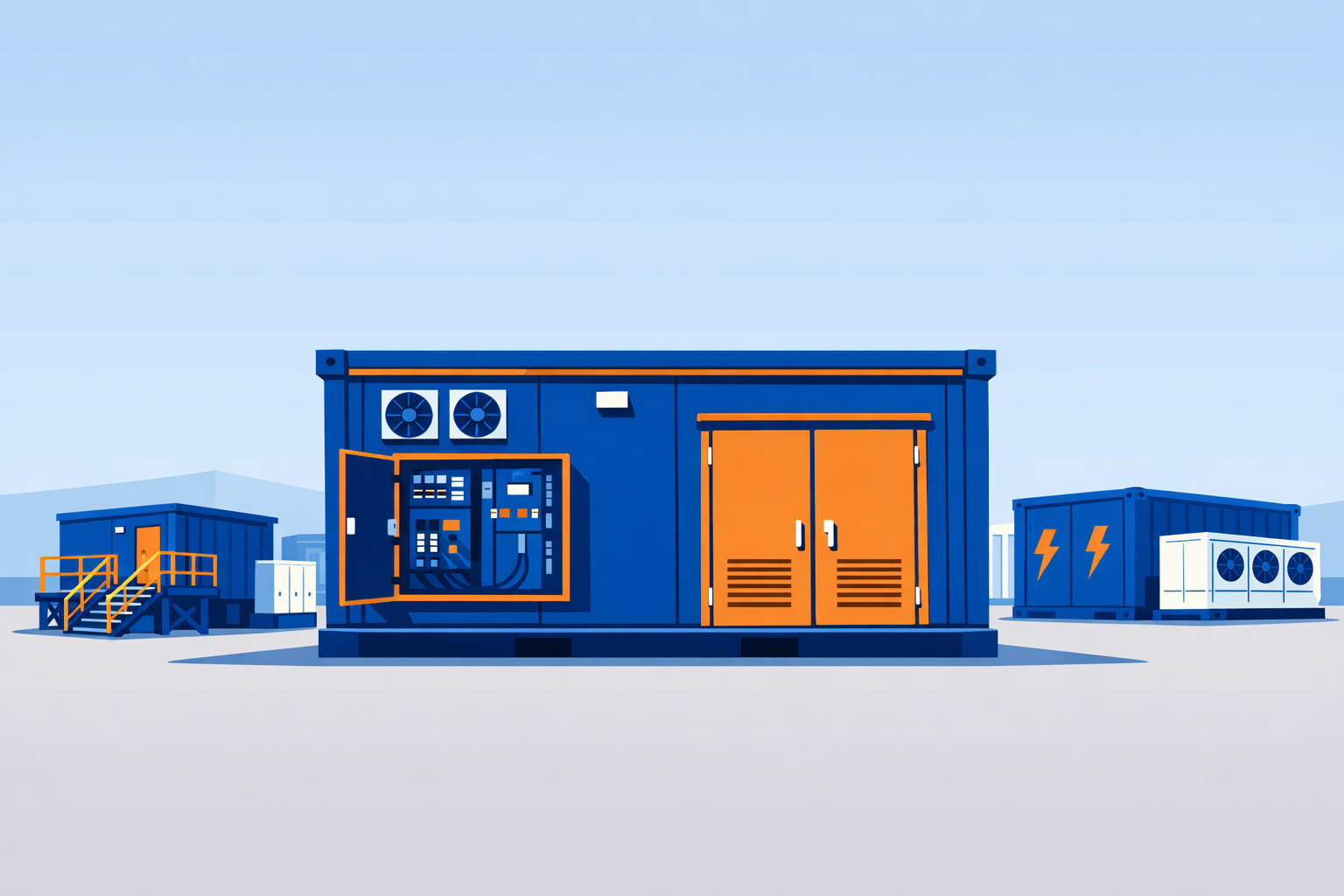
Panel Built Inc. has expanded its modular data center product portfolio, positioning prefabricated enclosures, e-houses, and battery energy storage system (BESS) structures as a direct response to accelerating demand from hyperscale and enterprise operators seeking shorter construction timelines and tighter cost control.
Background
Based in Blairsville, Georgia, Panel Built Inc. specializes in prefabricated modular buildings and is strengthening its role in the data center sector with solutions designed for complex, high-demand infrastructure environments. The announcement comes as operators face mounting pressure to bring capacity online faster. Where development cycles once stretched to five years, the average timeline has compressed to 18-24 months for a first facility in a given territory.
The broader market context underscores the urgency. The global modular data center market was estimated at USD 29.04 billion in 2024 and is anticipated to reach USD 75.77 billion by 2030, growing at a compound annual growth rate of 17.4%. Accelerated demand stems from artificial-intelligence training clusters, stringent data-sovereignty laws, and the operational need to activate capacity in months rather than years.
Details
Panel Built's data center portfolio includes e-houses, BESS enclosures, control rooms, mezzanines, catwalks, and in-plant offices-all engineered to support power distribution and technical systems critical to modern facilities. Data center construction often involves significant logistical and environmental hurdles, including remote locations, extreme weather, and compressed project schedules. Panel Built says its modular designs address these challenges by adapting to site-specific constraints and operational requirements.
By producing buildings offsite, the company aims to shorten construction timelines and improve consistency in quality and performance. The modular structures can serve as permanent facilities or be incorporated into phased expansions, allowing operators to scale capacity as demand evolves.
Central to the value proposition is the E-House, or electrical house-a modular enclosure used to house power distribution, control, and monitoring equipment. In modular data center deployments, E-Houses often serve as the central hub for electrical infrastructure. Manufacturing them offsite allows for greater consistency and quality control while reducing field installation time.
On the efficiency side, industry data indicates that prefabricated assembly carries measurable lifecycle benefits. Prefabricated modules can reduce construction and operating costs by upwards of 30% compared with conventional data center builds. Advanced cooling integration is also advancing rapidly: Schneider Electric's liquid-aware orchestration produces power-usage-effectiveness (PUE) ratios near 1.15, versus 1.4 for legacy air-cooled designs.
In 2025, conventional capacity-expansion projects held a 38.78% share of the modular data center market, yet hyperscale edge, AI, and high-performance-computing pods are projected to outgrow every other use case at a 19.87% CAGR through 2031. The prefabricated data centers segment led the overall market with a revenue share of 44.37% in 2025, driven by increasing enterprise adoption of scalable, factory-assembled modules that deploy faster and with greater operational reliability.
CBRE reports that North America recorded the largest year-over-year inventory increase in Q1 2025, with data center inventory up 43%, while the region also posted the world's lowest average vacancy rate at 2.3%. That supply-demand imbalance reinforces the case for construction methods that compress delivery schedules.
Outlook
As data center projects continue to face logistical and environmental challenges-including remote sites, harsh climates, compressed schedules, and ongoing expansion-Panel Built is applying its modular construction expertise to projects nationwide, delivering infrastructure through durable design and controlled offsite fabrication. Edge-computing deployments near 5G macro sites, liquid-cooled GPU pods exceeding 40 kW per rack, and micro-regional sovereign-cloud nodes together create a durable growth runway, while circular-economy directives push vendors toward designs that facilitate disassembly, reuse, and secondary-market trade.