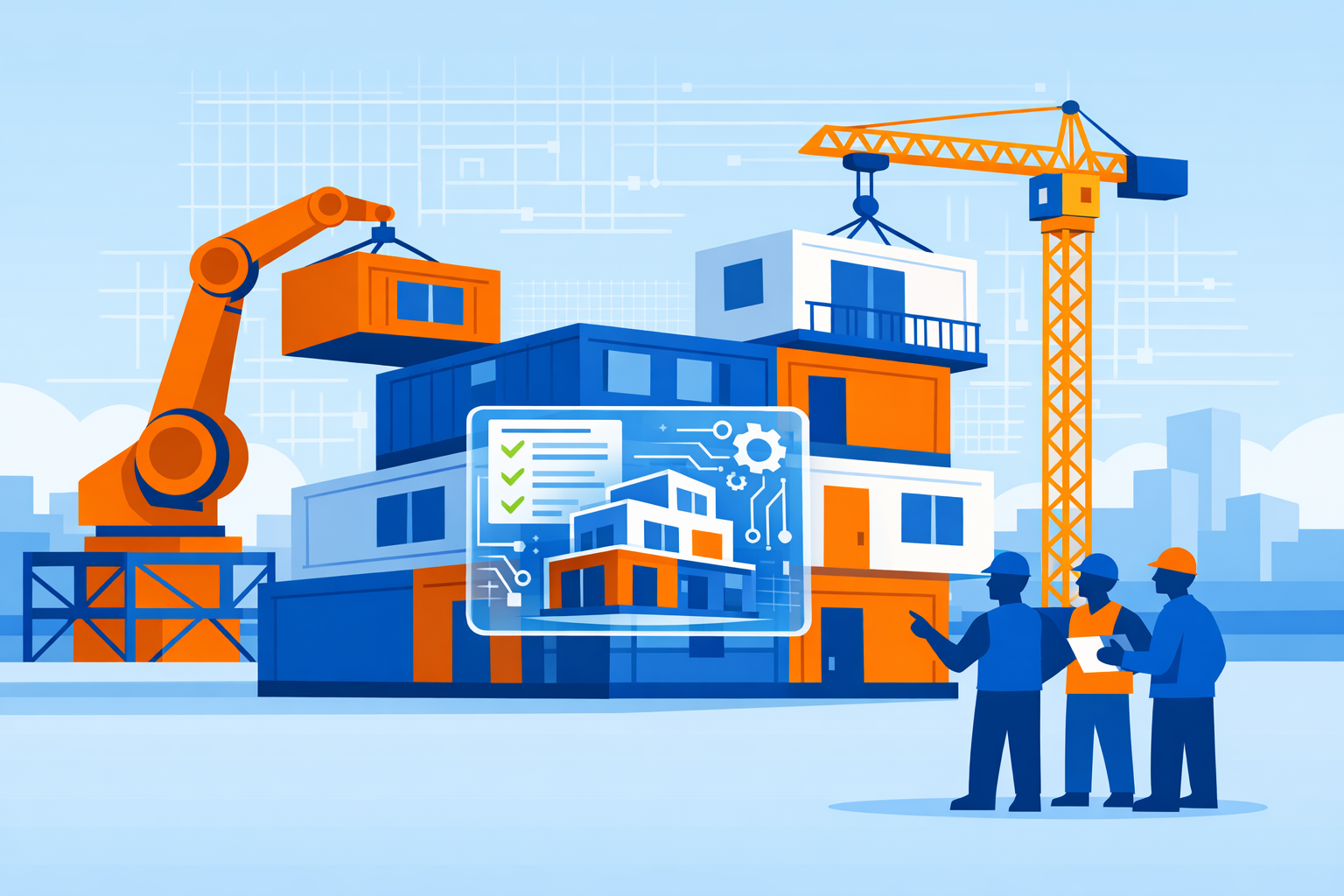
Only 8% of U.S. construction professionals currently use AI in their daily work[1] - yet 90% believe it will be indispensable within five years. That gap is no longer a talking point. It is now the target of coordinated federal action, union-industry partnerships, and a new generation of competency-based training programs reshaping workforce development across the skilled trades.
A convergence of initiatives launched in April 2026 signals a structural shift in how the industry approaches AI readiness - moving beyond passive awareness campaigns to funded, credentialed, and trade-specific upskilling at scale.
The AI-Readiness Gap: What the Data Shows
DEWALT's AI in the Trades study[1], surveying construction professionals worldwide in December 2025, revealed a stark disconnect between industry expectations and ground-level adoption.
87% of U.S. respondents said AI education must be embedded in trade schools and technical programs, while 59% expressed a need for hands-on training directly tied to real construction tasks. Despite this appetite, the primary barrier to AI adoption cited by construction professionals is a lack of formal, job-relevant training.
The findings align with a broader structural challenge: construction and manufacturing have historically lagged behind software-centric sectors in AI adoption. Yet IDC projects a compound annual growth rate of 32% for AI upskilling services through 2027[2], driven largely by construction, manufacturing, and logistics.
| Metric | Finding |
|---|---|
| Believe AI will be indispensable in 5 years | 90% |
| Say AI must be embedded in trade schools | 87% |
| Expect AI adoption to increase this year | 88% |
| Need hands-on, task-relevant training | 59% |
| Currently use AI on the job | 8% |
Source: DEWALT AI in the Trades Study, December 2025 (U.S. findings)
"As jobsites become increasingly complex and technology-driven, the need for practical AI training has never been more important," said Bill Beck, President of Tools & Outdoors at Stanley Black & Decker.
NABTU and Microsoft: A Nationwide Scale-Up
The most significant industry-level response came on April 21, 2026, when North America's Building Trades Unions (NABTU) and Microsoft announced an expanded partnership[3] targeting AI literacy across the skilled trades.
Building on a prior effort that trained 1,500 instructors in hands-on training centers nationwide, NABTU and Microsoft are now launching no-cost AI literacy courses and industry-recognized credentials accessible to millions of skilled craft professionals across North America.
The initiative operates through several channels:
- Joint Apprenticeship Training Committees (JATCs): AI curriculum is being co-designed with JATC faculty to reflect actual jobsite use cases, including safety monitoring, predictive maintenance, and on-site quality control.
- LinkedIn Learning: No-cost AI fluency courses are now publicly available, with participants able to earn an industry-recognized AI literacy credential[3] visible on professional profiles.
- TradesFutures Integration: The TradesFutures Apprenticeship Readiness Program, which enrolls more than 7,700 people annually across 34 states, will now embed AI literacy through its Multi-Craft Core Curriculum (MC3).
Training is structured in phases[4], beginning with data security and foundational AI literacy before advancing to practical applications for both instructors and workers. Instructors learn to use AI tools for streamlining administrative tasks, with the explicit goal of freeing more time for hands-on mentoring. As Tom Kriger, director of research and education at NABTU, put it: "That's the whole goal, to make our instructors more efficient so they can spend more time with apprentices."
NABTU is an alliance of 14 national and international unions collectively representing over 3 million skilled craft professionals in the United States and Canada, with its unions and signatory contractor partners investing over $2.5 billion annually to fund and operate over 1,900 apprenticeship training and education facilities across North America.
Federal Policy: The DOL's Landmark AI Apprenticeship Initiative
The private-sector push is matched by significant federal commitment. On April 1, 2026, the U.S. Department of Labor announced a national contracting initiative[5] to accelerate AI skills integration into Registered Apprenticeships nationwide.
"AI is transforming every industry, and our workforce systems must evolve just as quickly," said U.S. Secretary of Labor Lori Chavez-DeRemer. "This initiative will help ensure American workers are not merely participants in the AI economy but leading it."
The initiative takes a three-pronged approach:
- Embedding AI literacy into existing apprenticeship programs across all sectors, so workers in fields from welding to electrical gain exposure to AI tools relevant to their work.
- Creating new apprenticeship tracks in roles that directly build, manage, or apply AI technologies.
- Strengthening talent pipelines for industries critical to AI infrastructure, including data centers, telecommunications, and advanced manufacturing.
The DOL initiative aligns with the broader federal Make America AI-Ready directive and the department's AI Literacy Framework, reflecting a long-term commitment with a one-year base contract period and four option years.
Separately, the DOL has committed $30 million through its Industry-Driven Skills Training Fund[6], awarding grants of up to $8 million to state workforce agencies for expanding employer-led training in high-demand and emerging industries, with construction among the priority sectors.
Note: The DOL's AI apprenticeship initiative aligns with the broader Make America AI-Ready federal directive and the department's published AI Literacy Framework - signaling that workforce readiness is now a national infrastructure priority, not just an industry concern.
Training Modalities: What Works on the Jobsite
The new programs share a consistent view on effective delivery: no single modality suffices. The construction environment demands blended approaches combining digital instruction with tactile, real-world application.
Hands-On Simulator and VR/AR Training
Virtual reality and augmented reality are reshaping construction training[7] by enabling workers to gain hands-on experience in safe, controlled environments before deployment on live sites. For trades such as heavy civil, electrical, and welding - where errors carry significant safety and cost consequences - simulator-based learning reduces risk while compressing time-to-competency.
Digital twin environments are emerging as a particularly powerful training substrate. Workers can interact with virtual replicas of actual project sites, practicing AI-assisted tools and robotics workflows in conditions that mirror real project complexity. As research from Design News[7] notes, "employees, not just robots, can train within digital twins that replicate real production scenarios" - a principle now being adapted for construction trade instruction.
For a deeper look at how robotics and AI are navigating the data standards challenges that affect tool integration on site, see the earlier analysis on how construction robotics and AI face a data standards barrier.
Competency-Based E-Learning and Credentialing
The NABTU-Microsoft model demonstrates the scalability of cloud-delivered, competency-based modules. Delivered through Azure AI services[2], these modules require no additional hardware infrastructure at training centers - a critical factor for smaller trade schools and community college partners. The resulting credential, hosted on LinkedIn, also serves as a verifiable hiring signal for contractors seeking AI-competent crews.
Research from Lightcast[8] finds that job postings requiring AI skills offer salaries approximately 28% higher than those that do not - roughly $18,000 more per year. For apprentices entering carpentry, electrical, or plumbing programs, that earning premium is a powerful incentive to pursue credentialed AI training.
On-the-Job Coaching via ABC and DEWALT Partnerships
DEWALT has launched a pilot program[9] with Associated Builders and Contractors' (ABC) Central Florida Innovation and Technology Center to deliver hands-on, jobsite-relevant AI training for early-career trades professionals. DEWALT has also committed $75,000 to ABC's Trimmer Construction Education Fund to support AI-related training grants, with ABC chapters nationwide eligible to apply for funding.
ABC's monthly AI Toolbox Talks webinar series further extends reach, equipping member companies - representing approximately 24,000 firms - with practical roadmaps for adopting AI in project design, robotics, and quality control.
Trade-Specific Implications
These initiatives span multiple trades, each with distinct technology integration points:
- Carpentry & Framing: AI-assisted measurement tools and robotic prefabrication systems require workers to interpret digital models and coordinate with automated equipment.
- Electrical: Smart panel diagnostics, AI-driven load analysis, and energy monitoring platforms are already entering the journeyman's toolkit.
- Welding: Computer vision quality-control systems and collaborative welding robots demand familiarity with sensor outputs and machine override protocols.
- Heavy Civil: Grade-control AI, autonomous equipment telemetry, and site safety analytics are transforming operator roles in earthmoving and paving operations.
Standardized, trade-specific AI competency benchmarks - one of the goals of the DOL intermediary model - are expected to reduce inconsistency across regional training programs and establish a baseline for employer evaluation.
FAQ
What is the NABTU-Microsoft AI training initiative for skilled trades?
North America's Building Trades Unions (NABTU) and Microsoft announced an expanded partnership in April 2026 to launch no-cost AI literacy courses and industry-recognized credentials. The program builds on prior work that trained 1,500 instructors and now extends AI education through NABTU's JATC network, LinkedIn Learning, and the TradesFutures apprenticeship readiness program operating across 34 states.
What does the DOL's AI apprenticeship initiative cover for construction?
The U.S. Department of Labor's initiative - aligned with the Make America AI-Ready federal directive - aims to embed AI competencies into existing Registered Apprenticeship programs across traditional trades and infrastructure occupations. It also funds new pathways in high-demand AI roles and strengthens pipelines for construction, advanced manufacturing, and data center sectors.
What is the current state of AI adoption among construction tradespeople?
According to DEWALT's 2026 AI in the Trades study, 90% of U.S. construction professionals believe AI will be indispensable within five years, yet only 8% currently use AI in their daily work. The primary barrier is a lack of formal, job-relevant training.
How do digital twins support AI training in construction?
Digital twin environments enable trainees to practice operating AI-assisted tools, simulate complex site scenarios, and validate robotic workflows before real-world deployment. As VR and AR hardware costs fall, construction training centers are increasingly using these simulation environments to reduce time-to-competency and deliver safer, more scalable instruction across all major trades.
Are there salary benefits to AI credentialing for tradespeople?
Yes. Research from Lightcast indicates job postings requiring AI skills offer salaries approximately 28% higher than comparable roles without that requirement - roughly $18,000 more per year, making AI credentials a meaningful career differentiator for apprentices and journeymen alike.
Key Takeaways
- Only 8% of U.S. construction professionals currently use AI daily, despite 90% expecting it to be indispensable within five years, according to DEWALT's global AI in the Trades study.
- The NABTU-Microsoft partnership is scaling AI literacy through JATC training centers across all 50 states and Canada, with no-cost LinkedIn Learning courses now live.
- The DOL's landmark Registered Apprenticeship initiative embeds AI competencies into traditional trades curricula, backed by a multi-year federal contract and alignment with the Make America AI-Ready directive.
- Digital twin simulation, VR/AR environments, and competency-based credentialing are emerging as the most effective training modalities for trade-specific AI upskilling.
- Industry benchmarks for trade-specific AI competency - spanning carpentry, electrical, welding, and heavy civil - are expected to reduce regional inconsistency and give employers clearer hiring standards.