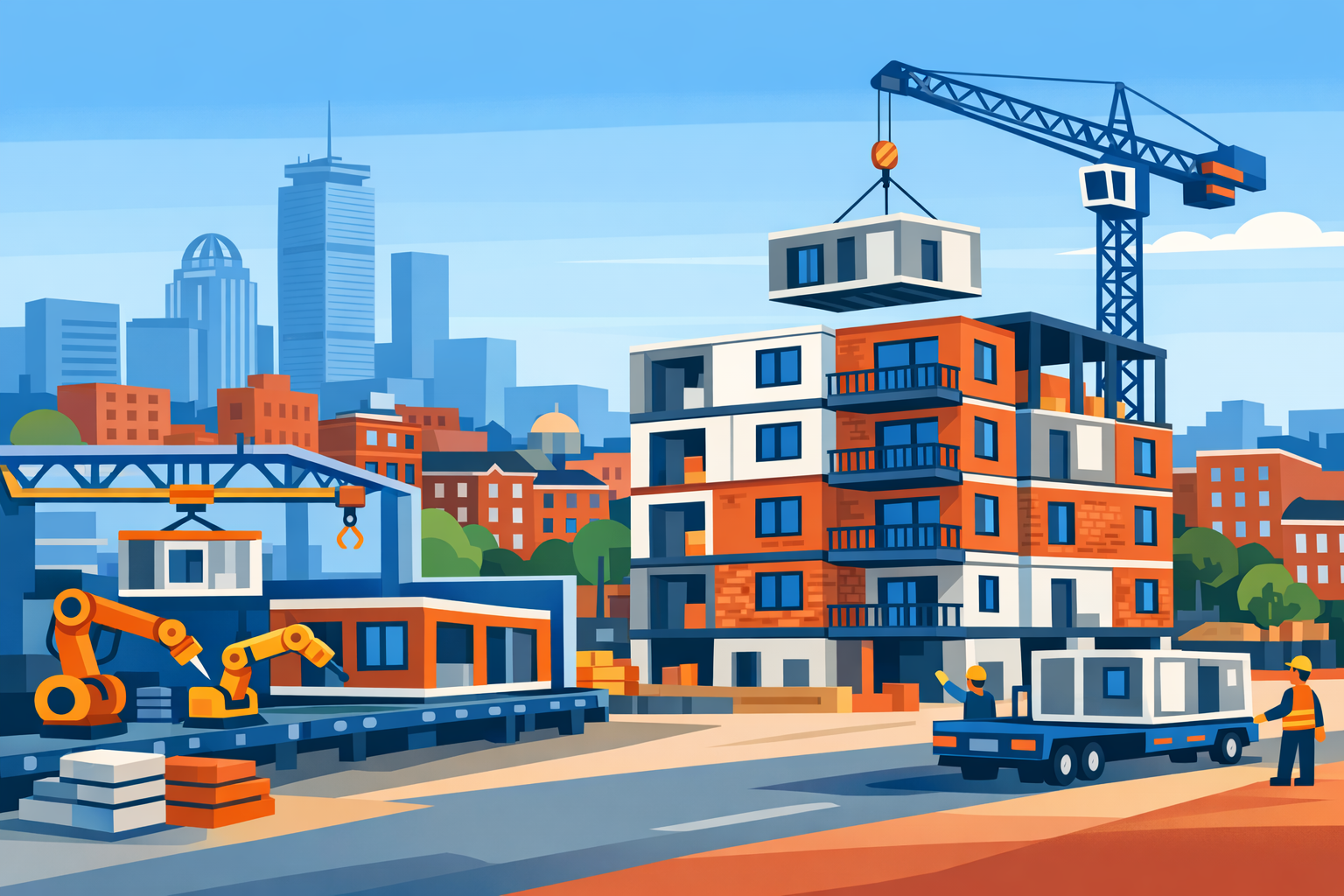
Executive summary. European policymakers are increasingly prioritizing modular housing for rapid disaster recovery, yet national building permit fragmentation and overlapping EU regulations continue to impede swift deployment. A move toward a harmonized, EU-wide permitting framework for modular disaster housing would connect civil-protection policy, construction-product regulation, and digital building permitting, potentially altering how contractors, manufacturers, and public clients plan emergency and reconstruction projects.
This article analyzes how such a framework might operate, its potential influence on project timelines, supply chains, and risk management, and the primary design choices regulators must address to balance speed, safety, sustainability, and local context.
Disaster Recovery Pressures Are Forcing a Rethink of Housing Permits
Climate change and geopolitical events have increased the scope and complexity of disasters affecting European housing.
A recent Joint Research Centre assessment found that approximately 87 million people in the EU27 and the UK live in areas exposed to multiple natural hazards.[1] Floods in Central Europe in 2024, Mediterranean wildfires in 2025, and events such as the 2021 German floods have displaced thousands and revealed gaps in emergency and permanent housing.[2]
An economic analysis for the EU estimated average direct disaster losses at about €14 billion per year, with 2023 European losses spiking to around €77 billion.[3] A significant portion of these losses relates to damaged or destroyed residential buildings and housing reconstruction costs.
Modular housing's role in the EU disaster toolbox
Modular construction has advanced from a niche technique to a central component in disaster and refugee housing.
The Union Civil Protection Mechanism (UCPM)-established in 2001-coordinates disaster aid among EU states when national resources are insufficient.[4] The rescEU reserve, part of the UCPM, relies heavily on prefabricated and modular units for emergency shelter capacity.
RescEU shelter stockpiles include prefabricated structures, flat-pack containers, and modular tents, pre-positioned in Croatia, Poland, Slovenia, Spain, Sweden, and Türkiye for rapid deployment post-disaster.[5] These shelters have supported responses to floods, earthquakes, and displacement due to the war in Ukraine.[6]
The broader market for modular homes is also expanding:
- One forecast estimates the European modular homes market at USD 121 million in 2025, rising to USD 154 million by 2034.[7]
- In Germany, modular and prefabricated methods accounted for about 26% of newly approved single- and two-family homes in 2024, up from 24.5% in 2023.[8]
- Most prefabricated building volume in Europe is residential, increasingly tied to affordable housing and renovation programs.[9]
Policy measures such as the EU Green Deal, Renovation Wave, and national industrialized renovation strategies are promoting off-site and modular construction for both new and refurbished buildings.[10] This rise in hazard exposure, combined with supportive policy, positions modular housing as strategic for European disaster recovery and reconstruction.
The Permitting Bottleneck for Modular Housing Projects
While modular construction can significantly shorten site activities, permitting-especially for cross-border projects-often erodes time savings.
Fragmented building permits across the EU
Building permits are primarily governed by national and local authorities within EU member states, each combining planning law, building codes, environmental assessment, fire safety, accessibility, and energy rules differently.
EU-funded research on digital permitting has highlighted this complexity. The ACCORD project, piloting automated compliance checking and digital permits, documented varied legal bases, document requirements, and approval workflows across multiple countries.[11] National platforms-like Greece's Hippodamos e-permitting-target streamlining but are country-specific.[12]
For modular projects, these differences are significant because modules are often manufactured in one country and installed in another-or deployed through EU civil-protection-into jurisdictions with distinct regulations unfamiliar to the manufacturer.
Off-site and modular construction remains a niche in most of Europe, with regulatory disparities and bureaucracy among the primary barriers to wider adoption.[10] These barriers intensify under urgent disaster recovery timelines.
Typical pain points for modular disaster-housing permits
Industry surveys and case studies reveal several recurring challenges for permitting modular housing:
- Multiple authorities (planning, building, fire, utilities, environmental, heritage) each operate separate approval processes and timelines.
- Factory-based quality control and certification are often unrecognized, forcing duplicate inspections on and off site.
- Zoning and land-use plans provide unclear guidance for relocatable modular homes, particularly during transitions from temporary to permanent housing.
- Interpretations of structural, seismic, and fire-safety requirements vary, notably for stacked modules.
- Some jurisdictions still rely on analog, paper-based permitting, complicating cross-border and digital compliance.
Permitting bottlenecks are not unique to housing. A European Commission-linked study notes that energy transmission projects in Europe average five years for permitting, with some renewables taking up to nine years.[13] Though these figures pertain to energy, they underscore the wider permitting challenges in critical infrastructure.
Fragmentation in practice: today vs. a harmonized future
The following table compares a typical cross-border modular housing project under today's fragmented permitting with a potential harmonized EU modular-permit framework. While illustrative, the comparisons reflect existing practices and policy trends.
| Aspect | Today: Fragmented National Permits | Possible Future: Harmonized EU Modular Framework |
|---|---|---|
| Core technical rules | Different rules per country and sometimes region; limited clarity for factory design teams | Common EU baseline (structural, fire, energy) with documented local add-ons |
| Recognition of factory certification | Factory QA assessed by each national authority; duplicate inspections | EU-recognized factory certification accepted across member states |
| Zoning and land-use status | Ad-hoc categorization; re-permitting frequent | Standard EU categories for emergency/transitional/permanent modular housing with defined permit tracks |
| Permit data model | Varied forms and document structures; little BIM integration | Standardized digital applications aligned with BIM for cross-border data reuse |
| Oversight and timelines | Parallel, uncoordinated agency reviews; timelines vary | Coordinated one-stop permit authority using EU timelines and rules |
The Emerging EU Drive to Streamline Permits for Strategic Sectors
No EU law currently harmonizes building permits for modular housing, but key initiatives are pushing for simpler, partially aligned permitting in strategic areas, including affordable housing and green infrastructure.
Horizontal reforms touching construction and housing
The European Commission's "Grids Package" and related measures spotlight permitting as a key barrier for energy and industrial projects. Package materials stress accelerated and streamlined permitting for strategic sectors, referencing affordable housing alongside digital and raw-materials initiatives.[14] Stakeholder feedback similarly emphasizes harmonized procedures, one-stop shops, and digital permitting platforms.[15]
Two existing EU regulations are particularly relevant to modular-housing permitting:
- Regulation (EU) No 305/2011 (the Construction Products Regulation, CPR) harmonizes EU conditions for marketing construction products, supporting CE marking based on common standards.[16]
- The recast Energy Performance of Buildings Directive (EPBD) imposes tighter minimum energy performance and targets zero-emission buildings, with new rules effective from 2024 and national adoption required by May 2026.[17]
The EU is also funding digital building permit projects like ACCORD, which is developing frameworks supporting automated rule verification.[11] By 2028, the Digital Building Logbook aims to harmonize building data, underpinning standardized permit structures.[18]
Likely areas of standardization for a modular-housing permitting framework
A harmonized permitting framework would likely build on these instruments, not replace national codes. Key focus areas would include:
Technical performance baselines
- Structural requirements for stackable modules
- Harmonized fire-safety classes and escape requirements for modular buildings
- Energy and indoor-climate standards matching EPBD and national zero-emission requirements
Standard use categories and timeframes
- Regulatory tracks for emergency (weeks-months), transitional (months-years), and permanent (decades) housing
- Clear pathways to convert emergency units into permanent dwellings without complete re-permitting
Cross-border factory approvals
- EU-recognized "type approvals" or European Technical Assessments, accepted for core safety and performance
- Standard protocols for factory audits and inspections, reducing cross-border duplication
Digital permitting and data standards
- Common BIM-based application schemas for permit submissions, enabling automated, cross-border compliance
- Requirements for digital tracking of modular units across deployments and jurisdictions
Local authorities would retain responsibility for land-use and site decisions, but an EU "layer" could accelerate modular system approvals and disaster-related fast tracks.
Potential Impacts on Project Timelines and Modular Supply Chains
Shorter lead times and changing risk allocation
Modular construction accelerates delivery by shifting work off-site and overlapping phases. However, lengthy permitting erodes these efficiency gains, complicating factory planning and public scheduling.
An EU modular-housing framework with defined timelines and one-stop shops for qualifying projects-similar to recent energy-infrastructure reforms-could drive:
- Reduced pre-construction uncertainty: Clear, EU-wide criteria enable permit-ready designs, minimizing project-by-project redesigns.
- More reliable disaster recovery schedules: Standard permit routes for modular schemes facilitate integrated planning among agencies and suppliers.
- Revised contractual risk allocation: Predictable regulations allow different distribution of permitting risks among clients, developers, and manufacturers.
For example, a 500-unit modular project might currently stretch pre-construction to 9-12 months per site due to adaptation and sequential approvals. Under a harmonized process, the timeline could be condensed, supporting faster replacement of temporary shelters with permanent modular housing.
Gains would depend on legal design and national implementation, but partial convergence and digital workflows could deliver significant time savings for reconstruction.
Stronger demand signals for modular manufacturers
Factory operators stand to gain demand visibility from harmonized permits.
Market analyses project steady growth in modular housing, driven by shortages and industrialized, low-carbon policies.[9] Yet investments in factories and training still depend on stable order pipelines, currently limited by local permitting delays.
With standardized technical requirements for disaster recovery and reconstruction, manufacturers could expect:
- Repeatable specifications across countries and tenders
- Aggregated volumes for long production runs, supporting scale
- Standardized structural and envelope systems, with localized finishes as needed
These outcomes would encourage digital management, automation, and higher prefabrication levels.
Cross-border logistics and compliance
Disaster recovery logistics for modular construction often require swift, long-distance transport. Harmonized permitting could simplify some regulations but also increase traceability and data responsibilities.
Key implications include:
- Border-agnostic modules, local foundations: CE-marked modules move freely; site works remain locally checked.
- Digital compliance passports: Digital certificates could document essential performance attributes, accessible by officials through EU registries.
- Civil-protection integration: Agencies and municipalities could coordinate modular deployments with emergency plans, aligning permits and response protocols.
Risks, Tensions, and Open Design Questions
A harmonized permitting framework would encounter several significant tensions.
Local context versus standardized rules
Disasters occur in diverse contexts. Regional building codes reflect local soil, climate, culture, and built form. Uniform EU rules risk:
- Under-specifying resilience in seismic or landslip areas
- Neglecting heritage preservation and urban character
- Misaligning with local housing and neighborhood standards
A likely outcome is common minimum EU criteria, with documented national additions for justified local risks-though this could recreate previous fragmentation.
Speed, safety, and sustainability balance
Disasters pressure authorities to expedite delivery, but EU policy stresses maintaining safety and climate goals.
Key issues:
- Fire/structural safety vs. rapid deployment: Stacked modules require strict fire and evacuation standards
- Short-term versus long-term performance: Designing temporary units to EPBD standards increases initial effort but lowers long-term energy use
- Material choices and circularity: Circular-economy and CPR revisions prioritize low-carbon, recyclable materials with transparent data for assembled elements[19]
A robust framework must set minimum safety and energy standards, using pre-approved solutions to simplify compliant delivery.
Digital capacity and data governance
Most harmonized permit scenarios presume digital submissions and automated rule checking. Many municipalities still depend on paper records and limited IT infrastructure.
To avoid widening capability gaps, implementation must address:
- Funding and support for local authorities transitioning to digital permitting
- Cybersecurity and privacy protections for building and occupancy data
- Clear division of responsibility between EU platforms (like Digital Building Logbook) and local permitting systems
What Construction Stakeholders Should Monitor and Prepare For
Though the scope and timing of an EU modular-housing framework remain uncertain, stakeholders can take preparatory steps.
For contractors and developers
- Standardize repeatable design modules that meet stringent safety and energy codes across target markets, minimizing future redesign
- Monitor EU and national consultations on digital permits, CPR, civil-protection, and housing strategies
- Prepare compliance-ready, structured project data (e.g., BIM objects with metadata) for automated permit systems
For modular manufacturers
- Align factory quality control and product declarations with harmonized standards and EPBD targets
- Prepare for EU-based, possibly remote, cross-border audits
- Design products and data systems for redeployment and traceability across jurisdictions
For public clients and housing authorities
- Pre-screen land for modular disaster housing and clarify pathways in local plans
- Participate in digital permitting pilots for modular schemes
- Integrate modular options into disaster-recovery strategies, coordinating roles for permitting, inspection, and long-term housing management
Frequently Asked Questions
How would an EU modular-housing framework interact with national building codes?
Such a framework would establish common minimum technical and procedural standards, especially for disaster-related projects, while allowing member states to apply stricter local requirements. National codes and plans would continue to govern many aspects of design and siting. Standardized mutual recognition of system approvals and permit processes would deliver the main benefits.
Would harmonized permitting apply to all modular housing or just disaster recovery?
Policy developments increasingly link emergency and long-term modular housing. Initial harmonization may focus on disaster and public projects, with broader application-such as digital permit standards or mutual recognition-expanding over time, subject to legislative choices.
Could an EU framework override local zoning and planning?
Even the most ambitious harmonization would leave zoning and land-use decisions to local or regional authorities. An EU framework might define categories and permit tracks for emergency or permanent modular housing, but municipalities would determine locations, per planning law. The framework would streamline assessment, not dictate sites.
How might factory inspections and CE marking for modular units change?
The CPR already supports CE marking for modular components. A future framework could extend EU-recognized approvals for whole modular systems and standardize inspections, reducing redundant national audits. Local authorities would retain inspection rights for site integration and foundations.
What is a realistic implementation timeline?
Recent EU legislation offers reference points: the recast EPBD entered into force in 2024 with national transposition due by 29 May 2026-a two-year window.[17] A directly applicable regulation might take effect sooner, with additional time needed for IT upgrades and coordination, implying phased rollout over several years.
Conclusion: A Structural Shift in How Europe Permits Post-Disaster Housing
Modular housing forms a growing element of European disaster recovery and mainstream housing plans. Ongoing permitting fragmentation, manual processes, and inconsistent recognition of factory-built elements continue to delay deployment, particularly for cross-border projects.
While harmonized EU permitting would not alone solve Europe's reconstruction challenges, a balanced approach-respecting local context while standardizing key technical and process elements-could speed modular delivery, strengthen industrial capacity, and enable safer, more sustainable post-disaster rebuilding.
For construction professionals, the trend points toward greater digitalization, industrialization, and regulatory coordination across the EU. Preparing for harmonized modular rules, data-driven permitting, and integration with disaster and housing policies will position organizations for regulatory changes ahead.