A furnace pressure switch fault is rarely the root cause - the diagnostic sequence determines what actually failed
A tripped furnace pressure switch is a symptom, not a diagnosis. Here is the field sequence that separates a $50 switch from a failing inducer motor, cracked heat exchanger, or blocked flue.
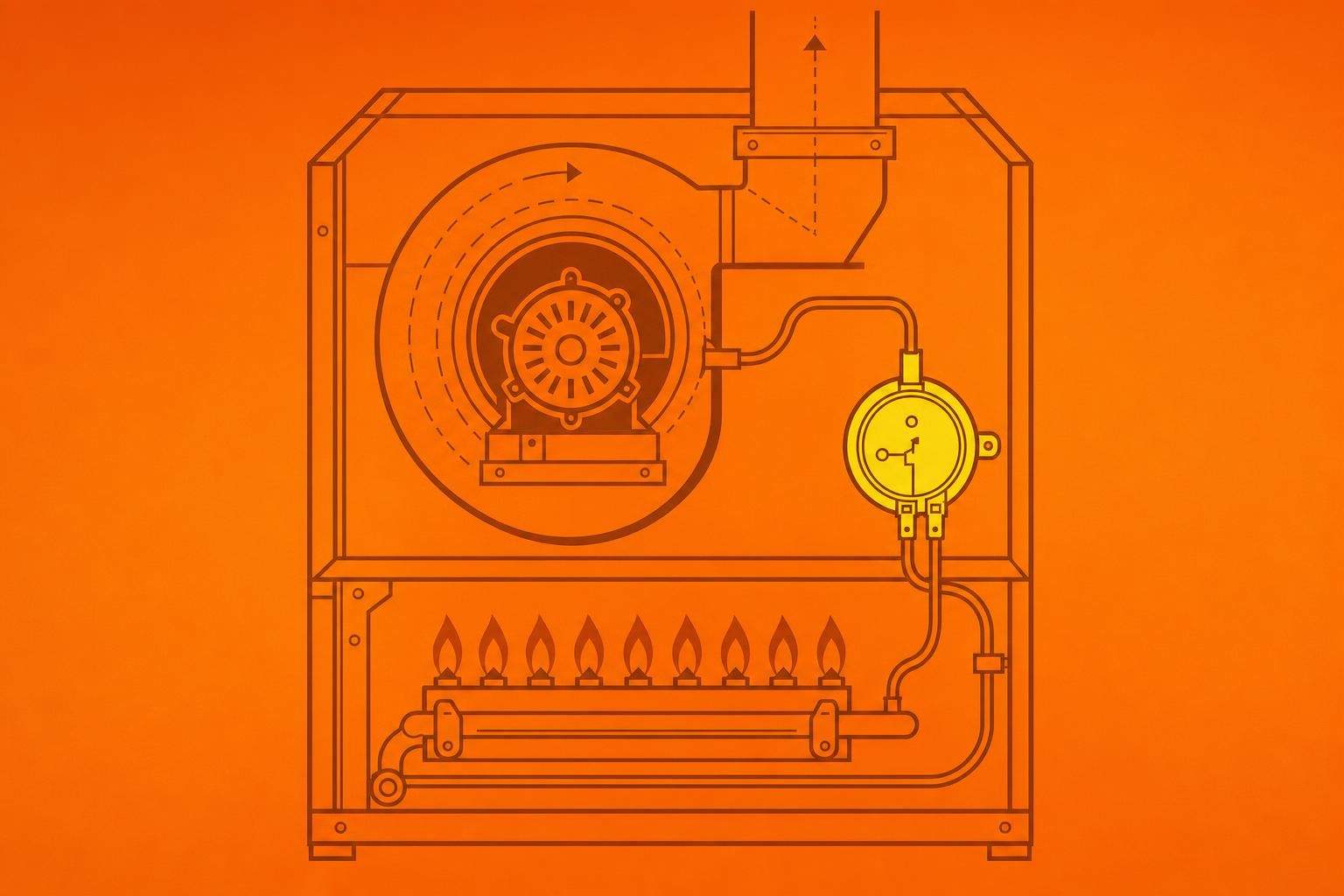
A furnace that locks out on a pressure switch fault is not necessarily telling the technician the switch has failed. The switch is a safety interlock - a normally-open device that closes only when the draft inducer motor generates sufficient negative pressure to confirm combustion airflow before the gas valve opens[1]. When it does not close, the control board withholds ignition. That behavior is correct. The fault is almost always upstream.
Never bypass a furnace pressure switch to restore runtime. The switch protects the heat exchanger and prevents combustion gases from entering the conditioned space. Bypassing it removes that protection without solving the underlying fault.
What the switch is actually proving
A pressure switch is a normally-open, single-pole device that closes when the pressure differential across it reaches its setpoint. In gas furnaces and boilers, the draft inducer motor creates a negative pressure in the flue proving circuit - the switch closes when that vacuum is sufficient, confirming combustion airflow before the gas valve opens.
During preignition, when the inducer motor is running before the flame is established, it draws the heat exchanger into a negative pressure. The pressure switch proves this draft through a connection - typically rubber or vinyl tubing - directly to the heat exchanger or to the inducer motor housing. When the switch detects proper vacuum, it closes, completing the circuit and allowing the furnace to proceed with ignition. If it does not close because of insufficient vacuum - whether from a cracked hose, blocked vent, or other restriction - the furnace shuts down and will not attempt ignition. This is deliberate: the switch exists to prevent exhaust gases, including carbon monoxide, from entering the building if venting is not working properly.
The diagnostic sequence
Pressure switches are the most misdiagnosed component in HVACR service calls. A technician who does not understand the mechanism of pressure switch failure will chase inducer motors, control boards, and gas valves before landing on a $50 part that was the root cause from the first call. The reverse error is equally costly.
The correct sequence works from the outside in:
- Vent terminations first. With power off, inspect the intake and exhaust ports for obstructions - birds' nests, debris, or ice - that could prevent the inducer from creating sufficient draft.
- Hose and port integrity second. Check the tubing that connects the pressure switch to the draft point. Look for cracks, brittleness, and crud or water inside the tubes. A waterlogged or cracked hose is a common cause of insufficient vacuum that has nothing to do with the switch or the motor.
- Manometer reading third. A technician tees a manometer into the pressure switch hose and reads the actual draft the inducer produces. Every switch has its activation setpoint printed on the switch body in inches of water column (" w.c.); if the measured draft is stronger than that rating and the switch still will not close, the switch is bad - if the draft cannot reach the rating, the fault is upstream in the inducer motor, hose, or venting.
- Inducer motor amperage fourth. Check the amperage rating on the inducer motor and confirm the actual amperage is in range. Let the motor run for a period; if the amperage rises substantially, or the motor becomes noisy or too hot to touch, there is potentially a motor issue. If vacuum is marginal - within 0.1" w.c. of setpoint - suspect the inducer motor capacitor before condemning the switch. Weak inducer pull is a capacitor failure pattern, not a switch failure.
When the switch fault signals a deeper assembly problem
Manual-reset high-pressure cutouts that trip repeatedly are a cascade warning. The technician who resets the cutout without diagnosing the cause of the high-head condition is setting up a compressor failure. The cutout is protecting the compressor - removing that protection to restore runtime is not a repair.
The most expensive misdiagnosis in this failure category is replacing the inducer motor when the real fault is upstream of it: a blocked flue, a cracked hose, or a waterlogged switch port. Other possibilities include a draft inducer motor that cannot produce adequate vacuum or internal restrictions within the furnace, such as heat exchanger issues. A cracked heat exchanger can alter the pressure differential the inducer sees, producing intermittent switch faults that resist straightforward diagnosis.
In most cases, pressure switch error codes are not caused by the switch itself but by airflow restrictions or venting problems. Technicians working condensing furnaces should also verify that the condensate trap is primed and draining freely - a trap that has not filled with water allows combustion air to push back through the secondary heat exchanger drain, disrupting the pressure signal. The manometer reading remains the single most decisive step: one measurement separates a component swap from a system-level investigation.
Written by Construction Trade News's automated desk from the sources above and reviewed before publication. How we work.
Related
 Equipment
Bobcat adds a factory-installed Land Management Package to the T86-2 compact track loader
Bobcat has released a factory-installed Land Management Package for the T86-2 CTL, bundling more than 10 guarding and comfort accessories onto its 115 hp flagship machine.
18 Aug 2026 Equipment
Ditch Witch RT125 Quad and RT80 Quad ride-on trenchers anchor a 36-hole irrigation overhaul at WinStar World Casino's golf courses
Texas Diamond Irrigation & Landscaping used Ditch Witch RT125 Quad and RT80 Quad trenchers to complete a full irrigation replacement across 36 holes at WinStar World Casino in under five months.
18 Aug 2026 Materials
NRCA data shows the average roofing contractor nets just 2.8%, while well-run shops hit 10-15%
NRCA member data puts the average roofing contractor's net margin at 2.8%. Here are the gross margin, labor, material, and overhead ratios that separate struggling shops from profitable ones.
18 Aug 2026